Tuesday July 28, 2015
BP had its worst quarter in ten years. A write down on Libyan investment and the spill settlement took profits lower.
Here is the WSJ summary.
LOW OIL PRICES, DEEPWATER HORIZON DEAL HIT BP
BP PLC swung to a loss in the second quarter, a victim of lower oil prices and a $9.8 billion pretax charge relating to the deal it reached earlier this month to settle U.S. claims over the 2010 Deepwater Horizon disaster, The Wall Street Journal’s Sarah Kent reports. Also, bets on Libya and Russia failed to pay off. BP’s replacement cost loss, similar to net income reported by U.S. oil companies, was $6.27 billion as compared with a profit of $3.18 billion a year earlier.
BP’s oil-trading results also declined, the Financial Times reports.
The loss comes even though the oil giant has cut spending by freezing pay, selling assets and delaying projects with reserves of over 3.5 billion barrels of oil and gas, which is more, according to Wood Mackenzie, than any other big independent energy company.
One bright spot for BP was its refining arm, which gained from the low oil prices. Pretax earnings increased to $1.6 billion from $933 million a year earlier for BP’s downstream business, which includes refining and marketing.
Still, investors want to know how BP plans to move forward from the Deepwater Horizon incident, now that the settlement has given the oil giant some breathing room. “We’re entering into a period where the company needs to decide what it’s going to be,” said Paul Mumford, an investment manager at Cavendish Asset Management Ltd.
Note, this is typical of the kind of press that happens as we approach a market low. I have no idea of how low oil prices will go but BP is going to be around, it is not going kaput. My point here is that amid all this torrent of bad news, most of which is now behind BP, one needs to use accounting analysis to really discern the strength of the company.
BP the long view
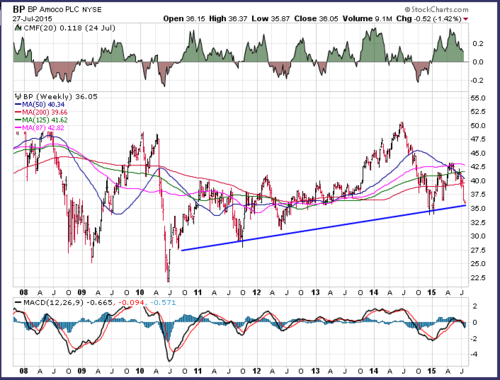
Here is a weekly chart going back to the 2008 meltdown. Now it is possible BP will continue falling all the way to 22.5, if oil drops to $35. If so that would really be a great opportunity to buy. As it is BP is going down to the blue uptrend line which has been in place for several years. Let's watch to see if it has a good bounce from the 35 level.
The key to investing is to buy low sell high. But most investors do the opposite, and are put off by bad news stories at market lows. This is where accounting knowledge is important. Will BP stay around, is the balance sheet strong enough to weather this? What is the book value, how much cash flow does BP have, is it self sustaining? That is what makes a study of both socionomics and accounting interesting. Social mood as evidenced by the first article on BP is negative, that is what makes buying at lows difficult, but profitable.
Now look at this
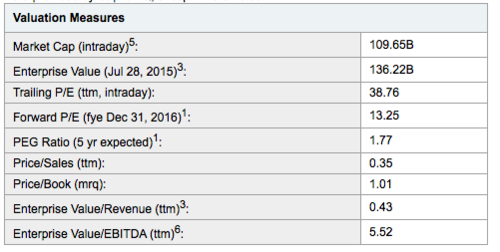
Yep BP is trading at book value! So how is cash flow?

Back in the late 1970s a guy came in my office observing that Exxon was trading with a 10% dividend. He said I think that's a pretty good deal. Indeed it was. The Exxon Mobil merger in 1998-9 was another classic good deal.
At its current price the dividend is 6.6%. Notice the article suggests the CEO cut back the capital expenditures to 'protect the dividend.' Why is that important?
So with a 6.6% dividend and trading at book value, is BP a good buy amid all this negative news? How would you structure a buy program if at all?
Good stuff this socionomics and accounting.
 Professor Elam
Leave a comment