3/5/2025
Old steelmaking equipment in Dortmund commemorates the area’s industrial past. Germany’s economy has relied on analog technologies, but that approach is falling behind. Photo: Martin Meissner/Associated Press
Accounting & Investing Info for San Antonio A & M
3/1/2025
Accountants Get Their Due
Everybody is famous for fifteen minutes
Andy Warhol
Everybody else has had their fifteen minutes on television. In spite of the huge spate of lawyer jokes, hey, they look great on television (Law and Order). Policemen (CSI), doctors (ER), firemen and EMTs (Rescue Me) all achieve heroic status every week. Well, enough is enough. It's high time our team got its due. Yep, coming to a network near you is the next season's hard hitting, comedy-drama. Sex, intrigue, gorgeous scenery, the inevitable black and white human dilemmas that turn to gray, we'll have it all on— THE YOUNG ACCOUNTANTS!
Clearly we need a hard driving, six beats to the bar theme song. The one Harold Faltermeyer did for Beverly Hills Cop or something akin to the old Mod Squad or Miami Vice shows would be about right. And the opening shots will be catchy and dramatic. No wooden faces or green eye shades here. Let's see, we'll need a dramatic backdrop for our larger than life characters. It will be located in a smaller place well outside New York or Chicago, allowing for great out door shots. The gang will be so financially successful they can live anywhere they want. So, hmm, how about Santa Fe, New Mexico? Our heroes and heroines will be framed shushing down the slopes, steadily peering at laptop screens while on their cell phones (during a break in a mountain bike race, of course), and, always, emerging triumphant from the IRS offices. Now to flesh out the cast….
Our hero, Braxton Slade (allowing everyone to call him Brax, for short) has graduated from the University of New Mexico in 2.5 years. While there he persuaded the railroad industry to found a $50 million scholarship fund for Native Americans in memory of those tribes displaced by the Westward move of the rails. He rejected law school to do something "really relevant." His graduate degree is in Forestry while he picked up a CPA after zipping through the review course, finishing in the top ten percent nationally, of course.
Sharon West is tan, firm jawed, and pilates certified. She finished at the University of Colorado at Boulder where she earned a bronze on the US Olympic ski team. Her graduate degree is in Public Administration where she served an internship with Colorado's Native American Senator. This guarantees our team special insight and access to government.
Every Lucy needs an Ethel and every Cisco Kid a Pancho. So, Booker T. Washington (allowing him to be called 'Book') is the resident computer guru and detail man. He finished at Grambling while helping to build the computer infrastructure for Black Entertainment TV. He's hip, he's always cracking jokes, and knows more about the internet than Al Gore ever will.
OK, in our first episode, the gang is logging on to e mail while helping sponsor Special Olympics for Skiing at Vail. Over pumpkin bread and potato soup, Brax receives a distress e mail from Manuel Guiterrez. Manuel runs Santa Fe's oldest custom saddler and is facing eminent domain eviction from the City for yet another civic center / hotel. The gang hops on their King Air, piloted by ex Viet Nam Ace, Major Skip Chapman, US Air Force Reserve.
Manuel is frantic. Brax jogs across the plaza to confront Manuel's lawyer. Bernie Short, Attorney, is hiding behind and almost under his desk. Sweat is pouring off his balding head which features a few wisps of graying hair pulled sideways, Sam Donaldson style. "You can't expect me to go up against City Hall," Short retorts. “Besides, the hotel firm is represented by Ketchum and Gigem, the best politically connected firm in the State.”
Brax does not even deem the plea worthy of comment and spins on the balls of his feet to face Sharon. Her Ray Ban Aviators glisten against her tanned face. Her tawny hair falls perfectly across the sheepskin collar of her leather bomber jacket. 'Book already has the answer we need,' she replies. They run from the office and Short collapses into his chair, hands shaking. (The lawyer's hands will shake and their heads will perspire a lot, on OUR show.)
Back at the office (an historic pueblo style building once used by Kit Carson as the Territorial Governor), Book already has already e mailed the National Commission for the Preservation of Historic Places. Book directs Sharon to the Courthouse where she determines that Manuel is sitting on the very spot where Kit Carson and his old friend Jim Bridger witnessed the official New Mexcio statehood ceremony. The laser printer spits out the form for Manuel's tax rebate on his improvements to his historic site. Brax faxes Ketchum that their client faces Federal fines and prison if they destroy as much as one adobe brick at the saddle company. As word of Manuel's rescue spreads, the Sierra Club recognizes the gang with a special award to protect Historic Environments.
Sharon’s iPhone rings. The IRS has seized the assets of the National Lead Dogs for the Blind, asserting as a non-profit 501c3 they are making money. The scene is set for next week's episode….and that's how we'll finally get our fifteen minutes.
Dennis Elam PhD CPA teaches at Texas A & M San Antonio campus and blogs at
2/24/2025
MH just sent me a list of revisions to the new Mintz ethics book, I replied that I had my own list
2/23/2025
1939 was a banner year for new movies. The Wizard of Oz, Mr. Smith Goes to Washington, and Gone with the Wind all Premiered.
Here the Wizard grants three wishes.
This is a classic scene demonstrating that what we wish for might be simpler than we realize.
2/23/2025
The purpose of a college degree should be to boost a person from just average to at least above average in terms of general knowledge.''
Frankly I don't think universities are doing a very good job of that so here is an example.
Meet Dorothea Lange. College educated as a photographer she literally traveled the world eventually landing in San Francisco.
It was here memorable photos of the Depression that brought her to national attention. The Federal Government hired her to illustrate the hardships of the Depression on ordinary people Perhaps her most famous photo was Migrant Mother, Nipomo CA 1936. I had seen this photo for years before noticing the her two children behind her, hiding their heads not wanting to be photographed. In this shot she had just sold her car. The photo speaks volumes of her
desperation wondering what she would do next. 
Old steelmaking equipment in Dortmund commemorates the area’s industrial past. Germany’s economy has relied on analog technologies, but that approach is falling behind. Photo: Martin Meissner/Associated Press
BERLIN—A decade ago, Germany was the model nation.
Its economy hadn’t just withstood the ascendance of China; it was thriving in its wake. Its balanced public finances stood out in a world of huge government debt. And while British and U.S. lawmakers were caught up in the culture wars, German politicians continued to practice the art of compromise.
Today, Germany has gone from paragon to pariah. Its economic model is broken, its self-confidence shattered and its political landscape fractured.
Europe’s former growth engine has shrunk for two years in a row, erasing any recovery made since the Covid-19 pandemic. Its manufacturing output is down about 10% over the same period and its companies, squeezed between rising costs and falling exports, are shedding thousands of jobs a month. When voters elect a new parliament on Sunday, the far right is likely to double its seats and a fragmented center could struggle to form a stable government.
Old steelmaking equipment in Dortmund commemorates the area’s industrial past. Germany’s economy has relied on analog technologies, but that approach is falling behind. Photo: Martin Meissner/Associated Press
BERLIN—A decade ago, Germany was the model nation.
Its economy hadn’t just withstood the ascendance of China; it was thriving in its wake. Its balanced public finances stood out in a world of huge government debt. And while British and U.S. lawmakers were caught up in the culture wars, German politicians continued to practice the art of compromise.
Today, Germany has gone from paragon to pariah. Its economic model is broken, its self-confidence shattered and its political landscape fractured.
Europe’s former growth engine has shrunk for two years in a row, erasing any recovery made since the Covid-19 pandemic. Its manufacturing output is down about 10% over the same period and its companies, squeezed between rising costs and falling exports, are shedding thousands of jobs a month. When voters elect a new parliament on Sunday, the far right is likely to double its seats and a fragmented center could struggle to form a stable government.
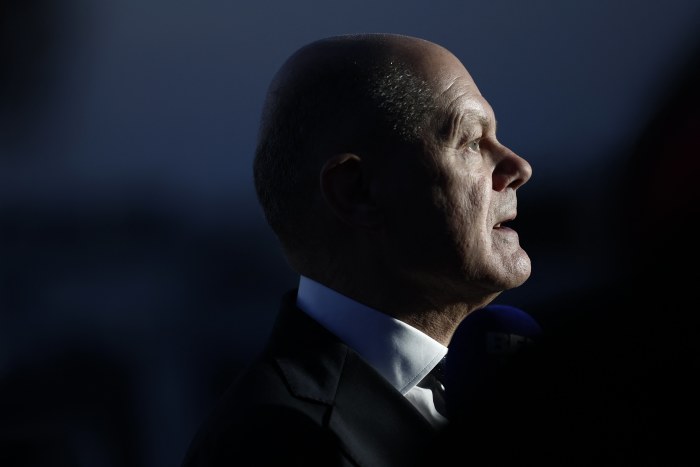
German Chancellor Olaf Scholz. The country faces a political crisis following a yearslong economic slump. Photo: behrouz mehri/Agence France-Presse/Getty Images
There are external causes for this malaise, from the war in Ukraine to U.S. protectionism and China’s economic slowdown.
Yet some analysts, economists and historians think Berlin mismanaged its response. The reason: conservatism—defined not as the political ideology but as the preference for the status quo over change, for reaction over action and for caution over risk.
This is partly the wage of success. As long as Germany’s economy was growing, brushing aside the financial crisis and the eurozone debt crisis, there was no pressure to course-correct, said historian Timothy Garton Ash, author of “Homelands,” a history of Europe in the past 50 years.
“Germany woke up last because they were doing best,” he said. “It’s a critique of the political, business, and, to some extent, intellectual elites because it would have been their role to look ahead and see the coming challenges.”
Germany was a pioneer in cutting CO2 emissions. It enacted its first ambitious renewable energy law a quarter of a century ago and aims to become greenhouse-gas-neutral by 2045, earlier than most other nations.

Old steelmaking equipment in Dortmund commemorates the area’s industrial past. Germany’s economy has relied on analog technologies, but that approach is falling behind. Photo: Martin Meissner/Associated Press
BERLIN—A decade ago, Germany was the model nation.
Its economy hadn’t just withstood the ascendance of China; it was thriving in its wake. Its balanced public finances stood out in a world of huge government debt. And while British and U.S. lawmakers were caught up in the culture wars, German politicians continued to practice the art of compromise.
Today, Germany has gone from paragon to pariah. Its economic model is broken, its self-confidence shattered and its political landscape fractured.
Europe’s former growth engine has shrunk for two years in a row, erasing any recovery made since the Covid-19 pandemic. Its manufacturing output is down about 10% over the same period and its companies, squeezed between rising costs and falling exports, are shedding thousands of jobs a month. When voters elect a new parliament on Sunday, the far right is likely to double its seats and a fragmented center could struggle to form a stable government.
German Chancellor Olaf Scholz. The country faces a political crisis following a yearslong economic slump. Photo: behrouz mehri/Agence France-Presse/Getty Images
There are external causes for this malaise, from the war in Ukraine to U.S. protectionism and China’s economic slowdown.
Yet some analysts, economists and historians think Berlin mismanaged its response. The reason: conservatism—defined not as the political ideology but as the preference for the status quo over change, for reaction over action and for caution over risk.
This is partly the wage of success. As long as Germany’s economy was growing, brushing aside the financial crisis and the eurozone debt crisis, there was no pressure to course-correct, said historian Timothy Garton Ash, author of “Homelands,” a history of Europe in the past 50 years.
“Germany woke up last because they were doing best,” he said. “It’s a critique of the political, business, and, to some extent, intellectual elites because it would have been their role to look ahead and see the coming challenges.”
Germany was a pioneer in cutting CO2 emissions. It enacted its first ambitious renewable energy law a quarter of a century ago and aims to become greenhouse-gas-neutral by 2045, earlier than most other nations.
Less known is how little success it has had. While emissions were down 60% in 2023 from their 1990 level, according to the government, a sharp drop that year was because of the recession. Today, Germany’s CO2 emissions per capita are above the global and the European Union average, higher than the U.K.’s and France’s and just below China’s, according to Our World in Data. Meanwhile, German households paid the highest electricity prices in the EU in the first half of 2024, according to official EU statistics.
One reason for this mixed record was Chancellor Angela Merkel’s 2011 decision, after the Fukushima nuclear accident, to accelerate a planned phaseout of nuclear energy. It meant Germany needed more fossil fuel, including coal and Russian natural gas, as it ramped up renewables.
The U.S. and European allies warned Germany it was too dependent on Russia. Yet Merkel stayed put in 2014, when Russia annexed Crimea. So did her successor Olaf Scholz when Moscow invaded the rest of Ukraine and began throttling gas deliveries, driving up prices and forcing Berlin to restart idled coal-fired plants.
“The problem with consensus societies is that sometimes the consensus is wrong, and when it is, there is no corrective mechanism,” said Wolfgang Münchau, author of “Kaput—The End of the German Miracle,” published late last year. “It’s the opposite of a whistleblower society.”
After a short extension over the winter months, Germany’s last three nuclear power plants went offline in April 2023, in the middle of an energy crisis that had begun to sink the German economy.
When Merkel let in hundreds of thousands of Middle-Eastern, Central-Asian and African asylum seekers stranded between Greece and Hungary in 2015, many Germans welcomed the move, flocking to train stations to greet the new arrivals.
The biggest influx of people in the history of postwar Germany resulted from a nondecision. As described by Robin Alexander, deputy-editor of the Die Welt newspaper, in his 2017 book “Die Getriebenen,” which translates as “The Driven,” Germany’s borders were already open under the provisions of the Schengen document-free travel area. As the migrants approached, Merkel chose not to close them.
Why? Because of the risk that a closure would be challenged in court and that the border police might have to use force to protect the borders.
2/21/2025
It seems to be a matter of faith among protectionists that trade deficits make the U.S. an economic loser. President Trump considers America’s trade imbalances with Canada, Mexico and China a matter of grave concern. At the same time, since taking office he’s announced several ambitious plans to increase foreign investment in the U.S. economy. The commitment both to eliminate trade deficits and to pursue foreign investment shows the inconsistency of the Trump administration’s policy. Trade deficits and capital surpluses are two sides of the same coin.
The value of the dollar is set on the foreign-exchange market, where the daily trading volume is $6.6 trillion. Americans exchange dollars for foreign currencies to buy goods and services from abroad and engage in foreign capital transactions. Likewise, foreign entities and individuals exchange their money for dollars to buy American goods and services and invest in the U.S. If for a nanosecond the supply and demand for dollars are not equal, the value of the dollar changes to bring them into balance. Therefore, if the U.S. has a surplus in its capital account balance, it must have a corresponding deficit in its trade balance.
Protectionists can’t turn the tide of markets. If Japanese tech-investing firm SoftBank fulfills its Dec. 16 commitment to invest $100 billion in the U.S., as SoftBank acquires dollars to fund the investment, the value of the dollar will rise relative to what it would have been without the investment, the cost of U.S. exports will rise, the cost of U.S. imports will fall, and the country’s trade deficit will rise. Fortunately, foreign capital investment creates American jobs and fuels economic growth no less than do foreign purchases of American exports.
Trade deficits don’t stifle growth, nor do trade surpluses foster it. In the 29 years after the end of World War II, during which the U.S. had a virtual monopoly in heavy manufacturing and regularly ran trade surpluses, real per capita gross domestic product grew 2.1% a year. Over the next 29 years, from 1976 through 2004, the U.S. ran chronic trade deficits, and the average annual growth rate of real per capita GDP was virtually identical: 2.2%.
During the Reagan administration, as economic growth surged, foreign investment flooded into the country and the trade deficit soared. The trade deficit similarly grew during the economic boom of the Clinton administration. In the high-growth years from 1998 to 2001, when the federal government ran a budget surplus, the annual trade deficit more than doubled. And when economic growth ramped up in 2017 and 2018 due to Mr. Trump’s deregulation and tax cuts, foreign investment surged and the trade deficit rose—despite Mr. Trump’s 2018 tariffs.
During 102 of the 120 months of the Great Depression, the U.S. ran trade surpluses. From 1900 to 1929, years of high economic growth, it also ran trade surpluses. From 1830 to 1860 and 1870 to 1890, when average tariff rates on imports were falling and the rate of industrialization was rapidly increasing, the U.S. generally ran trade deficits in goods and services.
Between 1890 and 2024, it is impossible to find a statistically significant correlation between America’s trade balance and its economic growth.
Has the expansion of global trade “hollowed out” U.S. manufacturing, as Joe Biden claimed in 2022? No. U.S. industrial production today is more than double what it was in 1975, the last time we ran a trade surplus. It’s 55% higher than in 1994, when the North American Free Trade Agreement went into effect, and it’s 18% higher than it was when China joined the World Trade Organization in 2001. Real wages are up 19% from 1994 and 10% from 2001. The inflation-adjusted value of America’s capital stock is 36% higher today than it was in 2001, 66% higher than it was in 1994, and 178% higher than it was in 1975.
Manufacturing as a share of total nonfarm employment peaked during World War II and has declined ever since, following the pattern of employment in agriculture, which fell from 40% of the labor force to 2% over the course of the 20th century. This is attributable not to globalization, but to the spread of modern technology and the rise in demand for services relative to goods. Neither Nafta nor China’s membership in the WTO notably increased the secular rate of decline in the share of workers employed in manufacturing.
The U.S. economy grew by only 2.3% in the fourth quarter of 2024, fueled largely by consumer spending at rates that current income growth won’t sustain and record government spending, which Congress and the Trump administration have pledged to reduce. The University of Michigan’s Jan. 24 Surveys of Consumers reveals that consumer confidence is falling and the expected inflation rate is rising, in part because of uncertainty surrounding the Trump administration’s tariff policies. Mr. Trump and Congress should focus on advancing economic growth by deregulating, controlling the budget deficit and extending the 2017 tax cuts. Fixating on the trade deficit, an imagined problem, will only draw the nation into a trade war that could overpower the positive effects of the Trump economic program.
Mr. Gramm, a former chairman of the Senate Banking Committee, is a nonresident senior fellow at the American Enterprise Institute. Mr. Boudreaux is a professor of economics at George Mason University and the Mercatus Center. This article is based on their forthcoming book, “The Triumph of Economic Freedom: Debunking the Seven Great Myths of American Capitalism.”
 Professor Elam