• Professor Elam

    Monday Dec 4, 2017

    Click here for final exam schedule.

    And note this warning to faculty.

    Final Exam Schedule – Fall 2017 – 16 Week Term
    1. A final exam, if required by the course syllabus, will be conducted on a designated day at the end of the course.
    No exam may be longer than 2.5 hours. No student is exempt.
    2. All final exams must be conducted as per University Final Exam schedule. Faculty are not permitted to change the
    final exam times for individual classes.
    3. Final examinations for the laboratory sections and UNIV courses are to be administered during the last meeting
    date.
    4. All final examinations are scheduled as indicated below.

  • Professor Elam

    Monday Dec 4, 2017

    Here is the Chinese versionof GM's new SUV.

    somehow the price starts at $8,250 way below the Chevy Equinox at $26,300. Not surprisingly the 510 outsold the Equinox 8 to 1 in September.

    The 510 offers a 1.5 liter engine, that's 90 cubic inches which is certainly more economical than the much larger Equinox.But I am still puzzled a car of this quality can be assembled at this price point. The real story here is that the USA is undergoing the same thing that happened to England in the 40 years leading up to WW I.  Power is shifting to the Far East now.  For England then power shifted west to the US.

    Screen Shot 2017-12-04 at 8.07.55 AM

  • Professor Elam

    Friday December  1, 2017

    Boone Pickens 100 square mile ranch is for sale.

    Read the article this is a true Texas J R Ewing event!

    Screen Shot 2017-12-01 at 12.23.43 PM

  • Professor Elam

    Tuesday Nov 28, 2017

    Becker has  50% scholarships for qualifying students. This amounts to a $1,600 savings.

    Requirements

    Does not have a job with a firm or organization that pys directly for or reimburses Becker Tuition

    NOt  currently enrolled in a CPA Exam Review Program

    CPA Eligible Fall 2017 Spring 2018

    Able to purchase Becker within  30 cays of receipt of  scholarship, extensions on a case by case basis

    Contact

    Meredith Harigan

    mharigan@becker.com


  • Professor Elam

     Wednesday November 21, 2012

    I have for many years  published Emerson's Essay on Gifts prior to Black Friday.  Ralph Waldo got it right in  1844, and he is still right today, consider this excerpt

    But it is a cold, lifeless business when you go to the shops to buy me something, which does not represent your life and talent, but a goldsmith’s. This is fit for kings, and rich men who represent kings, and a false state of property, to make presents of gold and silver stuffs, as a kind of symbolical sin-offering, or payment of black-mail.

    Wow where is his equivalent today?

    https://emersonsociety.org/


    Gifts of one who loved me,—
      ’Twas high time they came;
      When he ceased to love me,
      Time they stopped for shame.
        

    IT is said that the world is in a state of bankruptcy, that the world owes the world more than the world can pay, and ought to go into chancery, and be sold. I do not think this general insolvency, which involves in some sort all the population, to be the reason of the difficulty experienced at Christmas and New Year, and other times, in bestowing gifts; since it is always so pleasant to be generous, though very vexatious to pay debts. But the impediment lies in the choosing. If, at any time, it comes into my head, that a present is due from me to somebody, I am puzzled what to give, until the opportunity is gone. Flowers and fruits are always fit presents; flowers, because they are a proud assertion that a ray of beauty outvalues all the utilities of the world. These gay natures contrast with the somewhat stern countenance of ordinary nature: they are like music heard out of a work-house. Nature does not cocker us; we are children, not pets. She is not fond; everything is dealt to us without fear or favor, after severe universal laws. Yet these delicate flowers look like the frolic and interference of love and beauty. Men use to tell us that we love flattery, even though we are not deceived by it, because it shows that we are of importance enough to be courted. Something like that pleasure, the flowers give us: what am I to whom these sweet hints are addressed? Fruits are acceptable gifts, because they are the flower of commodities, and admit of fantastic values being attached to them. If a man should send to me to come a hundred miles to visit him, and should set before me a basket of fine summer-fruit, I should think there was some proportion between the labor and the reward.

      1
      For common gifts, necessity makes pertinences and beauty every day, and one is glad when an imperative leaves him no option, since if the man at the door have no shoes, you have not to consider whether you could procure him a paint-box. And as it is always pleasing to see a man eat bread, or drink water, in the house or out of doors, so it is always a great satisfaction to supply these first wants. Necessity does everything well. In our condition of universal dependence, it seems heroic to let the petitioner be the judge of his necessity, and to give all that is asked, though at great inconvenience. If it be a fantastic desire, it is better to leave to others the office of punishing him. I can think of many parts I should prefer playing to that of the Furies. Next to things of necessity, the rule for a gift, which one of my friends prescribed, is, that we might convey to some person that which properly belonged to his character, and was easily associated with him in thought. But our tokens of compliment and love are for the most part barbarous. Rings and other jewels are not gifts, but apologies for gifts. The only gift is a portion of thyself. Thou must bleed for me. Therefore the poet brings his poem; the shepherd, his lamb; the farmer, corn; the miner, a gem; the sailor, coral and shells; the painter, his picture; the girl, a handkerchief of her own sewing. This is right and pleasing, for it restores society in so far to its primary basis, when a man’s biography is conveyed in his gift, and every man’s wealth is an index of his merit. But it is a cold, lifeless business when you go to the shops to buy me something, which does not represent your life and talent, but a goldsmith’s. This is fit for kings, and rich men who represent kings, and a false state of property, to make presents of gold and silver stuffs, as a kind of symbolical sin-offering, or payment of black-mail.   2
      The law of benefits is a difficult channel, which requires careful sailing, or rude boats. It is not the office of a man to receive gifts. How dare you give them? We wish to be self-sustained. We do not quite forgive a giver. The hand that feeds us is in some danger of being bitten. We can receive anything from love, for that is a way of receiving it from ourselves; but not from any one who assumes to bestow. We sometimes hate the meat which we eat, because there seems something of degrading dependence in living by it.

             Brother, if Jove to thee a present make,
      Take heed that from his hands thou nothing take.

    We ask the whole. Nothing less will content us. We arraign society, if it do not give us besides earth, and fire, and water, opportunity, love, reverence, and objects of veneration.

      3
      He is a good man who can receive a gift well. We are either glad or sorry at a gift, and both emotions are unbecoming. Some violence, I think, is done, some degradation borne, when I rejoice or grieve at a gift. I am sorry when my independence is invaded or when a gift comes from such as do not know my spirit, and so the act is not supported; and if the gift pleases me overmuch, then I should be ashamed that the donor should read my heart, and see that I love his commodity and not him. The gift, to be true, must be the flowing of the giver unto me, correspondent to my flowing unto him. When the waters are at level, then my goods pass to him, and his to me. All his are mine, all mine his. I say to him, How can you give me this pot of oil, or this flagon of wine, when all your oil and wine is mine, which belief of mine this gift seems to deny? Hence the fitness of beautiful, not useful things for gifts. This giving is flat usurpation, and therefore when the beneficiary is ungrateful, as all beneficiaries hate all Timons, not at all considering the value of the gift, but looking back to the greater store it was taken from, I rather sympathize with the beneficiary, than with the anger of my lord Timon. For, the expectation of gratitude is mean, and is continually punished by the total insensibility of the obliged person. It is a great happiness to get off without injury and heart-burning, from one who has had the ill luck to be served by you. It is a very onerous business, this of being served, and the debtor naturally wishes to give you a slap. A golden text for these gentlemen is that which I so admire in the Buddhist, who never thanks, and who says, “Do not flatter your benefactors.”   4
      The reason of these discords I conceive to be, that there is no commensurability between a man and any gift. You cannot give anything to a magnanimous person. After you have served him, he at once puts you in debt by his magnanimity. The service a man renders his friend is trivial and selfish, compared with the service he knows his friend stood in readiness to yield him, alike before he had begun to serve his friend, and now also. Compared with that goodwill I bear my friend, the benefit it is in my power to render him seems small. Besides, our action on each other, good as well as evil, is so incidental and at random, that we can seldom hear the acknowledgments of any person who would thank us for a benefit, without some shame and humiliation. We can rarely strike a direct stroke, but must be content with an oblique one; we seldom have the satisfaction of yielding a direct benefit, which is directly received. But rectitude scatters favors on every side without knowing it, and receives with wonder the thanks of all people.   5
      I fear to breathe any treason against the majesty of love, which is the genius and god of gifts, and to whom we must not affect to prescribe. Let him give kingdoms or flower-leaves indifferently. There are persons, from whom we always expect fairy tokens; let us not cease to expect them. This is prerogative, and not to be limited by our municipal rules. For the rest, I like to see that we cannot be bought and sold. The best of hospitality and of generosity is also not in the will but in fate. I find that I am not much to you; you do not need me; you do not feel me; then am I thrust out of doors, though you proffer me house and lands. No services are of any value, but only likeness. When I have attempted to join myself to others by services, it proved an intellectual trick,—no more. They eat your service like apples, and leave you out. But love them, and they feel you, and delight in you all the time.


  • Professor Elam

    Tuesday Nov 21 2017

    UT DALLAS CMA Review Course

    UT DALLAS

    COMING SRING 2018!

    CMA (Certified Management Accountant)

    Live UTD Review Class: Parts I & II

    Dates: Saturdays 8:30 AM – 12:30 PM, 1/13/18 – 4/28/18
    * One or two of the classes may go from 8:30am – 5:30pm*

    Registration & Course Fees:
    * Compared to other online CMA review courses with materials, UTD offers a great value and much lower cost for both online/printed course materials plus a live instructor!

    • Register By 12/20/17: $1,025/part ($2,000/both parts)
    • Early Bird Discount – Register by 12/10/17: $1,850 (both parts)
    • Course Fees: Includes unlimited access to Wiley electronic course materials (until you pass the exam) + live instruction
    • Registration Link: https://ezpay.utdallas.edu/C20239_ustores/web/product_detail.jsp?PRODUCTID=1672

    Questions? Email Professor Surya Janakiraman: suryaj@utdallas.edu


  • Professor Elam

    Monday Nov 20, 2017

    Our friends at Gleim provided this information on passing the CPA Exam

  • Professor Elam

    Thursday Nov 16, 2017

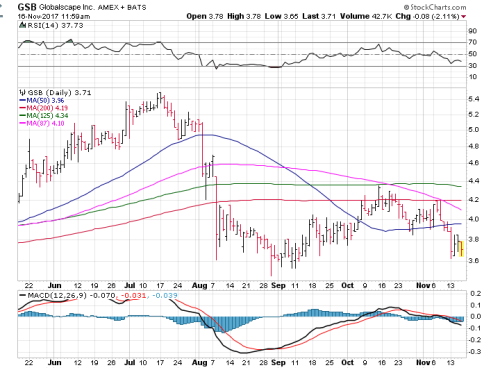
    Globalscape GSB responds to an earnings misstatement.

    Read the series of announcements here.

    Notice that the ticker symbol now has LF associated with it for late filing.

    Apparently the outside auditors have refused to file the report until various uncertainties are cleared up.

    As you can see below the markets do not reward such action.

    And notice that it has cost over a million dollars to investigate a $400,000 error!

    These expenses totaled approximately $190,000 and $873,000 for the three months ended June 30, 2017 and September 30, 2017, respectively.

    Screen Shot 2017-11-16 at 10.59.30 AM


  • Professor Elam

    Friday November 10, 2017


    I noticed that John Wallace, a member of our Accounting Advisory Committee, is Certified in Risk Information Systems Control.

    Learn about  this designation at iSACA.


  • Professor Elam

    Friday Nov 10, 2017

    Dr. Elam,
     
    Thank you for the opportunity to participate in the Accounting Advisory Board, and the most recent meeting!  I hope my contributions were helpful.  Nevertheless, there was much more I wanted to contribute about Artificial Intelligence, but time did not permit.  If I may, I would like to share a couple of things that are important to your students’ concept of this oft misunderstood technology.
     
    First, it is essential that your students understand the difference between Automation and Artificial Intelligence.  Automation is everywhere.  Artificial Intelligence is rare.  Automation and Artificial Intelligence are fundamentally different.  While both use computers, that is about the only similarity.  To use an old phrase, it is like “comparing apples and oranges.”  Automation helps us humans manage monotonous, repetitive tasks, and it is very rules-based.  Think, if “x” then “y.”  In other words, it is smart enough to follow orders.
     
    On the other hand, Artificial Intelligence, like humans, is horrible, and I can’t stress this enough, it is horrible at following rules.  Rules will predictably and reliably corrupt Artificial Intelligence.  Artificial Intelligence (AI) is, like humans, designed to identify patterns, learn from experience, and select appropriate responses in situations that are relevant to its experience.  It gives a computer the ability to learn without being explicitly programmed.  In other words, it can mimic what a human might think, say or do.
     
    Second, it is important to understand why true AI is still so slow to be adopted in the real world.  The biggest problem with the adoption of AI is ROI.  Most companies find that, while they may find the promise of AI attractive, they simply don’t have the necessary resources ($$$$$$$).  First, acquiring a truly smart AI “engine” is expensive.  Second, the “smarter” the AI engine, the more up-front time, effort and people it requires to plan and filter what is fed into the AI engine, so that the AI is not corrupted.  It is surprisingly easy to corrupt any AI by feeding it seemingly innocuous information or context that leads it astray.  This planning and filtering requires a lot of time, people and effort.  Monitoring and filtering information and context as you go along requires more time, people and effort (think more money).  Unlike Automation, which you can program and “forget,” AI requires considerable time and attention.
     
    A real-world example of the time, attention and money that is required with AI, is the story about IBM’s Watson that I mentioned during the meeting.  While Watson identified, in less than a second, malware on several computers that anti-virus software had missed, the task of bringing Watson to that point was both arduous and expensive.  IBM fed Watson massive amounts of information from the Internet and the Dark Web.  They also spent considerable time and effort examining and filtering the information before they fed it to Watson.  (Their Vice President would not tell us how much time and effort were involved, but only that it was “considerable.”)  In addition, they fed Watson a lot of information from their expensive computer event log Content Collector.  Only then was Watson ready to find the malware without being programmed or told to do so.  Certainly, that is not the end of the story.  I’m sure Watson is doing so much more.  IBM’s Vice President told us that they are offering “Watson as a Service” – no doubt to help with the ROI!
     
    In short, AI is very different from Automation in nature, function and cost.  While Automation is quite prevalent and useful in the Accounting field, AI may be more suited to other business fields and endeavors.

    While this is a bit long (my apologies), I hope you find it helpful.
     
    John

    John Wallace, CISA, CRISC | 
    Resources Global Professionals
    Consultant