• Professor Elam

    Monday Oct 23, 2017

    We will be running the Treasury Dept with less people in a couple of years,

    Tor Stian Kjollesdal, Norwegian Statoil

    Firms Leave the Bean Counting to the Robots

    Humans are being eliminated from entering multiple clicks transferring data from one program to another.

    Artificial Intelligence is gaining acceptance.  A finance exec in India remarks that because of robotization, finance jobs will evolve quickly.

    Let me put that in plain college speak.

    If we can automate data entry, forecasting, or data mining, we will.

    In class I emphasize the importance of obtaining advanced certifications. If the lower level jobs are going to be displaced by robots, and they are, this means obtaining an advanced certification is more important than ever.


  • Professor Elam

    Weekend Oct 20, 2017

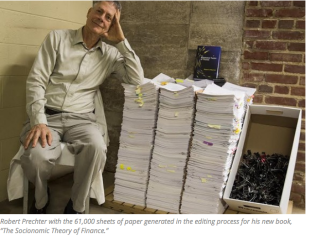
    Here is an interview with Robert Prechter. Screen Shot 2017-10-22 at 1.19.53 PM

    He has just published the fourth and fifth volumes of his series on socionomics.

    My review is here for Society and Culture.

    My research interest is in  how social mood drives market action.

    I just received volumes four and five and they will be added to our Socionomic Library Collection this week.

    Review our spring activities here. This link also covers the Donation Collection of Everything Socionomic.


  • Professor Elam

    Weekend Oct 22, 2017

    ACCT 3301 is accounting for non accounting majors.  I have mentioned to the class that

    • many entrepreneurs have no idea whether they are making money
    • they lack the expertise to calculate break even or target profit
    • They lack a budget
    • There are no standard costs for targets

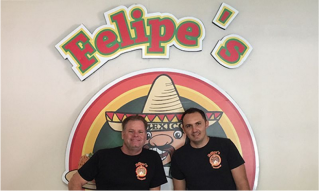
    Here is the story of Felipe's. Screen Shot 2017-10-22 at 11.22.07 AM

    Felipe's is a small Mexican Food restaurant in a strip mall in Palm Springs. It was begun by two Hispanic brothers in law whose only real experience was as waiters.  Does this sound familiar, gee how many of these do you suppose are in San Antonio?  There are so many the Express news is running a series called 365 DAys of Tacos, knowing they will never run out or restaurants to discuss.

    This is precisely the kind of story I have been alluding to in class. You never know if you would want to start a business or you might HAVE to start a business. The article mentions the necessity of making money from the get go, no rich relatives to lean on. And on the second page,  the lack of administrative expertise was solved by hiring a local accounting firm. Great idea!

    The article mentions paying required payroll and sales taxes which is certainly important. It does not mention having the CPAs help with break even calculations, to my thinking that would be crucial.

    But as I say we try to make students aware of the necessity of doing this. Otherwise the firm is sailing the boat without a map!


  • Professor Elam

    Friday Oct 20 2017

    I saw this on the TSCPA e mail as a result of my membership. It is an article from CFO magazine.

    Take a read. Here is another example of the benefit of having  a student membership in an accounting organization.

  • Professor Elam

    Wednesday Oct 18, 2017

    Check ou the graph on the back page of Section Two of today's WSJ. Spencer Jakab shows how each ten year slice of DJIA history ended badly in its

    7th year, as in 1987.  The glaring exception is this year.  Bob Prechter has mapped out an elaborate Fibonacci  metric suggesting the market has completed multiple Elliott Wave Patterns, we should be looking for a top.  At Insiide Track, Eric Hadik concludes  the markets are at a Gann time and price conjunction worthy of a top. 

    Yet the markets keep on chugging along.  Even articles in the WSJ admit the market is over priced.

    I have been preparing a talk for the annual San Antonio CPA Continuing Education day. I will present examples of how understanding social mood can help  predict accounting regulation or the failure to pass GAAP IFRS convergence .  I will also show how a socionomic analysis of political mood would have warned John Stumpf at WFC he was walking into his demise before Congress claiming responsibility but not accountability


    I am always looking for some image to demonstrate the power of linking social mood to social action. And this week I spotted one.

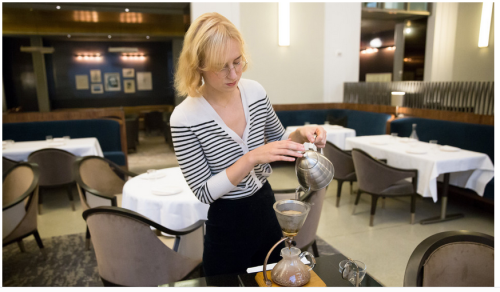
    A New York restaurant is offering a $24 cup of coffee.A pound of the raw beans runs to the hundreds of dollars. A California coffee shop raises the ante to $55!.  What does this tell us?  There are at least two messages here. The buyer is feeling expansive and more than willing to indulge in a personal perk.  And the second, is that apparently, the buyer is confident that the money will continue to stream in to finance such a purchase. Notice the elaborate contraption used table side to prepare the uber priced treat.

    Screen Shot 2017-10-17 at 6.51.11 AM

    Bugatti is marketing a car for over $2 million. The WSJ continues its Mansion Real Estate section on Fridays. Now the Starbucks $4 latte has been taken to new levels.

    Such behavior is common in frothy markets.  During the last tech boom in Austin, $12 glass of wine with lunch was common, In the late stages of the  1970s oil boom in West Texas one company began using Cadillacs as company cars. In her book on Enron, Mimi Swartz noted that the presence of too many exotic sports cars in the company parking garage was a danger signal.

    I give up on attempting to call a top here. And it may be that Trump's roll back of regulations and promise of tax cuts, along with higher interest rates is sparking new confidence in the economy. Emerging markets are higher world wide.

  • Professor Elam

    Tuesday Oct 17 2017


    Deflation Basics Series: The Quantity Theory of Money

    By Elliott Wave International

    Here's our challenge.

    In order to be aware of the investment pitfalls and opportunities that deflation can bring, we must first understand the basic elements of why it occurs. So our challenge is to try and make monetary economics, a subject that most people would find duller than watching paint dry on a wall, understandable and, dare I say it, fun! It's a big ask but we like a test, and so here is the first in our Deflation Basics Series — The Quantity Theory of Money.

    The Quantity Theory of Money (QTM for short) is the very essence of the true definition of inflation and deflation. You see, most people think of inflation and deflation as the rise and fall or prices when it is actually all about the rise and fall of the quantity of money.

    The QTM has its origins in the 16th century and the writings of the Prussian polymath Nicolaus Copernicus as well as followers of the School of Salamanca such as Martín de Azpilcueta. As European nations looted the Americas for gold and silver, an increase in the price of goods in general was noted as the metals were brought back to the Old World. This observation, via the writings of, among others, John Locke, David Hume, John Stuart Mill and Ludwig von Mises, led to a link between the quantity of money in an economy and the level of the price of goods.

    QTM is the cornerstone of monetarist economics which was largely developed by Milton Friedman, gaining popularity during the 1970s. Put simply, the Quantity Theory of Money can be expressed as the "Equation of Exchange":

    Formula

    In plain speak, the amount of money in an economy multiplied by the number of times that money is used, equals the price of stuff bought multiplied by the amount of stuff bought.

    Let's take a simple example.

    If an economy has $1,000 in total and that money is turned over 3 times during a month, total spending equals $3,000 that month. If the amount of stuff bought was 100 items, then the average price of each item would be $3,000 divided by 100 which equals $30.

    formula2

    We can re-arrange the Equation of Exchange to solve for the price level, P:

    Formula3

    Therefore, in our economy:

    Formula4

    Now let's assume that, the next month, money supply increases from $1,000 to $2,000, with the velocity of money and the amount of stuff bought staying the same. What would be the effect on the average price level?

    Formula5

    Formula6

    The average price level has gone up from $30 to $60. The average price of goods has gone up due to the inflation of the money supply.

    The next month, the money supply decreases from $2,000 to $500, with the velocity of money and the amount of stuff bought staying the same. What would be the effect on the average price level now?

    Formula 7

    Formula8

    The average price level has gone down from $60 to $15. The average price of goods has gone down due to the deflation of the money supply.

    This basic example shows the relationship between the level of the money supply in an economy and the average level of prices. The catch comes, of course, with the old economics chestnut, the Latin phrase ceteris paribus (all other things being equal). In the ivory towers of academic economics all other things can remain equal, but in the real world, they don't.

    So our assumptions in the example above that the velocity of money remained at 3 and that the amount of stuff bought remained at 100 would have to be challenged. In fact, one of the main criticisms of the QTM is that the velocity of money does not remain constant and changes due to the vagaries of spending impulses. However, if money supply didn't change but the velocity of money went down instead, the effect is the same — lower prices (assuming the amount of stuff bought remained the same that is!).

    Monetarists in the 1980s thought that, by targeting money supply growth, the level of goods and service prices in an economy could be controlled. However, although there is a link between the general level of prices in an economy and the amount of money, it is not rigid, and prices can move up and down for a myriad of reasons.

    Nevertheless, the general relationship in the Quantity Theory of Money stands. More money in an economy (inflation) tends to lead to higher prices and less money (deflation) tends to lead to lower prices.


    What You Need to Know NOW About Protecting Yourself from Deflation

    The best way to protect yourself from deflation is to first understand what it is. In this free, special report, you'll learn about this unexpected risk and what it can do to your portfolio. You'll also get 29 specific forecasts for stocks, real estate, gold and new cultural trends, to help you prepare and protect your wealth.

    Get instant access


    Your Bond Fund: It's Riskier Than You Think

    Quantitative Easing (QE) changed the bond markets in ways many don't realize. And now that QE is unwinding, investing in bonds comes with pitfalls that are too risky to overlook. This new resource from EWI's Murray Gunn offers insights you don't want to miss. Get your free report, Your Bond Fund: It's Riskier Than You Think.

    Get free, instant access

    This article was syndicated by Elliott Wave International and was originally published under the headline Deflation Basics Series: The Quantity Theory of Money. EWI is the world's largest market forecasting firm. Its staff of full-time analysts led by Chartered Market Technician Robert Prechter provides 24-hour-a-day market analysis to institutional and private investors around the world.
     

  • Professor Elam

    SatOct 14 2017

    Sorry for the delay here but I found out you can, indeed, join ALEKS as a single-user by registering and purchasing a subscription at the following

    link: https://www.aleks.com/.

    Click on New Students: Sign Up and then select, “Purchase ALEKS as a personal tutor” on the right hand side.
    When purchasing, be sure to select Higher Education: Business for “Market” and Accounting Cycle Corporation as “Class.”
    Good luck and please keep me posted on your progress!

  • Professor Elam

    Thursday October 12, 2017

    hope this email finds you well.  As your Chapter Relations Manager, I am reaching out to inform you of revisions being made to the CIA Exam Syllabi which will take effect in January 2019.  The changes are positive and have been made to better align content as well as allow for better preparation for the exam.  The revisions are the direct result of the Job Analysis Survey which launched in March of this year.  Please find the attached communication from our Certification’s Team direct to the CRC providing your leadership an overview of the revisions


    The IIA will be taking a full year to communicate these revisions to your members. To best prepare you for communication and promotion of these changes as well as to address questions and or concerns from your members, I am sending you the details specific to the revisions and The IIA’s communication strategy for the year ahead. 


    The following link will take you to a dedicated Certification web page where you will find:

    ·        A power point slide deck prepared specifically for our Chapter Leader to guide our members through the process and timeline associated with the revisions

    ·        A CIA Exam Changes Handbook and FAQs documents

    ·        As an additional note:  The CIA exam syllabi revisions will affect new and in-process candidates. In order to prepare CIA exam candidates for this change, a link to a dedicated CIA Exam Syllabi Revisions web page was created to provide exam candidates with the most current information available related to the syllabi revisions.


    These resources have also been shared with your District Representative and District Advisor.  Please do not hesitate to reach out to me, your DR or direct to the Certification team if you have questions, comments, or concerns. Thank you in advance for taking the time to review these important revisions as well as for your assistance in promoting and communicating this critical information to your members.


    Thank you,


    Artem Mulitsa
    Manager, North American Chapter Relations

    The Institute of Internal Auditors, Global Headquarters

    Tel: +1-407-937-1226  |  Fax: +1-407-937-1101 

  • Professor Elam

    Tuesday October 10, 2017

    On behalf of the members of the San Antonio CPA Society, thank you for helping promote the Accounting Careers Workshop to your students. A total of 123 students from seven universities and three Alamo Colleges campuses signed in this past Friday evening.  If you are counting, the totals were

    UTSA                     69

    UIW                       17

    NLC                        9

    TAMIU                  7

    Trinity                   6

    PAC                        4

    StMU                    3

    TAMUSA              2

    OLLU                     1

    SAC                        1

    Unknown/

      Other                  4


    FYI, we are still accepting registrations for the SACPAS Student Auxiliary tour of Toyota Motor Manufacturing Texas on Friday, October 20, between 1-3 pm.  Deadline to register is next Friday, October 13, at noon, unless the tour fills prior to that time. See the attached form for details and return it to me as soon as possible.


    Thanks again.


    Amanda Talaat

    Assistant Executive Director

    San Antonio CPA Society

    (210)828-2722

    amanda@sacpasociety.com

    www.sacpasociety.com

  • Professor Elam

    Tuesday Oct 10, 2017

    GM has too many plants making small cars that are not selling.

    The Obama Administration, as well as the state of California, wants automakers to build more small cars, read fuel efficient as well as electric cars. but now that gasoline prices are dropping, those cars are not selling.  In the article we learn that Ford is running plant at 100% plus capacity.This occurs when a third shift is added. GM runs but one shift to make the slow selling Sonic and Bolt, the latter an electric car. So the plant sits idle  for two potential shifts.

    In managerial accounting we learn that break even is calculated by dividing Fixed Cost by Contribution Margin, sales less variable costs.  When fixed costs rise, the break even point in unit sales and sales dollars rises making the company less profitable.

    GM closed its Fremont, CA plant during its bankruptcy. Toyota was making its smaller Tacoma pickup there. So Toyota transferred Tacoma production here. Recall that the Toyota plant here, designed to produce the larger Tundra pickup, actually closed three months after it opened.  Now it is running two shifts a day or 100% capacity.

    The purpose of the managerial accounting course for non accounting majors is to make students aware of cost behaviors and how to improve the bottom line using cost equations.