• Professor Elam

    11/22/2024

    Acct 5308 Fall 2024 Final Exam Preview

    40 m/c questions

    200 points

    100 minutes

    Rights Theory

    IMA Standards

    Aristotle’s belief

    Josephson Institute

    Audit Ethics – specific questions regarding behavior – 4

    Civility

    Heinz and the Drug

    Kohlberg stages – 2

    Cognitive Dissonance

    A Team Player Case

    Kidder Theory

    Director  Ethical Responsibility

    SEC action on misstatements

    Role of Leader

    J & J Credo

    Tone at the Top

    Backdating options

    Tax planning

    Independence impairment

    Remove the external auditor

    Beauda medical case

    AICPA Code

    Conceptual Framework

    Tax standards

    Communication

    Materiality

    ZZZZ Best

    Illegal acts

    SARBOX 302

    Material Misstatement

    Statement Fraud

    Monsanto Case

    Enron partnerships

    Allergan charge

    Earnings Management

    Non GAAP financial metric


  • Professor Elam

  • Professor Elam

    Tuesday 11/19/2024

    A San Antonio property appraisal firm’s former office manager, who stole more than $1.8 million from it to feed a gambling addiction, is headed to federal prison for 51 months.

    Jennifer E. Walker, who worked at Valbridge Property Advisors from 2012 to 2021, also must serve three years’ supervised release and repay the stolen money as part of a sentence handed down Monday by U.S. District Judge Fred Biery.

    Walker pleaded guilty to two counts of mail fraud earlier this year in connection with the theft. Six other counts were dropped as part of her plea agreement.

    Walker will remain free on a $20,000 unsecured bond until she has to report to prison by Feb. 10. Biery gave her the time to report so she can turn over the keys to her house and a $15,000 purse collection as part of her restitution.

    RELATED: Ex-office manager at San Antonio appraisal firm pleads guilty to inflating her pay by nearly $1.9M

    The theft started almost immediately after Walker joined Valbridge and continued for nine years, hampering the firm’s growth for several years, senior manager Paul Grafe told the court during a victim’s impact statement he delivered for the firm.

    “We believe as an ownership group that she should serve one year in prison for each of the nine years that she stole from us, as well as paying restitution — a sentence, to us, that proves our justice system is still in play, and the effort and time and financial burden that we have incurred does not get put aside,” Grafe said.

    The sentencing guidelines called for a prison term of 41 to 51 months, though Walker’s lawyer, Thomas McHugh, asked the judge to sentence her to home confinement because she accepted responsibility for her crimes and because she had no previous criminal history.

    Biery opposed that, noting that Walker had made no effort to reimburse Valbridge for its losses prior to her sentencing.

    Walker told Biery that she was addicted to online gambling, though Assistant U.S. Attorney Christina Playton said Walker made trips to Las Vegas and New Orleans to gamble.

    Walker poured her winnings back into her gambling, McHugh said. She later told the judge that she spent some of the money on Louis Vuitton purses, including one for about $3,500.

    READ MORE: How a bookkeeper with a long criminal history keeps getting jobs — and landing in more trouble

    Biery directed Walker, who was facing him from a lectern, to turn around and address the Valbridge officials she had “betrayed like Judas betrayed Jesus.”


    “I want to sincerely apologize for my actions during my time with your company,” she said, her voice cracking while she fought back tears. “Stealing money from you was not only wrong, but also a betrayal of the trust you placed in me. I deeply regret my behavior and harm it caused to you, your business and your families.” 

    Valbridge entrusted Walker to handle all of its accounting and administrative processes, including semimonthly payroll and certifying wage and tax statements for filing  with the IRS and Social Security Administration.

    Walker fraudulently inflated her own pay in the payroll reports she sent to the company’s bank, according to the charges. She stole about $24,000 her first year on the job, but the amount climbed to $280,000 and then more than $300,000 in subsequent years, Biery said.

    “So the addiction got really bad?” the judge asked.

    “Very, very bad,” she answered.


    Playton, the prosecutor, asked the judge to stay within the guidelines when imposing the sentence.

    very two weeks, she had to lie to the bank about her payroll, then she had to lie on the ledgers of the books, and then she had to look at the faces of her employers and her co-workers,” Playton said. “Every two weeks, she lied to these people and stole money that affected everyone’s lives in that firm.”

    Walker is among a number of San Antonio-area bookkeepers and office managers to be charged in connection with stealing from their employer.


  • Professor Elam

    Monday 11/18/2024

     
    Jacqui Belcher 
    From:jacqui@sacpasociety.com
    To:Dennis Elam,Dennis Elam,Richard Green,Ankur Chopra,Jared Koreff
    Cc:Anette Flores,Bryan Morgan Jr,Bryan Morgan,Hannah Graham,Brandon Howard
     
     
    Sun, Nov 17 at 3:33 PM
     
     
    Happy Holiday season, Educators!
     
    Before the Thanksgiving break – we have another GREAT (FREE) student event – please encourage your students to attend!! Always remember, Student Membership is FREE and as Educators, your TXCPA membership is at a significantly reduced rate!!
     
    The event will be held at The Shrine Auditorium (5:00-7:30) on Wednesday, November 20 – the program starting at 6:15.  Prior to the program, the students will be able to meet with firms/business to network and learn more about internship opportunities. We will also have light snacks/drinks available during networking.
     
    The Shrine Auditorium
    901 N Loop 1604 W
    San Antonio, TX  78232
     
    The flyer attached has more detailed information including a QR code to register.  Registration is NOT required; however, strongly encouraged.  Please support your students by considering giving them a few 'extra points' to attend and you are invited to attend the event with them!  If you provide credit and unable to attend, we will make sure you receive the list of students that attend.  You can also ask them make a photo with other CPA leaders at the event.
     
    Feel free to pass along this email to other Accounting & Finance Educators and definitely to your students!!
     
    Thank you for your continued support of the programs & opportunities that TXCPA San Antonio provides for the future of the accounting profession.
     
    Jacqui
     
     
    [A picture containing clipart  Description automatically generated]
    Jacqui Belcher
      Executive Director
     
      TXCPA San Antonio
      Direct: 210-828-2722
      Cell: 423-612-9848
     
  • Professor Elam

    Weekend 11/17/2024


    hVOters display a throw the bums out mentality which is typical of the developing negative mood.

    Positive social mood embraces incumbents and makes them appear successful, think Bill Clinton. Negative mood embracdes a throw them out mentality when it appears no one

    is serving their needs.  Democrats who despise Trump assumed everyone or at least a majority feel that way. Their negative nouns like deplorables and garbage came back to work against them.


  • Professor Elam

    11/16/2024

    Inflation is remaking America—again. It looms above all competing explanations for Donald Trump’s comeback. Despite the widespread belief that the worst economic cost of curing inflation—a steep recession—had been avoided, it turned out the political price had yet to be paid.

    The power of inflation to destroy a political establishment emerged clearly in the 1970s, when a decade of rising prices transformed American society and politics. High rates of inflation ushered in an age of neoliberal economic policies focused on free markets, free trade and globalization. Mr. Trump’s election, to be sure, marks a repudiation of this consensus. But ironically, this final break from neoliberalism came because both left and right ignored its signal achievement: decades of stable prices that insulated our fractious democracy from the pressures and strains that today threaten to tear it apart.

    John Maynard Keynes said the best way to overturn “the existing basis of society” was to debauch the currency—wisdom he attributed to Vladimir Lenin. The 1970s illustrate his point. While the rest of us think of disco, wide ties and Richard Nixon, economists know this decade as “the Great Inflation”—a steady and sustained rise in prices for nearly a decade, at a rate that in some years exceeded 10%. Not coincidentally, the decade also saw the dawning of globalization, financialization, accelerating inequality and a powerful new taxpayer politics, all of which can be traced directly to the rise in prices.

    It was America’s inability to control inflation that shattered Bretton Woods, the postwar currency system that bound the major trading nations together, ushering in a new era of globalization. Central to Bretton Woods were fixed exchange rates and capital controls, both of which gave governments considerable leeway over foreign investment and trade. The system couldn’t hold as the U.S. dollar inflated and lost value. Under Bretton Woods, other governments could trade their dollars for gold, and they did so with increasingly frequency. Fearing the Treasury would run out of the precious metal, Nixon slammed the gold window shut, killing Bretton Woods in the process.

    Instead of a managed, regulated currency system, the U.S. and the rest of the world moved to a regime of floating exchange rates, in which currencies traded against one another in global capital markets. Emerging alongside new computing technologies, this new system of fluid currencies accelerated globalization and underwrote the first serious challenges to U.S. manufacturing from abroad.

    At the same time, pervasive inflation meant skyrocketing interest rates, which pushed the economy toward financialization and simultaneously deepened inequality. Because it was easier to earn interest from accumulated capital than reinvest in factories and infrastructure, major corporations turned away from manufacturing and toward financial markets. The CEO of U.S. Steel, once a linchpin of American industry, announced that it “was no longer in the business of making steel” but “in the business of making profits.”

    In 1980 Congress hastened this process, along with sweeping deregulation of the financial system, by passing the Depository Institutions Deregulation and Monetary Control Act. This wasn’t the brainchild of free-market economists or the Reagan administration. Rather, the legislation was signed by Jimmy Carter and drafted in response to complaints from consumer advocates and commercial banks, which chafed against interest-rate caps. They pointed out, and rightly so, that the wealthy were able to benefit from high interest rates by using private banks and sophisticated investment vehicles.

    Financial deregulation in this context was a move toward equality. Yet in the end, financialization mainly benefited financiers. Along with globalization, it pushed the U.S. economy toward the FIRE industries dominated by educated professionals—finance, insurance and real estate—and away from the stable manufacturing jobs that predated inflation’s rise.

    In turn, this rising inequality ignited a populist reaction: the tax revolt of the late 1970s, epitomized by California’s Proposition 13 in 1978. This was a fierce new homeowner politics that, like the push for financial deregulation, stemmed from a mismatch between existing policy and the new era of inflation.

    Property taxes in many states tracked assessed value, calculated annually. When prices were steady, these taxes were predictable and manageable. When this tax rose by 7%, 8% or 11% because inflation had driven up home values, the result was rage. Pensioners and retirees, among others, feared the government would tax them out of hearth and home. Shaped into ballot initiatives by conservative political entrepreneurs, this rage fueled a durable political uprising that capped property taxes at a percentage of purchase price. The resulting fall in state revenue would hit education hard, again driving inequality.

    Subtly but surely, the ways Americans made a living, managed their economic institutions, traded with other nations, and understood the role of government transformed. The existing basis of society, for many, was overturned.


    But what happened next? After the Great Inflation came what economists call the Great Moderation—roughly 25 years of global price stability, with no major recessions, stretching from the mid-1980s to 2007. The new economic orthodoxy that emerged, which critics called neoliberalism, took inflation as a core concern. To varying degrees, both political parties embraced a standard menu of lower taxes and reduced spending and regulation, while monetary policy took priority over fiscal policy in managing the economy. At the heart of the neoliberal order lay a commitment to low inflation and rules-based monetary policy. Unlike previous eras of American history, financial shocks and crises—of which there were plenty—didn’t cause high inflation or deflation.


    How Inflation Ended Neoliberalism—and Re-Elected Trump

    In the 1970s, skyrocketing prices spurred free-market reforms that promoted economic stability. In the 2020s, they fueled Trump’s comeback.


    ET


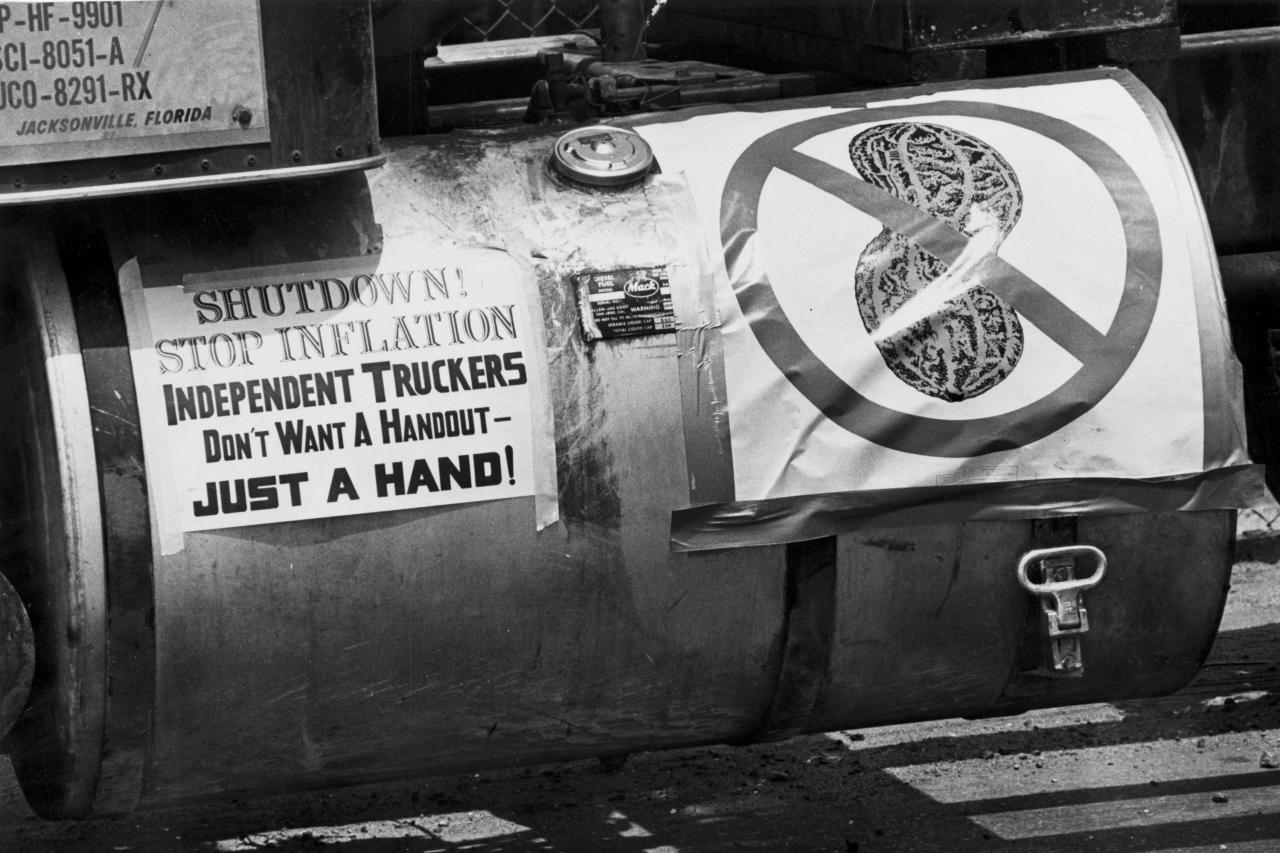
    A sign about inflation on a gasoline tank during a trucker demonstration in Chelsea, Mass., June 27, 1979. Photo: Boston Globe via Getty Images

    Inflation is remaking America—again. It looms above all competing explanations for Donald Trump’s comeback. Despite the widespread belief that the worst economic cost of curing inflation—a steep recession—had been avoided, it turned out the political price had yet to be paid.

    The power of inflation to destroy a political establishment emerged clearly in the 1970s, when a decade of rising prices transformed American society and politics. High rates of inflation ushered in an age of neoliberal economic policies focused on free markets, free trade and globalization. Mr. Trump’s election, to be sure, marks a repudiation of this consensus. But ironically, this final break from neoliberalism came because both left and right ignored its signal achievement: decades of stable prices that insulated our fractious democracy from the pressures and strains that today threaten to tear it apart.

    John Maynard Keynes said the best way to overturn “the existing basis of society” was to debauch the currency—wisdom he attributed to Vladimir Lenin. The 1970s illustrate his point. While the rest of us think of disco, wide ties and Richard Nixon, economists know this decade as “the Great Inflation”—a steady and sustained rise in prices for nearly a decade, at a rate that in some years exceeded 10%. Not coincidentally, the decade also saw the dawning of globalization, financialization, accelerating inequality and a powerful new taxpayer politics, all of which can be traced directly to the rise in prices.

    It was America’s inability to control inflation that shattered Bretton Woods, the postwar currency system that bound the major trading nations together, ushering in a new era of globalization. Central to Bretton Woods were fixed exchange rates and capital controls, both of which gave governments considerable leeway over foreign investment and trade. The system couldn’t hold as the U.S. dollar inflated and lost value. Under Bretton Woods, other governments could trade their dollars for gold, and they did so with increasingly frequency. Fearing the Treasury would run out of the precious metal, Nixon slammed the gold window shut, killing Bretton Woods in the process.

    Instead of a managed, regulated currency system, the U.S. and the rest of the world moved to a regime of floating exchange rates, in which currencies traded against one another in global capital markets. Emerging alongside new computing technologies, this new system of fluid currencies accelerated globalization and underwrote the first serious challenges to U.S. manufacturing from abroad.

    At the same time, pervasive inflation meant skyrocketing interest rates, which pushed the economy toward financialization and simultaneously deepened inequality. Because it was easier to earn interest from accumulated capital than reinvest in factories and infrastructure, major corporations turned away from manufacturing and toward financial markets. The CEO of U.S. Steel, once a linchpin of American industry, announced that it “was no longer in the business of making steel” but “in the business of making profits.”

    In 1980 Congress hastened this process, along with sweeping deregulation of the financial system, by passing the Depository Institutions Deregulation and Monetary Control Act. This wasn’t the brainchild of free-market economists or the Reagan administration. Rather, the legislation was signed by Jimmy Carter and drafted in response to complaints from consumer advocates and commercial banks, which chafed against interest-rate caps. They pointed out, and rightly so, that the wealthy were able to benefit from high interest rates by using private banks and sophisticated investment vehicles.

    Financial deregulation in this context was a move toward equality. Yet in the end, financialization mainly benefited financiers. Along with globalization, it pushed the U.S. economy toward the FIRE industries dominated by educated professionals—finance, insurance and real estate—and away from the stable manufacturing jobs that predated inflation’s rise.

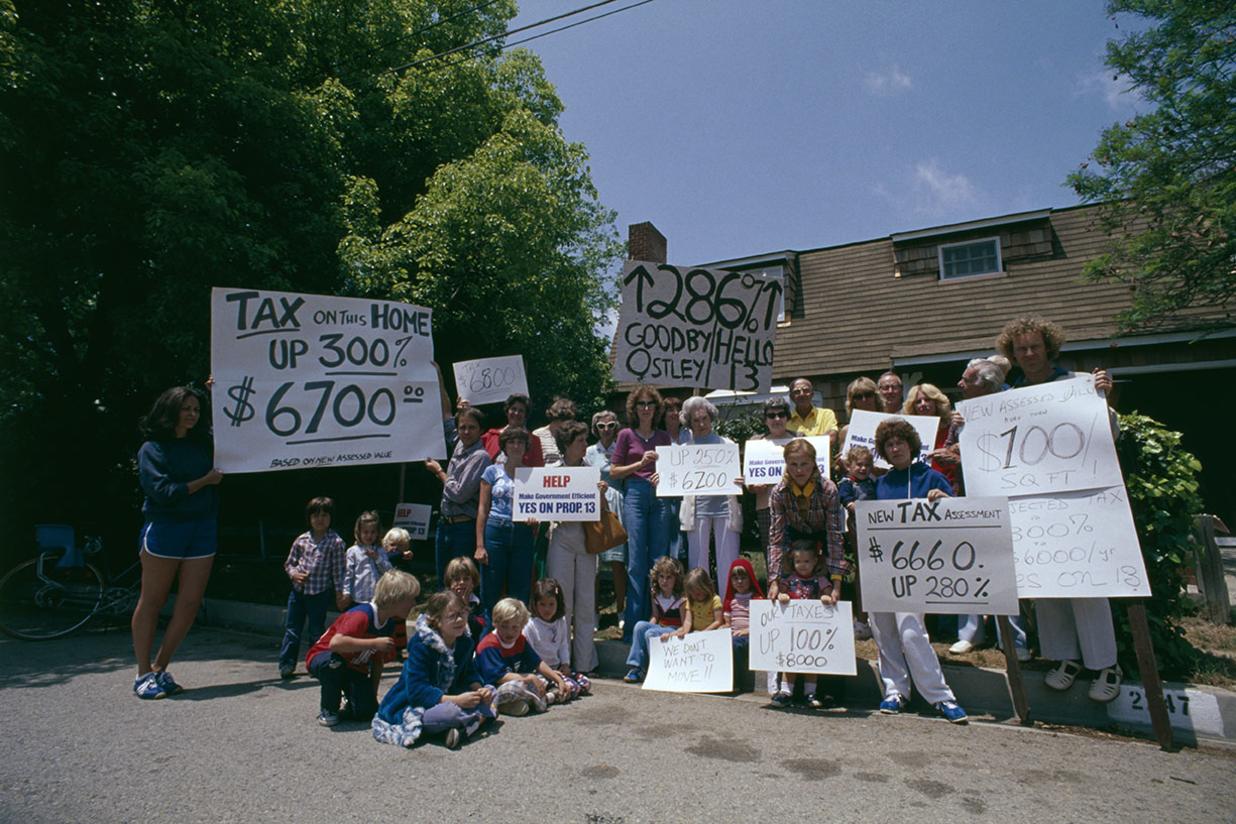
    California residents gather in support of Proposition 13, 1978. Photo: Sygma via Getty Images

    In turn, this rising inequality ignited a populist reaction: the tax revolt of the late 1970s, epitomized by California’s Proposition 13 in 1978. This was a fierce new homeowner politics that, like the push for financial deregulation, stemmed from a mismatch between existing policy and the new era of inflation.

    Property taxes in many states tracked assessed value, calculated annually. When prices were steady, these taxes were predictable and manageable. When this tax rose by 7%, 8% or 11% because inflation had driven up home values, the result was rage. Pensioners and retirees, among others, feared the government would tax them out of hearth and home. Shaped into ballot initiatives by conservative political entrepreneurs, this rage fueled a durable political uprising that capped property taxes at a percentage of purchase price. The resulting fall in state revenue would hit education hard, again driving inequality.

    Subtly but surely, the ways Americans made a living, managed their economic institutions, traded with other nations, and understood the role of government transformed. The existing basis of society, for many, was overturned.


    But what happened next? After the Great Inflation came what economists call the Great Moderation—roughly 25 years of global price stability, with no major recessions, stretching from the mid-1980s to 2007. The new economic orthodoxy that emerged, which critics called neoliberalism, took inflation as a core concern. To varying degrees, both political parties embraced a standard menu of lower taxes and reduced spending and regulation, while monetary policy took priority over fiscal policy in managing the economy. At the heart of the neoliberal order lay a commitment to low inflation and rules-based monetary policy. Unlike previous eras of American history, financial shocks and crises—of which there were plenty—didn’t cause high inflation or deflation.

    Advertisement

    This isn’t how we remember the 1980s, 1990s and early 2000s, because we often focus on the unfolding of the stories that started in the 1970s. We see the rich getting richer and the poor getting poorer, the decline of manufacturing, the birth of a new global economic order. But in the sweep of American economic history, it is a remarkably long period of stability. The disorder and divisions of the late ’60s and the Watergate era subsided, the political system functioned at a level that seems enviable today, and while some economic losses persisted, others were repaired.

    Yet in recent years, a new elite consensus has emerged that blames neoliberalism for all our social, economic and political problems. Since the 1970s, the story goes, Americans have traded a stable, regulated mixed economy for the Wild West of unfettered capitalism. The essence of this story is true: The 1970s did inaugurate a new economic era that rewired the existing basis of society through globalization, financialization and the rise of conservative economic populism. Yet rarely does this story grapple with inflation, the fundamental cause of neoliberalism’s rise and many of the changes it wrought.

    It’s tempting to leave inflation out of this story because the lessons it offers often aren’t ones we want to hear. For one thing, inflation can be ignited by government spending, as the Covid-19 era demonstrates. When we like the reasons we’re spending or regard it as necessary, we don’t want to hear about the negative consequences. Moreover, fighting inflation is painful. What broke the back of the Great Inflation was the Volcker shock—the 1982 recession caused by Federal Reserve Chairman Paul Volcker’s deliberate policy of setting interest rates high enough to reset the price level and end the cycle of inflationary expectations. Along the way, unemployment reached Depression-era levels in key industries, and many never recovered. This is the worst-case scenario today’s Fed sought to avoid at all costs.

    Yet in the early years of the pandemic, policymakers brushed aside concerns about emerging inflation as a relic of the past, perhaps believing they were in a new world where the old lessons didn’t apply. Because neoliberalism is so often framed as a failure by both left and right, few stop to consider why new ideas and approaches to the economy emerged after the 1970s, why they lasted so long, and what they may still have to offer. With Milton Friedman vilified as an arch-neoliberal, few noticed that pandemic relief programs approximated what he called a “helicopter drop”—a policy intended to create inflation. That isn’t to say relief payments were unjustified, and Friedman would likely have supported some of them. But they were undertaken with little sense of their potential downside, economically or politically.


    That inflation came down without a recession is a triumph for economic policy; that it emerged at all is a failure of both economics and politics. Although he has inflation to thank for his victory, Mr. Trump shows little understanding of its dynamics. Many of his proposed policies may reignite the price rises he promised to cure, and the rise in year-over-year consumer-price inflation to 2.6% in October is a warning sign. Yet whether inflation sparks again or recedes, leaving Mr. Trump’s election as its only legacy, one thing is sure: We are standing at the precipice of another great social and political transformation—because money matters, even when we wish it didn’t.

    Ms. Burns is an associate professor of history at Stanford, a research fellow at the Hoover Institution and author of “Milton Friedman: The Last Conservative.”


  • Professor Elam

    Thursday 11/14/2024

    I have posted this perfect for Black Friday essay at this time of season for many years. Emerson sums up the insanity of crowding into stores for some 'bargain.'  OR worse  a chase for the latest fad toy as Arnold portrayed in Jingle All the Way!

    As he says the best gift is one from your self, something you made or fashioned. Sadly such craft is rare  today. No doubt the lack of hand crafted objects led to the phrase 'store bought.'  A vase of flowers or basket  of fruit are always timeless.

    __________________________

    It is said that the world is in a state of bankruptcy, that the world owes the world more than
    the world can pay, and ought to go into chancery, and be sold. I do not think this general
    insolvency, which involves in some sort all the population, to be the reason of the difficulty
    experienced at Christmas and New Year, and other times, in bestowing gifts; since it is
    always so pleasant to be generous, though very vexatious to pay debts. But the impediment
    lies in the choosing. If, at any time, it comes into my head, that a present is due from me to
    somebody, I am puzzled what to give, until the opportunity is gone. Flowers and fruits are
    always fit presents; flowers, because they are a proud assertion that a ray of beauty
    from Essays: Second Series (1844)
    Type to enter text
    Gifts
    Gifts of one who loved me, —
    'T was high time they came;
    When he ceased to love me,
    Time they stopped for shame.


    Gifts Ralph Waldo Emerson
    outvalues all the utilities of the world. These gay natures contrast with the somewhat stern
    countenance of ordinary nature: they are like music heard out of a work-house. Nature does
    not cocker us: we are children, not pets: she is not fond: everything is dealt to us without
    fear or favor, after severe universal laws. Yet these delicate flowers look like the frolic and
    interference of love and beauty. Men use to tell us that we love flattery, even though we are
    not deceived by it, because it shows that we are of importance enough to be courted.
    Something like that pleasure, the flowers give us: what am I to whom these sweet hints are
    addressed? Fruits are acceptable gifts, because they are the flower of commodities, and
    admit of fantastic values being attached to them. If a man should send to me to come a
    hundred miles to visit him, and should set before me a basket of fine summerfruit, I should
    think there was some proportion between the labor and the reward.
    For common gifts, necessity makes pertinences and beauty every day, and one is glad when
    an imperative leaves him no option, since if the man at the door have no shoes, you have
    not to consider whether you could procure him a paint-box. And as it is always pleasing to
    see a man eat bread, or drink water, in the house or out of doors, so it is always a great
    satisfaction to supply these first wants. Necessity does everything well. In our condition of
    universal dependence, it seems heroic to let the petitioner be the judge of his necessity,
    and to give all that is asked, though at great inconvenience. If it be a fantastic desire, it is
    better to leave to others the office of punishing him. I can think of many parts I should prefer
    playing to that of the Furies. Next to things of necessity, the rule for a gift, which one of my
    friends prescribed, is, that we might convey to some person that which properly belonged
    to his character, and was easily associated with him in thought. But our tokens of
    compliment and love are for the most part barbarous. Rings and other jewels are not gifts,
    but apologies for gifts. The only gift is a portion of thyself. Thou must bleed for me.
    Therefore the poet brings his poem; the shepherd, his lamb; the farmer, corn; the miner, a
    gem; the sailor, coral and shells; the painter, his picture; the girl, a handkerchief of her own
    sewing. This is right and pleasing, for it restores society in so far to its primary basis, when a
    © 1996-2019 EmersonCentral.com Page of 2 5


    Gifts Ralph Waldo Emerson
    man's biography is conveyed in his gift, and every man's wealth is an index of his merit. But
    it is a cold, lifeless business when you go to the shops to buy me something, which does not
    represent your life and talent, but a goldsmith's. This is fit for kings, and rich men who
    represent kings, and a false state of property, to make presents of gold and silver stuffs, as a
    kind of symbolical sin-offering, or payment of black-mail.
    The law of benefits is a difficult channel, which requires careful sailing, or rude boats. It is not
    the office of a man to receive gifts. How dare you give them? We wish to be self-sustained.
    We do not quite forgive a giver. The hand that feeds us is in some danger of being bitten.
    We can receive anything from love, for that is a way of receiving it from ourselves; but not
    from any one who assumes to bestow. We sometimes hate the meat which we eat, because
    there seems something of degrading dependence in living by it.
    "Brother, if Jove to thee a present make,
    Take heed that from his hands thou nothing take."
    We ask the whole. Nothing less will content us. We arraign society, if it do not give us
    besides earth, and fire, and water, opportunity, love, reverence, and objects of veneration.
    He is a good man, who can receive a gift well. We are either glad or sorry at a gift, and both
    emotions are unbecoming. Some violence, I think, is done, some degradation borne, when I
    rejoice or grieve at a gift. I am sorry when my independence is invaded, or when a gift
    comes from such as do not know my spirit, and so the act is not supported; and if the gift
    pleases me overmuch, then I should be ashamed that the donor should read my heart, and
    see that I love his commodity, and not him. The gift, to be true, must be the flowing of the
    © 1996-2019 EmersonCentral.com Page of 3 5


    Gifts Ralph Waldo Emerson
    giver unto me, correspondent to my flowing unto him. When the waters are at level, then my
    goods pass to him, and his to me. All his are mine, all mine his. I say to him, How can you
    give me this pot of oil, or this flagon of wine, when all your oil and wine is mine, which belief
    of mine this gift seems to deny? Hence the fitness of beautiful, not useful things for gifts. This
    giving is flat usurpation, and therefore when the beneficiary is ungrateful, as all beneficiaries
    hate all Timons, not at all considering the value of the gift, but looking back to the greater
    store it was taken from, I rather sympathize with the beneficiary, than with the anger of my
    lord Timon. For, the expectation of gratitude is mean, and is continually punished by the
    total insensibility of the obliged person. It is a great happiness to get off without injury and
    heart-burning, from one who has had the ill luck to be served by you. It is a very onerous
    business, this of being served, and the debtor naturally wishes to give you a slap. A golden
    text for these gentlemen is that which I so admire in the Buddhist, who never thanks, and
    who says, "Do not flatter your benefactors."
    The reason of these discords I conceive to be, that there is no commensurability between a
    man and any gift. You cannot give anything to a magnanimous person. After you have
    served him, he at once puts you in debt by his magnanimity. The service a man renders his
    friend is trivial and selfish, compared with the service he knows his friend stood in readiness
    to yield him, alike before he had begun to serve his friend, and now also. Compared with
    that good-will I bear my friend, the benefit it is in my power to render him seems small.
    Besides, our action on each other, good as well as evil, is so incidental and at random, that
    we can seldom hear the acknowledgments of any person who would thank us for a benefit,
    without some shame and humiliation. We can rarely strike a direct stroke, but must be
    content with an oblique one; we seldom have the satisfaction of yielding a direct benefit,
    which is directly received. But rectitude scatters favors on every side without knowing it, and
    receives with wonder the thanks of all people.
    © 1996-2019 EmersonCentral.com Page of 4 5


    Gifts Ralph Waldo Emerson
    I fear to breathe any treason against the majesty of love, which is the genius and god of
    gifts, and to whom we must not affect to prescribe. Let him give kingdoms or flower-leaves
    indifferently. There are persons, from whom we always expect fairy tokens; let us not cease
    to expect them. This is prerogative, and not to be limited by our municipal rules. For the rest,
    I like to see that we cannot be bought and sold. The best of hospitality and of generosity is
    also not in the will, but in fate. I find that I am not much to you; you do not need me; you do
    not feel me; then am I thrust out of doors, though you proffer me house and lands. No
    services are of any value, but only likeness. When I have attempted to join myself to others
    by services, it proved an intellectual trick, — no more. They eat your service like apples, and
    leave you out. But love them, and they feel you, and delight in you all the time.

  • Professor Elam

    Monday 11/11/2024

    Most companies are starting to figure out how artificial intelligence will change the way they do business. Chegg CHGG 0.00%increase; green up pointing triangle

    is trying to avoid becoming its first major victim.

    The online education company was for many years the go-to source for students who wanted help with their homework, or a potential tool for plagiarism. The shift to virtual learning during the pandemic sent subscriptions and its stock price to record highs.

    Then came ChatGPT. Suddenly students had a free alternative to the answers Chegg spent years developing with thousands of contractors in India. Instead of “Chegging” the solution, they began canceling their subscriptions and plugging questions into chatbots.

    Since ChatGPT’s launch, Chegg has lost more than half a million subscribers who pay up to $19.95 a month for prewritten answers to textbook questions and on-demand help from experts. Its stock is down 99% from early 2021, erasing some $14.5 billion of market value. Bond traders have doubts the company will continue bringing in enough cash to pay its debts.

    Though Chegg has built its own AI products, the company is struggling to convince customers and investors it still has value in a market upended by ChatGPT.

    “It’s free, it’s instant, and you don’t really have to worry if the problem is there or not,” Jonah Tang, an M.B.A. candidate at Point Loma Nazarene University in San Diego, said of the advantages of using ChatGPT for homework help over Chegg.

    A survey of college students by investment bank Needham found 30% intended to use Chegg this semester, down from 38% in the spring, and 62% planned to use ChatGPT, up from 43%.

    “My concern is that the headwinds to Chegg’s top-line aren’t temporary—they’re more structural in nature,” said Needham analyst Ryan MacDonald.

    Dan Rosensweig, Chegg’s CEO of more than a decade, stepped down in June after the stock cratered under his leadership. Chegg said Rosensweig notified the board of directors he planned to retire a year in advance.


    Company veteran Nathan Schultz took over as CEO and laid off 441 employees, almost a quarter of Chegg’s workforce. He has pushed for international expansion and outlined a plan for Chegg to become useful to students for more than just homework answers. 

    In an interview, Schultz said Chegg was dealing with a hangover from the growth it experienced during the pandemic and an uncertain outlook for classroom policies around AI. He said Chegg plans to target more serious students than what he calls the “curious learner” by offering more comprehensive answers and services such as counseling.

    “In moments of disruption, you have to focus on what you do best,” he said. 

     
    Tech News Briefing

    The Wall Street Journal Tech TalkHow AI Is Threatening an Online Education Giant


    Researchers at the University of Illinois at Urbana-Champaign conducted a study in the spring last year to see how ChatGPT had influenced cheating in an introductory programming course. They found students had overwhelmingly moved to ChatGPT from what the researchers called “plagiarism hubs” such as Chegg.

    “It appeared that they completely shifted over from trying to find online solutions and copying them to just going to ChatGPT and having it generate solutions for them,” said Craig Zilles, professor of computer science at the University of Illinois at Urbana-Champaign.

    The Chegg spokeswoman said, “We take any attempt to misuse our platform extremely seriously, cooperate with official university investigations into allegations of cheating  and invest in our technology and solutions to prevent such actions.” OpenAI declined to comment.

    Screenshot 2024-11-11 at 7.36.09 AM

  • Professor Elam

    Weekend 11/9/2024

    Screenshot 2024-11-09 at 6.29.55 AM

    This is what happens when EY disclaims and opinion on  a former client.


  • Professor Elam

    11/7/2024

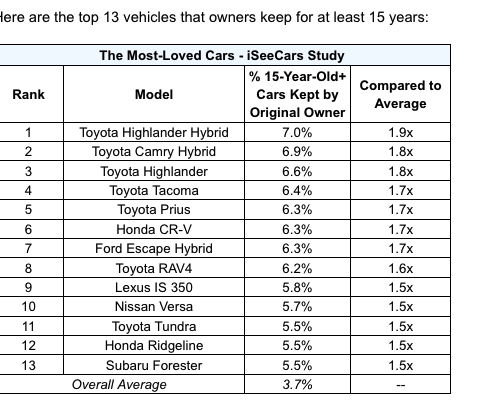
    I ran across this and found it interesting, the cars we keep the longes

    Screenshot 2024-11-07 at 2.15.30 PM

    Sevem of the 13 are Toyotas, I bought my 2009 Toyota RAV 4 in  2009, to date sure lots of usual maintenance but really only one repair, the alternator died around  580K no doubt, should have kept my MR 2 , mid engine


    Only one American car, I had  a Ford Escape, third party transmission died at  120K should have replaced and kept it


     a victim of the under hood heat of a FWD V 6, I replaced the front struts and rear shocks about  130 K and it drives like new, same original water and fuel pump, amazing

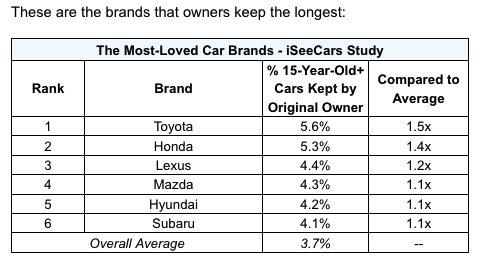
    Screenshot 2024-11-07 at 2.22.09 PM
    Screenshot 2024-11-07 at 2.22.09 PM