• Professor Elam


    Accounting Students

    Here is a great opportunity for an internship in internal audit. Make sure you qualify by reading both the job bulleting and description of the intern program.

     We had two student selected last summer and both made a favorable impression. Let's keep up the good work.

    Dennis Elam


    Download City of SA Internship Position

    Description of Intern Program

    Office of the City Auditor

    Internship Program


    Objective of Internship Program


    The major objective of our Internal Audit internship program is to provide talented young people an opportunity to learn about the City and the internal audit profession while they apply and enhance their skills and knowledge through a summer, fall or spring internship.  It is designed for individuals who have two or more years of education with an accredited college/university at the time they begin their internship and have an interest in the Auditing or Accounting profession.  The goal is to provide a rewarding experience for both the student and the employer.


    At the start of the internship program, interns will be required to write a summary of expectations.  This will help focus on the objective of the program and will help both the student and the employer with planning and evaluation purposes. 


    Employer Expectations


    The manager or lead auditor will expect interns to provide weekly status reports.  Interns will be expected to meet weekly deadlines just like the other audit professionals.  Interns may assist in all areas of the audit process for projects they are assigned.  


    What to Expect as an Intern


    Week 1             – The program will begin with approximately 1 week of orientation.  During this time we will go over the phases of the audit that are followed by our full-time audit staff, introduce you to the rest of the audit team and provide you with an overview of our day to day operations, including an overview of our audit software.   Just like all audit professionals in the department, interns will be assigned a laptop and other necessary equipment needed to complete audit work.


    Week 2 through end of term – During the rest of the internship in the Office of the City Auditor, you will be working with audit staff on assigned audits gaining valuable experience in a mature internal audit department environment while applying college learned theory and practices.


    Program evaluation


    During and at the end of the internship, the intern will receive evaluations with feedback to continue to improve the skill set required as an internal auditor. 


    Essential Job Functions/Job Requirements


    Performs assigned audit program procedures with direction to include developing scope, objective, and methodology; preliminary planning; individual and group interviews; program development; qualitative and quantitative data collection, work paper preparation; and report preparation.  Performs related duties and fulfills responsibilities as required.


    Knowledge, Skills, and Abilities


    Accounting, Information Systems, or Computer Science major, completed at least 60 hours towards undergraduate degree, minimum 3.00 GPA overall, minimum 3.00 GPA in College of Business courses, working knowledge of MS Word and Excel, strong analytical and communication skills. Completion of Auditing class preferred.


    Dates of Current Summer Program

    May 18, 2015 through July 24, 2015 (10 weeks)

    35 – 40 hours / week

    Pay rate: $14.00 / hour

    No benefits


    Selected candidate will be required to complete all reviews and screenings required by the City’s Human resources department.

    Wed February 4, 2015

    I just received this message from the Head of Internal Audit for the City of San Antonio.


  • Professor Elam

    Tuesday Feb 3, 2015

    russian Banks reel from the interest rate increases designed to prop up the ruble.

    Let's connect the dots.

    Oil prices collapse 50%.

    Putin has bet the farm on oil, it is half the Russian economy. 

    The currency measured in rubles collapses against the US Dollar. 

    The Russian Central Bank raises rates to  18% to stem the flow of rubles being exchanged for anything of value. 

    Rates then fall to  15%. 

    Russian banks holding rubles suffer currency losses and increased borrowing costs. 

    This is why currency transactions are one of the four parts of Other Comprehensive Income. 

  • Professor Elam

    Tuesday Feb 3 2015

    We have followed the misfortunes of Radio Shack RSH for some time. Now  the NYSE has de listed the stock. RSH has not filed a re organization plan and the stock price has fallen to 24 cents.  It is worthwhile to read the NYSE Statements. 

    Rumors are that one or more mobile phone companies may buy some stores or perhaps Amazon. 

    Electronic retailers are famous for flaming out after short term success, Crazy Eddie being a famous case in point. RSH succumbed to on line retailing the demise of audio systems, and do it your self types. I mean when was the last time you saw someone using a soldering iron?

  • Professor Elam

    Monday Feb 2, 2015

    Apple AAPL has a cash stash of about $178 B. So why is Apple selling $5 B in notes and bonds?

    If Apple brought the money back to the US it would pay 35% income tax. It is cheaper to borrow at these low rates and avoid the tax.

    The President wants a 14% tax on that money now and 19% on future earnings.

    I think the better idea is a  2015 Tax Holiday. Let companies bring the money back tax free and invest in property plant and equipment.

    If the government gets the money it will vanish into favored pockets just as the QE money did. What happened to all those shovel ready projects?

  • Professor Elam

    Monday Feb 2, 2015

    If you are having difficulty with the basics we can recommend one of two fine review or prep programs.

    One is FAME Financial Accounting Made Easy.  This is a Gleim product priced at 29.95.

    A second is ALEKS Assessment and Learning in Knowledge Spaces. This linke takes you to a menu of programs. There are several for accounting, the one for corporations looks appropriate.


    If you failed our first exam, I recommend you begin one of these immediately.

  • Professor Elam

    Monday Feb 2 2015

     Socionomics is he new predictive social science which focuses on social mood as  the engine of change in society. These articles below reflect the attempt, at least the first one, to discern changes in social mood. The mood in Brazil is so rife with corruption that a complete top to bottom change would have to occur in both political and corporate leadership. Thinking a group this corrupt will change is naive. The same is true for El Salvador. 

    Regulators Focus on Culture Ihe front page headline in the WSJ today discusses the difficulty of defining culture. Is an organization ethical?  Are there buzzwords like workaround that suggest employees are disregarding the rules?

    We study corporate  culture in ACCT 5308 as well as intermediate accounting. What does a firm do to establish the proper culture, monitor that and report results?  Remember the tone starts at the top. 

    Petrobras Giant Spawns Colossal Mess Not long ago the acronym BRIC was coined to describe growth engines Brazil, Russia, India, and China. Today only India seems able to retain the mantel. As is so often the case, South American countries are rife with corruption and this article makes that clear. A photo in the actual WSJ shows a young lady displaying a sign outside Petrobras Headquarters

    Petrobas, the Largest Corruption Scandal Ever

    What is wrong, all the usual, bribes, pay offs, kickbacks,  and of course a cozy monetary relationship with the ruling political party. 

    What to do now, no one knows. 

    Notably Russia's population has decreased from about 165 million when the Berlin Wall fell to about 135  million today. Life expectancy for males is a mere 59 years. the country is literally shrinking. I suspect in twenty years China will slowly assimilate Siberia and there will be nothing Russia can do about it. 

    China has  had  a huge run up in its stock markets, is that for real, or is Chinese future growth problematic with ghost cities and questionable accounting practices?

    Speaking of Central America Mary O'Grady's column on Mondays highlights the latest usually depressing news from Central and South America. Today she notes America is funding repression of Americans in El Salvador. 

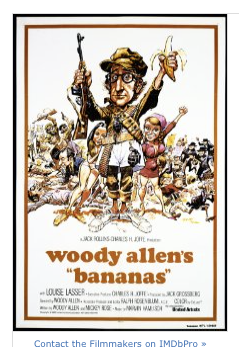
    In 1971 Woody Allen produced a spoof on South America he named his movie Bananas..  Back in the day Screen Shot 2015-02-02 at 8.38.38 AMthis is the sort of film that would be shown on campus to stimulate discussion about such issues. 


    Allen's first three or four films back then were hilarious satires on the contemporary condition of the world. Since  then he has done a series of movies that mean a lot to him but I don't now a soul that has seen one. Has anyone seen a recent Woody Allen movie?

  • Professor Elam

    Weekend Feb 1 2015

    This is my newspaper column for this weekend. 


    Return  of the Nifty Fifty

    The Nifty Fifty were fifty large capitalization stocks popular in the   1960s bull market right up to the January 1972 top at Dow 1,051.

    The long bear market of the 1970s that lasted until 1982 caused valuations of the nifty fifty to fall to low levels along with the rest of the market, with most of these stocks under-performing the broader market averages.

    Wikipedia on Nifty Fifty

    Our thesis has been that the equity markets would peak and then fall in the same fashion at 1973-74. Many of the same events then have parallels now. Finally, the puzzle pieces are aligning. The end of a bull market is a topping process. Various indexes top at different times.  The popularity of some stocks (every generation has its Nifty Fifty) masks the overall decline of the market. Like the  frog in slowly heating water, many investors will buy and hold , for too long.

    ‘Buy and hold good stocks’ is hardly a new idea. The Nifty Fifity contained some companies that were hot stocks then, and even today. Others went out of business.  Survivors include stalwarts like Coke, DuPont, and Halliburton. Some failed to see change coming like Kodak, Avon, Polaroid, and Sears.  Which stocks might constitute  that same vaunted rank today?

    The obvious number one answer is Apple AAPL.  Apple just recorded the largest quarterly net profit of any public company ever- $18 billion.  This dwarfs Microsoft MSFTat $5.98 B or Netflix NFLX at a mere $.8 B. Gross profits (sales less cost of goods sold)  are 40% of sales.   The cash hoard totals $178 billion. AAPL sold 74.5 million iPhones during the last quarter.  But one headline asks, Can AAPL sustain this growth? Alternatively I would ask, can we really anchor the US economy to gizmo sales?

    Facebook FB just earned $.7 B for the quarter, not bad for a company that really produces nothing at all. It merely acts as a host for its users.

    Apple and MSFT are owned by nearly everyone who owns a mutual fund.  Our point is that AAPL, MSFT, FB, and until recently Amazon, are the rising tide that lifts all investor boats. This masks all sorts of other early warning signals.

    The New York Stock Exchange Index has made a series of lower highs the last few months. And these important indexes have now turned their daily trends down.


    Index

    Support or Turn

    1/29/15 Close

    Dow Industrials

    17,517

    17,168

    S & P 500

    2,027

    1,,998

    NASD

    4,190

    4128


    As I write on January 29, there is only one trading day left in the month. I am guessing this, the result of a near 500 point Dow collapse over two days, has turned things to the downside.  Or as January goes, so goes the markets.

    We strongly suspect this will parallel the collapse in 1973-74, 2000-2002, or 2008-2009.  The durable goods report was down 3.4% this week. Were it not for people simply dropping out of the labor force the unemployment would be 10%. The situation in Europe continues to crumble with Greece already shunning austerity and putting government employees back on the payroll without funds to pay them. Greece is a small economy of only 10 million people but Portugal, Spain, Italy, and perhaps France are certainly watching.

    We began the year suggesting one word would typify the markets and economy-DEFLATION. That has been the case this month.  While the OPEC Secretary called a bottom in the oil price earlier this week, the markets did not listen. Spot West Texas Crude fell another 3% Wednesday, closing under $45. This literally means the next level of chart support is at the 2008 low around $35.  Why, well the Energy Information Administration reports US oil supplies are at an 80 year high.  Couple that with world wide over production, and, well, how long will it take to work off the overhead supply? As we noted last week, this does not happen with avocados but does with storable commodities like oil.

    Natural gas is down 3.8% this week to $2.85 on Wednesday’s close. The previous low of $1.92 was recorded in 2012. And until we get a reversal, that becomes a target as with $35 oil.

    The carnage continues in energy service stocks.  Patterson PTEN, Nabors NBR, and Transocean RIG are trading at 80%, 50%, and 40% of respective book values.

    And so deflation continues to creep into the vocabulary, and the markets.

  • Professor Elam

    Weekend Feb 1 2015

    Socionomic theory holds that endogenously generated mood governs behavior. In this excerpt, Chuck Thompson, writer for  the Socionomist, explains a recent experiment analyzing tendencies towards herding. I asked the Ethics Class to read an excerpt from Shadow Account. In that fictional story a CPA explains how this sort of thing occurs between a client and external auditor.  for more on this idea se

    http://www.socionomics.net


    Socionomists have long been interested in how individuals make decisions while under the influence of a group. In The Wave Principle of Human Social Behavior, Robert Prechter explains that investors herd, which leads to poor choices and financial losses.

    In this brief article, socionomist Chuck Thompson explores another effect of group membership – a loss of individual ethics. 

    Here is an excerpt of the December 2014 article.

    A recent neurological study conducted by Dr. Mina Cikara, assistant professor of Psychology at Harvard, and three other researchers sheds light on how “Otherwise decent individuals can be swept up into ‘mobs’ that commit looting, vandalism, even physical brutality.” When groups compete, the tendency of group members to think for themselves can be superseded by a strong desire to express loyalty to the group. In turn, group loyalty can morph into hostility toward members of other groups. The researchers cited three common explanations for the behavior:

    1. It serves the greater good of the group;
    2. Groups provide anonymity to individuals, which diminishes a sense of personal accountability; and
    3. To act as a group member separates individuals from their personal moral standards.

    Regarding the third explanation, some researchers have proposed that acting in a group reduces self-awareness. To test this hypothesis, Cikara and her colleagues used functional magnetic resonance imaging (fMRI) to scan the brains of study participants. They focused on “self-referential processing,” which happens in the brain’s medial prefrontal cortex (mPFC). They said that dozens of studies have shown this region of the brain is engaged when people access self-knowledge or reflect on their own personality, mental state, or physical characteristics.

    Their hypothesis is that when individuals act in a group, they experience reduced self-referential processing regarding personal morals, which shows up on fMRI scans as reduced mPFC activity.

    The researchers discovered that when competing in a group, some participants showed a decreased level of mPFC activity when reading moral statements about themselves—indicating that these participants had lost touch with their moral selves while acting as members of a competitive group.


  • Professor Elam

  • Professor Elam

    As markets collapse from gold to oil to iron ore to copper to an exchange itself, FXCM, Now entire countries are imploding like Greece and while Russia is not in tatters as the President says, it is struggling. 

    this news is ignored while investor focus on a new high in Apple, it can't happen here, right?

    I mentioned in my first newspaper column this year that DEFLATION would be the by word for the world economy. Our friends at EWI take a look at high valuations. 

    And as they say, S & P could not be trusted to do just what they were supposed to be doing, warning of danger with a rating down grade. 


    Wed jan 28 2015

     What's Bigger Than a $1.4 Billion Mortgage Ratings Scandal?
    The great "inflated" expectations for gold, oil, commodities — and now stocks

    By Elliott Wave International

    Last chance to get prepared for the major moves in U.S. stocks, commodities, gold, USD and more for 2015 and beyond — Elliott Wave International's free State of the U.S. Markets online conference ends Wednesday, January 28! Register now and get instant access to a free video presentation from market legend Robert Prechter plus all of the great insights from our most recent publications and presentations from our key analysts.

    Editor's note: You'll find the text version of the story below the video.

    Get insights on the economy and investing for 2015 and beyond.
    Last chance to join our free, online State of the U.S. Markets Conference.

    On January 21, one of the biggest financial lawsuits in recent history came to a costly end. The accused, ratings behemoth Standard & Poor's, agreed to a $1.4 billion settlement for "inflating credit ratings on toxic assets," thus accelerating and exacerbating the 2008 subprime mortgage crisis.

    Settlement aside, there is a far bigger issue here than business ethics or conflicts of interests, which is not likely to get a hearing in the court of mainstream finance.

    Which is: The professionals who are supposed to assess investment risks are no better at it than you or I.

    Case in point: Think back to November 30, 2001. The world's largest seller of natural gas and electricity has gone from cash cow to dry bone. Its share price had plummeted 99%, from $90 to just under $1. YET– the company continued to enjoy an "INVESTMENT GRADE" rating.

    The company's name: Enron. Four days later, it filed for the largest bankruptcy in U.S. history.

    Enron seems like a distant memory, but what about the subprime mortgage debacle? Moody's rating service slashed the ratings of 131 subprime bonds due to higher than expected defaults, in July 2007 two years after the market for non-traditional mortgages had already turned.

    Spot a trend here? The "experts" failure to anticipate huge trend changes in companies, and in the overall economy. In the first edition of his business best-seller Conquer the Crash, EWI president Bob Prechter wrote:

    "The most widely utilized ratings services are almost always woefully late in warning of problems within financial institutions. They often seem to get news about a company around the time everyone else does… In several cases, a company can collapse before the standard ratings services know what hit it."

    So here's the question: What are the experts not seeing now that you and I need to prepare for?

    What about gold? In 2012, with prices nearly reclaiming all-time high territory, the Federal Reserve's quantitative easing campaign was supposed to keep the wind at gold's back.

    "Ben Bernanke has just offered gold investors a… gilded invitation to participate in the greatest secular bull market of our time." (April 14, 2012, Motley Fool)

    Then this happened:

    The same goes for the 2008 peaks in oil and commodities — two more "safe-havens" that were supposed to benefit from the Fed's money-printing campaign, but instead prices fell to lows not seen since the 2007 financial crisis.

    So, that leaves the remaining outlier — equities, which have climbed to record highs. And, according to the experts, the path of least resistance remains up. A December 14, 2014 article in the New York Times:

    "We don't see a lot on the horizon that could derail the U.S stock market in particular."

    Our January 2015 Elliott Wave Theorist urges caution with this single chart of the S&P 500's year-end valuations since 1927. Every major peak of the last 90 years landed well outside the normal range: 1929, 1987, 2000, and 2007.

    We believe the precarious placement of 2014 sends a similar message: "The stock market and the economy are not in a new multi-decade recovery as economists believe, but very late in a transition phase from boom to bust."


    State of the U.S. Markets Conference

    LAST CHANCE to Join Elliott Wave International's free State of the U.S. Markets online conference — Ends Wednesday, January 28.

    Get prepared for the major moves in U.S. stocks, commodities, gold, USD and more for 2015 and beyond. Register now and you can still get instant access to a free video presentation from market legend Robert Prechter plus all of the great insights from our most recent publications and presentations from our key analysts. Hurry – Ends Wednesday, January 28.

    This article was syndicated by Elliott Wave International and was originally published under the headline What's Bigger Than a $1.4 Billion Mortgage Ratings Scandal?. EWI is the world's largest market forecasting firm. Its staff of full-time analysts led by Chartered Market Technician Robert Prechter provides 24-hour-a-day market analysis to institutional and private investors around the world.