• Professor Elam

    Tuesday Jan 20, 2015

    I hope you will participate in next week’s (1/28) webinar for Texas Educators as it will give you some great insight on the tools and resources that IMA has available for accounting and finance students and educators, see email below for more information and to register.  Please share this information with your colleagues.


    In addition, I want to make you aware of the following:

    ·         The Institute of Management Accountants is accepting applications for its scholarship program: The Memorial Education Fund (MEF) ($1,000 to $2,500) and the Stuart Cameron & Margaret McLeod Memorial ($5,000) Scholarships, now through February 15, 2015.  Interested students can download an application form at IMA’s website athttp://www.imanet.org/PDFs/Public/Research/2015%20IMA%20Scholarship%20Pr%20MEFSCMS_%20Flyer-%20august%201_DJD%20-%20MB%20(2)_writable%20frm.pdf.

    ·         CMA Scholarships – Students are nominated by faculty to receive these scholarship, which allows students to take the CMA exam at no cost to them.  Each educator can nominate the greater of 5 students or 5% of their students.  For more information, go tohttp://www.imanet.org/PDFs/Public/Scholarships_Rewards/2015%20CMA%20ACM%20Sch%20Progr%20Flyer%20for%205%20sts.pdf

    ·         IMA is currently offering discounts for students to join IMA.  For more information, see the attached flier.  The discount code is STUMEM2515.


  • Professor Elam

    Tuesday Jan 20 2015

    Here is the link to the Gleim How to Study Accounting tutorial.

  • Professor Elam

    Tuesday Jan 20 2015

    We study earnings management and financial engineering in both intermediate accounting and ethics. 

    Here is an example of a potential research article for the ethics class. How much have stock buy backs figured in moving the stock market higher?  Do companies have to generate real earnings are can we just buy plow our own earnings into stock. lowering hte numnber of outstanding shares and raising earnings per share?

    Are Buyouts Checking Out?
    Two more key measures of optimism suddenly betray a diminishing appetite for stocks

    By Elliott Wave International

    Editor's note: With permission, this article was adapted from the January 2015 issue of The Elliott Wave Financial Forecast. For one week only, EWI is throwing open the doors to its big-picture U.S. outlook. Follow this link to read a lot more of their latest analysis, 100% free, by joining the State of the U.S. Markets Conference.

    _____

    NYSE margin debt was $457 billion in November, still down from its February 2014 peak of $465.7 billion.

    This updated chart of corporate buybacks and mergers shows that after reaching the highest levels since the S&P's 2007 top, buyers pulled in their horns somewhat as 2014 drew to a close.

    U.S. Mergers and Stock Buybacks

    Thus, two more key measures of optimism suddenly betray a diminishing appetite for stocks.

    As we noted in The Elliott Wave Financial Forecast in November, the investment community's obsession with share buybacks at price peaks generally turns into a deep misgiving. This process appears to be underway, as Bloomberg recently quoted a chief investment officer saying, "You can only go so far with financial engineering before you actually have to have a business with real growth."

    The financial media sometimes refers to this corporate largesse as "money returned to owners." But history shows that it's nothing of the kind, because shareholders invariably hold on to their investment until stocks prices are much lower. By then, buybacks are so completely discredited that they all but cease to occur.

    A reversal must be close: Bloomberg recently reported that in 2014, S&P firms will spend about 95% of their earnings on their own shares and dividends. Some companies are even borrowing money to buy their own shares. It's a strategy they will come to regret.

    _____

    Editor's note: With permission, this article was adapted from the January 2015 issue of The Elliott Wave Financial Forecast. For one week only, EWI is throwing open the doors to its big-picture U.S. outlook. Follow this link to read a lot more of their latest analysis, 100% free, by joining the State of the U.S. Markets Conference.


  • Professor Elam

    Tuesday Jan 20 2015

    I am re printing this from Hill and Ford, CPAs. Notice that as I have emphasized, one of her CPAs has just carnered a CFF designation.

    Weapon in the War on Employee Fraud

     
    Two articles by Jo Craven McGinty in December issues of the Wall Street Journal describe one of several data analysis tools used by forensic accountants to catch fraud.
     
    When a team of forensic accountants began sifting through refunds issued by a national call center, something didn’t add up:  There were too many fours in the data.  And it was up to the accountants to figure out why.  Until recently, such a subtle anomaly might have slipped by unnoticed.  But with employee fraud costing the country an estimated $300 billion a year, forensic accountants are increasingly wielding mathematical weapons to catch cheats.
     
    “The future of forensic accounting lies in data analytics,” said Timothy Hedley, a fraud expert at KPMG, the firm that did the call-center audit.  In the curious case of the call centers, several hundred operators across the country were authorized to issue refunds up to $50; anything larger required the permission of a supervisor.  Each operator had processed more than 10,000 refunds over several years.  With so much money going out the door, there was opportunity for theft, and KPMG decided to check the validity of the payments with a test called Benford’s Law.
     
    According to Benford’s Law—named for a Depression-era physicist who calculated the expected frequency of digits in lists of numbers—more numbers start with one than any other digit, followed by those that begin with two, then three and so on.  “The low digits are expected to occur far more frequently than the high digits,” said Mark J. Nigrini, author of Benford’s Law:  Applications for Forensic Accounting, Auditing, and Fraud Detection and an accounting professor at West Virginia University.  “It’s counterintuitive.”
     
    Most people expect digits to occur at about the same frequency.  But according to Benford’s Law, ones should account for 30% of leading digits, and each successive number should represent a progressively smaller proportion, with nines coming last, at under 5%.
     
    In their call-center probe, Mr. Hedley and his colleagues stripped off the first digits of the refunds issued by each operator, calculated the frequencies and compared them with the expected distribution.  “For certain people answering the phones, the refunds did not follow Benford’s Law,” Mr. Hedley said.  “In the ‘four’ category, there was a huge spike.  It led us to think they were giving out lots of refunds just below the $50 threshold.”  Bingo.
     
    The accountants identified a handful of operators—fewer than a dozen—who had issued fraudulent refunds to themselves, friends and family totaling several hundred thousand dollars.  That’s a lot of $40 refunds. But before running the Benford analysis, neither the company nor its auditors had evidence of a problem.
     
    Getting the accounting profession to adopt Benford’s Law and similar tests has been a slow process, but Mr. Nigrini has spent two decades inculcating Benford’s Law in the accounting and auditing community, promoting it through articles, books and lectures.
     
    Benford’s Law isn’t a magic bullet.  It’s only one approach.  It isn’t appropriate for all data sets.  And when it is a good tool for the job, it simply identifies anomalies in data, which must be explained with further investigation.  In many cases, there are reasonable explanations for incongruities.
     
    “I think people use Benford’s Law incorrectly,” said Mark Nigrini, the author of Benford’s Law: Applications for Forensic Accounting, Auditing, and Fraud Detection and an accounting professor at West Virginia University.  “They expect it to be like a lie detector.  Take data and run it against Benford’s Law, and if it doesn’t fit the pattern, it’s automatically fraud.  Nothing could be further from truth.”
     
    Benford’s isn’t appropriate for all datasets, and when it is a good tool for the job, it simply identifies anomalies that must then be investigated.  Sometimes, the anomalies do reveal fraud.  But in many cases, there are reasonable explanations for the incongruities.
     
    Hill & Ford's team of highly skilled forensic accountants employ a variety of data analysis techniques to review data.  Their experience and training help them to determine if the anomalies found are truly fraud or if there are reasonable explanations.  If you or your client are concerned about a possible fraud situation, contact us at (210)340-8341 to discuss our services.  We’ll help you get to the bottom of the issue.
     
     
    Announcement
    We are proud to announce that Jennifer Edwards, a leading member of Hill & Ford's Forensic Accounting Team, has received her Certified in Financial Forensics (CFF) designation from the American Institute of Certified Public Accounts (AICPA). The CFF credential is granted exclusively to CPAs who demonstrate considerable expertise in forensic accounting through their knowledge, skills, and experience. The CFF encompasses fundamental and specialized forensic accounting skills that CPA practitioners apply in a variety of service areas, including: bankruptcy; electronic data analysis; family law; valuations; fraud prevention, detection, and response; financial statement misrepresentation; and damages calculations.
     
  • Professor Elam

    Monday Jan 19 2015

    Here is a 50 minute interview with Tom Sowell His fifth edition of Basic Economics is the subject of the discussion. 

    It is rare to find an interview with Dr. Sowell as he distrusts most post editing done by somene else. 

    This is a lecuture worth hearing. 

  • Professor Elam

    Sat Jan 17 2015

    Nassim Taleb rose to fame with his Black Swan TeheImpact of Highly Improbable Events. 

    He has followed with other books.Today we viewed a paper titled The Financial Collapse of 2008, Black Swan or Tipping Point?  Reading this and the last post should give you some insight to what the authors meant by that title. 

    Taleb has his own home page Fooled By Randomness

    Is it possible you might have a quiz over these posts and links, 

    what do you think, would that be a Black Swan Event?

  • Professor Elam

    Saturday Jan 17 2015

    'We viewed an article to day in Ethics which mentioned Tipping Point. When I asked the class I got blank stares all around. 

    Here is the Amazon Malcolm Gladwell Page. OUtliers and Tipping Point were best sellers for him. No dobut the other books since have been as well. 

    We are asking you to write a paper. Here is one of the best examples of good writing around

    The Pitchman by Gladwell  This first brought Gladwell to national attention. It is his profile of Ron Popei pitchman for numerous gadgets sold over the years on cable tv on the weekend. 


  • Professor Elam

    This is a re print from August 2011, looks like my speculataion about Israel and Iran did not take place. And gee, Dow 10,000 seems far away, but at any rate this post covers some of our discussion in the Acct 5308 Ethics class today. 


    Monday August 29, 2011

    Note this is a repeat of a post from a year ago, just as relevant now. 

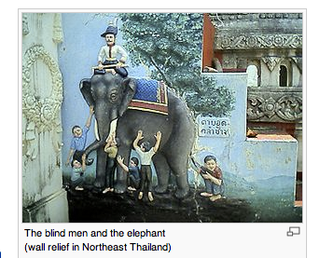
    One might wonder just how so many people can look at, the oil spill in the Gulf, unemployment in Michigan, health care, etc, and reach such different conclusions. The answer is in this hundreds year old fable of the six blind men and the elephant. Notably it appears in multiple religions and languages. 

    now, couple this point of view story with Dale Carnegie's observation that every person thinks he or she is the very center of the universe. Indeed, for thousands of years everyone assumed the sun revolved around the earth. Even when it was proved otherwise, the Catholic Church waited about four centuries to admit Copernicus was right. So, don't expect those that are convinced of their views that they should change them, even within your lifetime!


    Behold the Elephant
     

    Screen shot 2011-08-29 at 7.46.16 AM It was six men of Hindustan

    To learning much inclined,

    Who went to see the Elephant
(Though all of them were blind), 

    That each by observation

    Might satisfy his mind.

    John Godfrey Saxe, 1816-1887


    We re in a period of prolonged economic stagnation. This is the inevitable result of the 1982-2000 period of boom. This bear market will root out failed strategies and require new perspective if one is to survive it intact. Another feature of such a period is the idea of exclusion. Other ideas and indeed peoples will be excluded rather than included. Already there are calls to nationalize British Petroleum (a third world idea of expropriating assets of foreign company) and Israel is under fire even more than usual. To appreciate and endure what is happening, we return to the parable of the six blind men of India who attempt to describe an elephant.

    Saxe’s poem quoted above is the most famous Western version but there are Jain, Hindu,  Buddhist  and Muslim versions as well.   Here is the Jain (an Indian religion of the ninth century) version.

    The blind man who feels a leg says the elephant is like a pillar; the one who feels the tail says the elephant is like a rope; the one who feels the trunk says the elephant is like a tree branch; the one who feels the ear says the elephant is like a hand fan; the one who feels the belly says the elephant is like a wall; and the one who feels the tusk says the elephant is like a solid pipe.

    The point of the story of course is that everyone has a totally different perspective of the same facts. Working in groups of faculty, administration, and students has brought this home to me the last few years. Indeed, there are many elephants on the same campus.

    Now, to complete one’s understanding of what is happening, appreciate that the power of Point of View prevents each blind person (or the one sitting next to you in a meeting) from seeing the perspective of anyone else in the group. Dale Carnegie put his finger on this one, each person believes that he or she is the center of their own universe.  And so each argues that the ‘elephant’ is a tusk or a pillar but certainly not a rope.

    This difficulty takes many forms. Peace in the Middle East to Syria means an absence of Israel.  A ‘clean environment’ may mean some fantasy escape from the necessity of carbon based fuels. Access to health care may actually mean considerable re distribution of wealth.   Just his week Oliver Stone was extolling the virtue of Hugo Chavez to Larry King; a Congressman expressed amazement at this view.

    The ultimate negative social disagreement is war. With the Dow at 10,000, North Korea has already sunk a South Korean vessel resulting in loss of life.  Israel may well attack Iran.  If my assumptions come true, that the Dow will revisit its March 2009 lows in the next two years, expect that opinions and actions will harden that much further.

    Saxe sums all this up as follows, and remember this observation has floated around for hundreds of years, nothing is going to change human nature.

    Moral:

    So oft in theologic wars,

    The disputants, I ween,

    Rail on in utter ignorance

    Of what each other mean,

    And prate about an Elephant

    Not one of them has seen! 


  • Professor Elam

    Monday Jan 12 2015

    Dow Jones is seeking creative, ambitious students to become part of the Wall Street Journal’s elite group of student ambassadors. Selected students will work with the WSJ College team to develop a marketing strategy specific for their campus. The ambassador program lasts one month in which you will have the opportunity to voice and implement your ideas for the future of news media marketing on your campus.


    If you know any student that would like to be a WSJ Campus Ambassador please have them send their resume to me at Lindsay.Bodin@dowjones.com


    JOB DESCRIPTION:


    Responsibilities:

    • Develop      campus specific marketing strategy 
    • Identify      effective methods to reach students and professors
    • Communicate      with campus representative on project and research statuses

    Qualifications:

    • Currently      enrolled college student
    • Strong      understanding of campus student body
    • Social media      savvy
    • Forward      thinking of businesses in the digital age
    • Enthusiasm      to work for a trusted news source

    Benefits:

    • Subscription      to WSJ
    • Recommendation      letter, if successful
    • Excellent      experience working with a trusted news source 
    • This is      a paid position 
  • Professor Elam

    Thursday Jan 7 2015

    Cyber security and internal control will be lead issues with the SEC this year.

    I expect a sectino on cyber security will become mandatory in annual reports.