• Professor Elam

    Monday Oct 13 2014

    The IMF suggests that easy money Central Bank policies led to the last crisis and here we are again.

    Consider this quote.

    What we see is extraordinary risk-taking in the financial markets while in the real economy risk-taking has taken a holiday,” said Claudio Borio, a senior economist at the Bank for International Settlements, a clearinghouse for global central banks.

    Mr. Borio is of course exactly correct. Hedge funds are now leveraged eight to one at the top of the stock market frenzy. Yet employers are reluctant to hire. There is an op ed in the WSJ today suggesting too much regulation has too much regulation has choked off job creation..

    At the Fed Chicago Trading Desk, Overnight Ramp Capital stock futures surged 20  points on no volume Sunday night. Gee would the Government let the markets crash before an election?


  • Professor Elam

    Monday Oct 13 2014

    Mark Cuban, rich guy who naturally thinks he is expert on evrothing, correctly identifies a big Pro blem.

    The big problem is the $1+ Tillion Debt. So far so good. This is keeping students hourseoving out of the parents'  house, starting families, etc.

    Bt his solution is all wrong. Mark suggests limiting the debt you can assume to $10,000 per year.

    I don't think so Mark because

    • This does nothing to address the existing problem.
    • This does not link accomplishment or course completion to the loan.
    • This does not give college administrators much incentive to economize, which is the REAL problem.

    The amount of money available for loans should start shrinking year by year. This would put colleges on notice that their product is not ;lsubject to unlimited demand, totally elastic if you will.

    And frankly I would limit loans by major. It is ridiculous to let someone in marginal job opportunity majors like fine arts to pile up tens of thousands of dollars. Come to think of it, there should be a ceiling on how much one can boorw by major, the better the chances of getting the job we might lend you a bit more money.

    But as long as the govt is in the game, the gaming of the system by colleges will continue.


  • Professor Elam

    Monday Oct 13 2014

    Bloomberg reports the Russian Ruble is falling with oil prices. Half of all Russia's revenue comes from oil. Oil just dropped 20%. Bingo Russian revenue just dropped 10%. 

    And the dollar is moving up which makes things just that much worse for the ruble. 

    Putin has shunned any pretext of a consumer economy in Russia. That would give manufacturers real power. It is much easier to control a commodity based economy centered on oil. 

    If you read my newspaper coumn or columns, you know I am fairly confident all of this will resutl in lower prices. Marginal economies like Russia nd Nigerai have no other sources of income. My guess is that they will expand output in to a lower price environment to keep cash flow constant. It won't be constant but that won't stop them from trying. 

    And so the price of oil is iikely to fall further. 

  • Professor Elam

    Weekend Oct 12 2014

    It is said that the industry of hte Caribbean is smuggling. The only thing that changes is the cargo from century to century. Once it was molasses for distilling rum, lately it has been various drugs. 

    Jamaica has drafted legislation to decriminalize marijuana, perhaps by year's end. The country's justice minister also expects his nation to decriminalize marijuana for religious purposes; Rastafarians smoke the "holy herb" as a ritual. Jamaica is also considering medical marijuana use, which would require changes to Jamaica's Dangerous Drugs Act. Still another legislative proposal seeks to clear minor marijuana convictions from the record of Jamaican citizens.

    This article from the Socionomics site indicates the shift in opinion on legalization. I have long thought that the public would have tired of the bloodshed by now and like Prohibition, demanded an end to it. Now tha tColorado has legalized some use, no doubt tourist destinations see this, like casino gambling, as an inducement to travel there. 


  • Professor Elam

    Weeekend Oct 12 2014

    I have written a weeklynewspaper column for the Odessa American and the Andrews County News for many years. Here is the latest. I am posibly the only analyst in the state to have correctly predicted the simultaneous collapse of both oil and stock prices. If you have not been reading my companion investment column this wold be a good time to start. The markets are exhibiting the beginning of extreme social mood. 

    http://www.themarketperspective.com

    A Social Mood Shift for The  Fall

    Wednesday and Thursday marked the biggest one day rally and worst one day drop for the Dow Jones Industrial average (^DJI) for all of 2014. That’s the first time those extremes have been hit on back to back days in nearly 17 years.

    Jeff Macke, Yahoo Finance

    Taken together, oil and stock prices are more likely to fall in tandem than for falling oil prices to stimulate stock prices. That is my minority view for what it is worth. This December will mark the 40th year anniversary of the low in the Dow Industrials at 577. I suggest this might be a good time to be watching stock and oil prices, from the sidelines.

    Dennis Elam in One on One, Sept 9, 2014

    You can’t say I didn’t warn you….

    This past week has seen volatility in stock prices reaching multi-year extremes. Moves, which used to take three days, now occur in one day. No doubt high frequency trading is the root of some of the up 250 Dow points up one day and then down the next.  But October has a deserved reputation as a crash month.  The meltdowns of 1929, 1987, and 9/11 all occurred in October. So here we are again.

    Today we address the real question, what happened?  Oil prices were triple digit just weeks ago. Stock prices were on a tear amid cries of a new bull market from even long term observers. Now oil prices are down $20 and headlines report energy stocks are being crushed. The change is not so much in the market fundamentals but in the social mood of investors. Social Mood finally caught up with the reality of sky-high markets.  Let’s examine this phenomenon.

    Social mood motivates social actions. Conventional wisdom has it that individuals are acted upon by the news, and then make decisions. But social mood is unconscious and internally regulated. For example, the price of oil in the spring of 2013 was $87.50. By August it hit $112.50. That is an amazing 28% increase. Did world demand increase 28% or did the supply fall by 28% in those few months?  No, but the social mood of the participants certainly expanded that much. If I have learned anything writing these columns, it is that the price of oil has little relation to supply and demand.

    Last week I remarked on attending a conference on the Eagle Ford Shale play. I noted no one discussed the falling price of oil. Another large conference is slated for next month in Midland on the Permian Basin play.  Regardless of a string of correct predictions in this space, my telephone is not ringing with an invitation to speak. The reason is that my views do not fit the social mood of the organizers.

    The S & P 500 soared from 1920 to 2020 in less than two months since August. Then, like Wiley Coyote chasing the Roadrunner over the cliff, social mood went in reverse. The S & P index is now testing the exact it low it up in during August. But by the headlines one might think it was Black Tuesday in 1929.  The explanation is that social mood moves in fractals. The mood can be massive compared to the actual price change.

    Finally headlines are reflecting my long-standing skepticism over the durability of triple digit oil prices. One analysts reports that ‘if ‘prices drop another5 $4 or $5, companies will be forced to trim their capital budgets.’ (Emphasis added) I find the prediction of Robert Baird and Company intriguing  that ‘prices could drop to $53 in certain parts of the Permian and Eagle Ford and still be profitable to drill. ‘

    To which a student of social mood can only reply, fat chance of that. Rather the more reliable prediction is that at some point on the way down, the social mood switch will be thrown from wild optimism to just plain fear. Capital budgets will not be trimmed; they will be slashed.  No one really knows the minimum price at which frocking enjoys price support. But I will bet few to no industry players will hang around to find out just where that break-even point may be.

    And why is that?  Finally, social mood arises when humans interact socially. The process appears to be related to the herding impulse. It is all so typical that joyous celebrations, billed as conferences, on the Permian and Eagle Ford would be planned just two months apart. And it is just as likely they would be planned at the very pinnacle of positive social mood on the topic, After all extreme expression of social mood tends to occur near the end of a trend, not at the beginning.

    Learn more about social mood and its outcomes at http://www.themarketperspective.com.

    Dennis Elam is an Associate Professor at Tx A & M SanAntonio.
     

  • Professor Elam

    Thursday October 9 2014

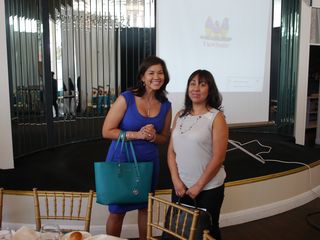
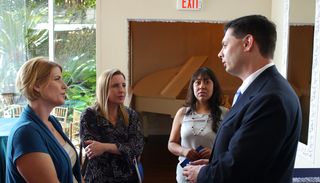
    TAMUSA accounting students Denise Trejo, Jesika Mota, Mandy Student, Jenifer Angell, and Justin Mire attended the monthly San Antonio Institute of Internal Auditors meeting Wednesday.  The  Director of the American Center for GTovernment Auditing is Jim Pelletier. the Center is part of IIA.      This proved to be an extraoridnary P1040172opportunity for our students to visit with someone who works at the national levell of IIA. 

    IIA now offers six certifications.  He had been the Chief Internal Auditor for the City of Palo Alto and later San Diego. His program freatured the resources available to IIA members. He noted that it was difficult to obtain out of state travel money for government auditors. As IIA is located near Orlando FL, seen as a 'tourist destination' with Disneyland there, many of the programs are available by webinar. 

    P1040181I urge students to 'fan out' at these events so we all get to visit with differnet groups at the meeting. Denise Trejo and   Jesika Mota   did just that and compared notes afterwards. 

  • Professor Elam

    Thursday Oct 9 2014

    Check out Bowlmor's Cupertino Alley.  THis is not Archie Bunker's bowling alley. 

    Here is an interesting article on how Bowlmor wtih a 20% market share of the bowling market puts a different spin on this business. Cocktails and canapes are featrued rather than leagues and hot dogs. And it appears that going for corporate outings are a big part of the business. .

    Bowling has fought, as Tom Shannon observes, a 1950s blue collar image. Actually it is amazing that golf became as big as it has. Golf is now waning, no wonder. It is an incredibly dificult game, expensive, and time consuming, and int Texas, it is hot. 

    Bowling on the other hand is indoors out of the weather Like pool, it is a game of precision. 

    Waht caught my eye was that Shannon bought is first alley for $1.4 million twenty years ago. Today he owns 340 locations. Bowlmor generates $575 M in annual revenue.  This is another good example of managerial accounting at work. How do you make an otherwise out of favor past time in favor?

    Considering this is in the 'small business' section of the paper I would say, not bad. An interesting read on changing a downsized sport. 

    Final question, just what is a 'certified bowling alley?'  There are  4,666 in the US.


  • Professor Elam

    Tuesday Oct 7 2014

    I have had at least three students today by e mail after class or in the office obsessing with their grade. 

    Well yes there is something to grades but we are only six weeks in here. 

    You do not want Cs on your transcript. I never realized the impact of that unti my 'advisor'  in college,actually one of my finance professors, was examing my transcript. He looked over the top of the folder and casually said

    You have nevermade a C, in any class, have you. 

    I had not thought of it that way and replied well no.

    Today I realize I was probably the only student he had ever sat with who could make that claim, mind you this was at th height of the Viet Nam war, grade inflation had not happened, you could and many did, literally flunk out of college. 

    At any rate, here is what you should be focusing on. 

    I returned to college after completing my MBA and working for two years. Then I spent yet another semester studying for the CPA exam.  But, a short term sacrifice paid lng term dividends.

    I began studying January 1975. By February 1976 I hd my answer, I had passed all four parts of the CPA exam on my first attempt, virutally unheard of at that time, about 3-5% of candidates did that well. 

    So, if you can walk into the interview, and announce that you have already passed the appropriate certification for the job, all you need is the experience, 

    trust me, they won't worry about your grade. 

    Bottom line, focus on learning,coetence, big picture, read for context, 

    right now can you lead a discussion on

    new COSO requirements

    New revenue recognition requirements

    whether RSH will avoid bankruptcy, or SHLD for at matter

    what do you think of the audit partner sign off suggestion

    how will dollar strength affect multi-natonal companies

    the ability to do this would set you apart from other candidates

    and that is the purpose of this blog

    to set you apart from all the other graduates in town


  • Professor Elam

    Tuesday Oct 7, 2014

    We will soon have HEB night here at TAMUSA. And there will be several managers from HEB on campus.

    Several students have attended SA IIA meetings and or the SA CPA Career Night.

    What to say on those occasions. Mark Goldman a professional accounting recruiter, has some suggestions.

    As always, just talk about the other person, it will be his or her favorite subject.

    Ask open ended questions, never a yes or no question.

    Ask, how did you become a cpa, or internal auditor, or whatever?

    Rather than, what is the minimum gpa you look for?

    See our post, Working the Room a Primer

  • Professor Elam

    Tuesday Oct 7 2014

    If you have still not subscribed, here is the link

    www.subscribe.wsj.com/professor (or) www.wsj.com/impress