• Professor Elam

    Wednesday March 26 2014

    Community colleges only address proprietorships in their accounting classes. As a result the corporate form of the balance sheet is new to students. We are at a unique point in stock market history. Several of the indexes are at all time highs. This is the polar opposite, in terms of valuation and social mood, from where we were in March 2009. But I am getting ahead of myself.

    Over the next few days, I am going to introduce some basic concepts of equity to you. Then we will examine different companies to show you how the market values the company, and just how wildly different such valuations can be.

    Okay we start with the basic equation

    Assets = LIabilities + Equity

    or re formulated

    A – L = OE

    In this case Owner Equity, OE, would bebook value. Recall that once stock is sold to the public, the equity section reflects that original price for the stock. It is NOT adjusted to reflect market prices.  It will only change if the company buys or sells more of its own stock.

    Recall that common stock with par value gets credited for par value. Any amount paid in excess of this is paid in capital, example

    We sell one share of commmon $1 Par for $10.

    Cash           $10

        Common Stock            $1

        Paid In Capital            $9

    There are several ratios presented in your textbook to reflect the valuations of the copany once the stock begins trading.

    Price Earnings Ratio = Price of one common share/Earnings Per Share

    Simply put, how many dollars is the public willing to pay for one dollar of this company's earnings. THis can vary wildly. Slow growth companies with stable earnings will sport a low p/e. Not surprisingly, in fits of irrational exhuberance, a company can  have a sky high p/e, a high stock price with little earnings or no p/e as the stock has no earnings. This occured with the dot.com bubble of 1999. Hundreds of stocks went public claiming they would make a bundle selling on the internet. It tuned out this was little more than the original Sears Catalog brought up to date with an electronic scree. But even at that, most folks elected to buy a washing machine locally, bye bye applicances.com.


    Earnings Per Share = Earnings Available to Common/Avg Weighted # of Shares outstanding

    Market Capitalization = # shares outstanding x Price per share, this literally reflects the total market value of the stock

    Now let's look at some examples. Since Warren Buffet is pretty much  a household name these days, let's start with his Company, Berkshire Hathaway or BRK. Oh, stocks trade by symbol Stocks on the New York or American Exchange have no more than three letters in a symbol. Stocks on the NASD have four letters, like Microsoft or MSFT or Apple APPL.
    Screenshot 2014-03-26 12.19.04

    This information is available for all public companies at finance.yahoo.com. I wil be using this for our root information.

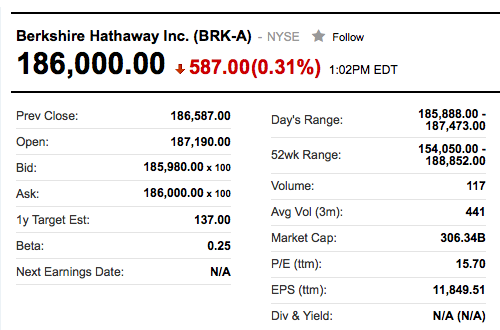
    We can learn a lot here. Finance.yahoo has sumarized a lot of information for us. Notice that the market cap is $306.4 billion. You could determine the number of shares outstanding by dividng the market cap by the price per share. Why?

    Because, see above, market cap equals price times number of shares so

    $306,400,000,000 / $186,000 = 1,647,312 shares outstanding

    Now most stocks trade for less than $100. If theprice gets to $100, companies will split the stock, meaning you might now have four times as many shares at one fourth the price, say now you own 400 shares at $25 instead of 100 shares at $100.

    Okay why would Warren want the stock priced so high?  The price earnings is fairly modest at 15.7. But notice that the stock only traded 117 shares yesterday and averages a paltry 441 shares a day over the last three months. The answer is that Warren does not want people speculating in BRK, he wants long term shareholders. Also notice he pays no dividend. The profit comes in long term growth.

    Remember Warren likes traditional companies that as he says, have a large moat around them. That means other companies would be hard pressed to generate the same business model or capture the same audience. He also tends to buy the entire company resulting in a consolidation, he literally owns the income as with his railroad or Dairy Queen. By the way, how is Dairy Queen different from say McDonald's?  My experience is that DQ is mostly in small towns where there is no large chain competition, they have all the burger business. He likes boring companies that throw off lots of cash.

    By the way, if you have never read a Letter to the Shareholder by Warren,  this would be a good time to start. Yes you should at least read the latest letter for 2013.

    750 words is a typical newspaper column. So it is probably time to start another post. But grant me a bit more space here, let's look at the opposite end of the spectrum, yep, Facebook or FB.

    By the say, have you thought about why FB is so popular. The answer is found via Dale Carnegie's How to Win Friends and Influence People. FB allows everyone to have their ow personal magazine, think O for Oprah. Who is on the cover of O every month, think hard now.

    Yep, O is Oprah's ideal image of herself. And FB allows every person to do the same Screenshot 2014-03-26 12.42.37thing, Think Daffy Duck, it's all about me me me.



    Okay let's take a look at FB.
    Screenshot 2014-03-26 12.43.19

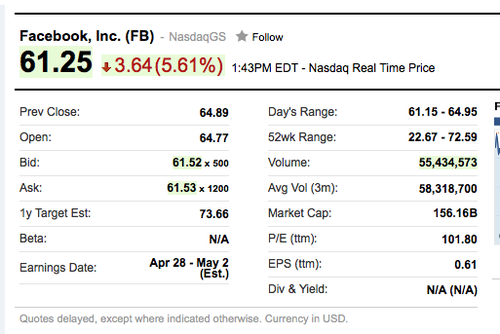
    FB sports a p/e of 101.8 or 6.7 x BRK. Hmm, are investors 6.7 times more confident in Zuckerburg than in Buffet, apparently so. Interestingly the market cap is at 156 ia bout half what BRK is valued. So FB must be making lots of money, right?

    Uh wrong, E/S is 61 cents. No that is not a misprint. Rounded BRK is making

    $11,850. per share, again not a misprint.

    What is going on here? Well, the p/e is an expectation ratio. Expectations for FB are remarkably high. And FB is on a buying spree.


  • Professor Elam

    Wednesday March 26 2014

    Here is a Journal of Accountancy article on internal audit.  I am a member of SA Institute of Internal Auditors. Several students have accompanied me to their monthly meetings. I continue to recommend that our non traditional students consider internal audit as a career. 

    The article makes the point that increased regulation has organizations focused on their risks, and how to abate that risk. That is an internal audit function. 

  • Professor Elam

    Tuesday March 25, 2014

    I have previously mentioned the down to earth helpful advice as well as the practical exam available through the American Insitute of Professional  Book Keepers. Here is a sample. This is precisely the sort of question a practicing tax preparer, at any level, gets from a client. Knowing the corrrect answer is what makes one a professional.

    I am on record suggesting a ladder of certifications. Start wtih Professional Book Keeper, and you might learn smomething along the way.


    Making sure that   business dinner,

    night out or ball   game is deductible

    Our goal as your national   association is to raise bookkeepers’ professional status. We do this by   offering self-study   courses (ebooks or hard copy)   in bookkeeping, accounting and tax—and by keeping you current in our member   newsletter, The General_Ledger.

    Here’s an   example from a recent issue:


    AO Corp   was a medical practice with a single   shareholder/professional employee. AO paid to send the   shareholder/employee on hunting trips,   because he was developing medical devices to make the ear less susceptible to damage from loud noises such   as gunfire and needed to test the devices. The expenses generally involved renting hunting lodges and camps or paying expenses for a hunting trip. The   IRS denied the deductions, claiming   that the payments were constructive dividends to the shareholder.

    Held: For the IRS.   Expenses for entertainment facilities   are subject to special rules. An   entertainment facility is any item   of personal or real property owned, rented or used by a taxpayer for or in connection with entertainment, including lodges, camps and ranches. No expenses   for these facilities are deductible. So the taxpayer was denied all   deductions for renting the lodges and camps.

    However,   expenses for entertainment activities that do not involve renting a lodge or   camp could be deducted   under the strict rules of §274, Disallowance of certain entertainment, etc., expenses. Such expenses must be directly related to active   conduct of the trade or business. They must   meet each of four requirements:

    1.   The taxpayer must have had more than a general expectation of   deriving some income or other business   benefit at an indefinite future time;


    1.   During the entertainment period, the taxpayer must have   engaged in a bona fide business transaction other than entertainment   for the purpose of obtaining such business benefit;


    1.   The   principal character of the combined business and entertainment was the active conduct of the taxpayer’s trade or   business; and


    1.   The expenditure was allocable to the taxpayer and a person or persons with whom the   taxpayer engaged in the active conduct of   trade or business during the   entertainment.


    The court   said the trips did not meet requirement #3. The equipment could have been   more easily tested at a lower cost at outdoor shooting ranges. Also, the   amount of time spent on each trip researching the devices tended to show that the trips’ primary purpose was   personal pleasure, not business.   When a corporation distributes money   or property to a shareholder or incurs expenses for the benefit of a shareholder, the amounts are   treated as dividends to the shareholder if they primarily were for the benefit of the shareholder. In this case, the   expenses primarily were for the   personal benefit of the shareholder, so they were treated as   nondeductible dividends. [Austin Otology Associates v. Commissioner,   T.C. Memo. 2013-293]


    Why risk   falling behind?


     Try a   no-risk membership and see what it can do for you. If not completely   satisfied, cancel for a refund. Join now and   get: 


    •      The   General Ledger   newsletter every month.


    •   Free use of our member   telephone AnswerLine, where experienced accountants answer your everyday   bookkeeping and payroll questions.


    • Discounts on convenient continuing   education for bookkeepers, and other professional discounts.


    Join now and you also get 3 special   reports, free:


    Free   Report #1: “21   Key Bookkeeping Changes in Current Tax Laws.” Discover:


    • Change #7: When the same worker can be both employee and   independent contractor.
    • Change #11: IRS coming after your ICs: what   to do.
    • Change #14: How workers who quit can   qualify for UI benefits.
    • Change #18: New regs on 50% v. 100% T&E   deductions.


    Plus: 17 other key   changes you should know about.


    Free Report #2: “Better   Bookkeeping in 15 Minutes: The 25 Best Bookkeeping Tips of 2013.” Find out how to:


    • Post returned checks.
    • Withhold from car allowances.
    • Know when to take, or refuse, a prompt-payment   discount.
    • Record checks made out to cash.
    • Prove expenses if canceled checks are lost.
    • Correct W-2 errors the easy way.
    • Prepare internal income statements.
    • Set up successful collection calls.


    Plus:   A special section on what is (and is not) overtime pay, and how to compute   it.


    Free Report #3:   “The Bookkeeper’s Guide to Internal Controls.” Protect your company or   client. And, make sure you are not held personally liable. Includes:


    • How to protect yourself if you sign company checks.
    • Self-protection if you withhold taxes on paychecks.
    • How to make sure you are not liable for company loans   or notes.
    • Steps you can take to avoid inadvertent disclosure.
    • And more.


    Offer your company or clients protection,   including:

    • 9 ways to prevent bad-check losses.
    • 5 ways to protect company bank accounts and other   cash.
    • 12 policies that prevent fraud.
    • 15 signs that employees are stealing.
    • And more.


    Enjoy member   benefits, such as:

    •   Free use of our telephone Member AnswerLine, where experienced   accountants answer your everyday bookkeeping and payroll questions


    •   Discounts of up to 34% on UPS.


    •   Discounts on continuing professional education.


    •   Discounts on professional liability insurance.


    Get the recognition you deserve, and stay up to date.   Join 30,000 bookkeepers as a member of The American Institute of Professional   Bookkeepers.  Join now.


  • Professor Elam

    Tuesday March 25, 2014

    For the last two years I started a Who's the Worst thread on my blog in advance of the Spring Ethics class. We have noted that some characters revive their status. Eliot ?Spitzer got a gig on CNNa nd then failed to be elected NY Comptroller. Nick Lessonwho took down Barings Bank has re surfaced as a speaker and consultant. Barry Minkow after claiming he had reformed is back in jail for atempting to manipulate stocks. 

    Now Anthony Weiner aka Carlos Danger is getting a column at Business Insider. After having to resingn from Congress and then losing the NY Mayoral Race all over revealing photos on the net, he has landed a media gig of sorts. Remember the CEO of BI is 

    The site editors vary greatly in background. Henry Blodget, a Yale graduate who previously worked on Wall Street, then was fined $2,000,000 as part of a civil suit for fraud, and another $2,000,000 in disgorgement, and being censured and barred from the securities industry by the Securities and Exchange Commission,[10] is the CEO and Editor-In-Chief.

    So maybe as they say it takes one to know one. 

    Or as the article says, what could go wrong?

    Would you have Anthony as your columnist?

  • Professor Elam

    Monday March 24 2014

    Porsche records a $23,00 an average profit for each car it sells. That c omes ot an average 18% per vehicle. Porsche is famous for addin gon expensive gotta have it accessories like expensive wheels, navigation systems, and variou sperformance enhancing options.

    The way to make money in the  car business is to make multiple vehicles off the same platrform. The 100 K Cayenne shares a  platform with a VW SUV.

  • Professor Elam

    Monday March 24, 2014

    If you are invited to speak at TED, you have arrived. This is an annual high tech confab of who is who. 

    Carminhe Gallo examined 500 TED talks and came up with these three recommendations.

    1. Don't bore people with facts and figures, tell a story. Everyone from Bill Cosby to Jesus Chrits used this idea to their advantage. People remember stories. This was the foundation that launched Cosby's career. He told stories about hea nd his Brother, he and the neighborhood kids like Fat Albert, and everyone identified with the stories. With the movie Noah on tap, one of his first was Noah talking to God. 

    2. Create Emotionally Charged Events. Frankly I don't think I would let mosquitoes go on stage but the idea has merit. Use a demonstration to illustrate your point. In high school, regarding a topic on nuclear weapons proliferation, one debater painted the earth on an empty egg shell. At his conclusion warning of imminent danger he held it aloft and crushed it, demonstrating the danger of nuclear weapons proliferation. 

    3. Use the rule of three, people remember three not two or four. 

  • Professor Elam

    Weekend March 21 2014

    I ran across another designation today, this is new to me. It is CTP for Certified Treasury Professional.

    The link describes the exam but let me make a point about that. One has 3.5 hours which is

    3.25 x 60 = 210 minutes to answer 170 questions or 210/170 = 1.24 minutes per question. 

    How's that for speed and concentration spread across 3.5 hours. 

    I keep telling classes the difficulty is something they have not really experienced, a short time fuse on each and every question. 

    Here is another example. 

  • Professor Elam

    Wednesday March 19, 2014

    Here are the 30 Management Principles of the Marines.

    THe first, the 70% solution, means we never have all the intell we need. But wait for 80% and you will be the defender, not the attacker. 

  • Professor Elam

    Tuesday March 18, 2014

    This past year the San Antonio Council of Petroleumn Accountants awarded five  $1,000 scholarships.

    I urged our students to apply this past sumer. The result was that TAMUSA students were awarded two of the five. Amazingly at the awards ceremony we were the only ones You definitely do need to have a desire to be in the oil and gas business.

    My best advice on scholarships is this. Ifyou co not apply, you definitely positively absolutely will not win. Period.

    See me with any further questions.


  • Professor Elam

    Tuesday March 18, 2014

    Please share the following information the accounting faculty and students.  Currently, the odds of being awarded one of the five scholarships are very high.  I thank you in advance for your assistance, and I look forward to awarding these scholarships at the San Antonio CPA Society's Accounting Excellence Awards/Meet the Firms luncheon on Wednesday, April 23, 2014. 


    The deadline to submit the application for the 2014-2015 San Antonio CPA Education Foundation Scholarship is March 31, 2014.  The Foundation will be awarding up to five scholarships for the 2014-2015 academic year.  The link for the application and qualification requirements are found at http://www.sacpasociety.com/students (“Apply soon for 2014-15 SACPAS scholarship”).  Please contact info@saCPAsociety.com  or Amanda Talaat at (210) 828-2722 if you require more information.


    Kind regards,


    Maria A. Martinez, CPA, CGMA

    & Bethany Eggleston, CPA

    Education & Accounting Careers Committee

    San Antonio CPA Society

    901 NE Loop 410, Ste. 420

    San Antonio, TX  78209