• Professor Elam

    Wednesday January  15, 2014.


    I originally posted this last November 15 2013.  Today at the SA internal Auditor Meeting Adam Avalos asked if anyone was interested. This suggeststhere are still opennings. 

    As always I cannot offer an assessment of your getting picked. I can however assure you that ifyou do not apply, your chances are zero.

    CST is the spin off of Valero's convenience store operations. I got a notice of a nice

    internship opportunity at CST from the President of SA IIA.  Check out the requirements, if you qualify this would be a great oppoprtunity to intern at one of San Antonio's premier companies.

  • Professor Elam

    Wed January 15, 2014

    I have mentioned the Certified Book Keeper Exam. The American Insitute of Professional Book Keepers puts out helpful newsletters on a variety of subject. In Acct 3311 we study Current Assets, specifically Accounts Receivable. I just received these tips on evaluating receivables and wanted to share them with you. Note I included the link to subscribe to the newsletter.


    .

    Are some of your firm’s customers about to   become bad debt? If so, which ones?


    Here are red flags that signal no-pays in   time for you to discontinued shipping or performing services, provided to our   members by Attorney Donald B. Kramer, J.D., President, Kramer & Frank,   P.C., St. Louis, MO:


    Customer orders:

    •   Does the order form show a new company name?
    •   Is the customer suddenly asking for extended terms?
    •   Is the order size materially different from prior ones?
    •   Is a different person signing the order form?


    Customer payments:

    •   Is the customer paying later than it did before?
    •   Did a check not clear the first time it was deposited?
    •   Is the current check drawn on a different bank?
    •   Does a check show a change in company name?
    •   Is a different person signing the checks?


    Customer contact procedures that have   changed:

    •   Are your phone calls returned?
    •   Are your letters answered?
    •   Are excuses for nonpayment flimsy?


    Actions filed against customers (watch   public records):

    •   Are UCC filings being made on your customer (i.e., is   someone going after the customer’s personal property for unpaid debt)?
    •   Is a customer on a list of newly filed lawsuits or tax   liens?
    •   Are suits being filed against your customer for unpaid   bills?


    Miscellaneous:

    •   Is your customer dependent on a major company or   industry experiencing financial problems or scandals?
    •   If your customer is on the stock exchange, has its   stock recently dropped materially in   value?
    •   Does a new product/service endanger a customer’s   business?


    Why risk   falling behind?


    Try a   no-risk membership and see what it can do for you. If not completely   satisfied, cancel for a refund. Join now and   get: 


    •      The   General Ledger   newsletter every month.


    •   Free use of our member   telephone AnswerLine, where experienced accountants answer your everyday   bookkeeping and payroll questions.


    • Discounts on convenient continuing   education for bookkeepers, and other professional discounts.


    Join now and you also get 3 special   reports, free:


    Free   Report #1: “21   Key Bookkeeping Changes in Current Tax Laws.” Discover:


    • Change #7: How to prepare for the new credit-card sales   audits.
    • Change #11: IRS coming after your ICs: what   to do.
    • Change #14: How workers who quit can   qualify for UI benefits.
    • Change #18: New regs on 50% v. 100% T&E   deductions.


    Plus: 17 other key   changes you should know about.


    Free Report #2: “Better   Bookkeeping in 15 Minutes: The 25 Best Bookkeeping Tips of 2013.” Find out how to:


    • Post returned checks.
    • Withhold from car allowances.
    • Know when to take, or refuse, a prompt-payment   discount.
    • Record checks made out to cash.
    • Prove expenses if canceled checks are lost.
    • Correct W-2 errors the easy way.
    • Prepare internal income statements.
    • Set up successful collection calls.


    Plus:   A special section on what is (and is not) overtime pay, and how to compute   it.


    Free Report #3:   “The Bookkeeper’s Guide to Internal Controls.” Protect your company or   client. And, make sure you are not held personally liable. Includes:


    • How to protect yourself if you sign company checks.
    • Self-protection if you withhold taxes on paychecks.
    • How to make sure you are not liable for company loans   or notes.
    • Steps you can take to avoid inadvertent disclosure.
    • And more.


    Offer your company or clients protection,   including:

    • 9 ways to prevent bad-check losses.
    • 5 ways to protect company bank accounts and other   cash.
    • 12 policies that prevent fraud.
    • 15 signs that employees are stealing.
    • And more.


    Enjoy   member benefits, such as:

    •   Free use of our telephone Member AnswerLine, where experienced   accountants answer your everyday bookkeeping and payroll questions


    •   Discounts of up to 34% on UPS.


    •   Discounts on continuing professional education.


    •   Discounts on professional liability insurance.


    Get the recognition you deserve, and stay up to date.   Join 30,000 bookkeepers as a member of The American Institute of Professional   Bookkeepers.  Join now.


    BOOKKEEPING   TIPS is a weekly e-letter published by The American Institute of   Professional Bookkeepers (AIPB), Suite 500, 6001 Montrose Road,   Rockville, MD 20852.

    Tel.:   800 622-0121, Fax: 800-541-0066, e-mail: info@aipb.org.


    This publication is designed to provide   accurate and authoritative information in regard to the subject matter   covered, with the understanding that the publisher is not engaged in   rendering legal, accounting or other professional services. If legal advice or   other expert assistance is required, the services of a competent professional   should be sought. – From a Declaration of Principles jointly adopted by a   Committee of the American Bar Assn. and a Committee of Publishers.


    To unsubscribe: Send a blank e-mail to bookkeepingtips-off@aipb.org.   If you continue to receive the e-letter, you probably have more than one   e-mail address and subscribed under the old one or both and need to   unsubscribe from each account. This works 99.99% of the time. If it does not,   please call us at 800-622-0121 and we will unsubscribe you.


  • Professor Elam

    Wednesday January 15 2014

    Several of you reported being unable to access Connect. Apparently the end course dates had to be re set. I have done this. It should be working now. 

    But Connect shold be writen in such a way that the instructor cannot post a course that will not work due to the wrong end date, sigh. 


    Is electronic homework really any better than if the answers were posted to every other problem  and you turn in the solutions ?  I seriously doubt it especially given all the time I spend trying to get connect to work. 

  • Professor Elam

    Tuesday January 14 2014

    On page B6 of today's WSJ, we learn that external auditors are digging deeper. The PCAOB last October isssued Audit Practice Alert #11.

    the PCAOB ntoed that in nearly one of 3 audits if found less than sufficient evidence to defend the internal control function.

    The result is that external auditors are asking for more documents and sitting in on meetings at the firm to learn more about day to day workings of the internal controls.

    A couple of posts back the President of the IIA noted the difference in East and West auditing. In the East, Asian auditors are more likely to be on the spot. Here is a good example of just that. 'This is also an example of how reading the WSJ keeps one in touch with what is happening in accounting.

  • Professor Elam

    Monday Jan 13 2013

    Welcome back TAMUS-SA Faculty!
     
      Beginning this semester ITS/Academic Technologies is now offering an
      Online Blackboard Student Orientation Course!


    What will your students learn?

    Some of the learning objectives include:

    •   Navigate the   Blackboard Learn interface and course environment
    •   Identify the   basic skills needed to successfully learn online
    •   Establish a   personal profile
    •   Schedule tasks   and calendar events
    •   Communicate   with others online in real-time and on your own time
    •   Collaborate   with others by sharing your thoughts through journaling, blogging, and   building a wiki
    •   Exchange   digital files such as word processing documents with peers or instructors
    •   Complete online   tests and surveys
    •   Monitor your   progress using the Grade Center


    To see a full lesson by lesson description, please   click the course organizer link
      (http://www.tamusa.tamus.edu/uploadFile/folders/sherita.love/Pdf/Pdf-635252201921279721-10.100.150.124.pdf).

    How long will it take?

    Students can go at their own pace. The course should   take a few hours to complete. 

    How will students be assessed and given credit?

    At the end of the training, students will be asked   to take a short 20 question assessment.  Upon achieving a score of 80%   or better, the students will be given the option to print a personalized   certificate for their records and to turn into you if desired.

    How can your Students participate?

    To register your students, please send an email to   the ITS helpdesk at Helpdesk@tamusa.tamus.edu   , or contact any member of the Academic Technologies Staff. 


    Please be   sure to include in the email/request your name and the full course ID and   title (e.g. EDED 3409_098_201426). 

    Once your request has been processed, we will enroll   the students in the Blackboard course for you, and send you a confirmation   when it has been completed.  Students will access the course similarly   to the way they access any course in Blackboard.


    We recommended that students take this course as   early in the semester as possible so that they can apply what they have   learned in your courses.


  • Professor Elam

    Monday January 13 2014


    We are glad to receive reports from Resources Global Professionals. Here is their latest on Private Company Reporting


    Dennis Elam


    ____________________


    The Financial Accounting Standards Board (FASB), in conjunction with the Private Company Council (PCC), recently finalized the Private Company Decision-Making Framework: A Guide for Evaluating Financial Accounting and Reporting for Private Companies (the Guide). In addition, the FASB also issued ASU 2013-12, Definition of Public Business Entity: An Addition to the Master Glossary.


    Private Company Decision-Making Framework (the Guide)


    The PCC was established in May 2012 by the Financial Accounting Foundation (FAF), which is the FASB's parent organization, with the mission of improving accounting standards for private companies applying U.S. GAAP. To facilitate their examination of U.S. GAAP and identify areas where standards should be modified to better address the needs of private company financial statement users, a framework was created to guide their discussion. The framework was exposed for public comment in 2012 and recently finalized. The Guide is intended to help the FASB and PCC determine whether and to what extent U.S. GAAP should be modified as to implementation timing, method, or other requirements for non-governmental private companies, with the goal of reducing complexity and cost for these companies while meeting the different informational needs of their financial statement users. Obviously, one of the critical decisions with regard to the Guide is to whom any separate guidance issued applies, which is the subject of the next topic "Definition of a Public Business Entity".


    Definition of a Public Business Entity


    The FASB's revised definition of a public business entity is intended to eliminate the current inconsistencies and complexity of multiple definitions of "private", "nonpublic" and "public" within U.S. GAAP, which will also help clarify the types of organizations excluded from the scope of the Guide mentioned above. The definition does not affect existing requirements but will apply to new guidance as it is issued.


    A business entity (which excludes not-for-profits and employee benefit plans) is considered to be a public business entity if any of the following criteria are met:


    a)      It files or furnishes financial statements with the U.S. Securities and Exchange Commission (SEC), whether required or not, which includes voluntary filers and those whose information is included in another entity's filings.


    b)      It is required by the Securities Exchange Act of 1934 to file or furnish financial statements with a regulatory agency other than the SEC.


    c)       It is required to file or furnish financial statements with a regulatory agency (foreign or domestic) in preparation for the sale of or for purposes of issuing securities that are not subject to contractual restrictions on transfer.


    d)      It has (or is a conduit bond obligor for) securities that are traded, listed, or quoted on an exchange or an over-the-counter market.


    e)      Its securities are not subject to contractual restrictions on transfer, and it is required to prepare U.S. GAAP financial statements and make them publicly available on a periodic basis, pursuant to a legal, contractual, or regulatory requirement. An entity must meet all those conditions to meet criterion (e).


    It is anticipated that the first guidance to be issued using the new terminology of public business entity, expected in January 2014, will be the final Accounting Standards Updates on the first two PCC consensuses: 1) accounting for goodwill and 2) the simplified hedge accounting approach for certain interest rate swaps.


    A news release on the Guide and definition of a public business entity can be seen on the FASB website by clicking here.

  • Professor Elam

    Monday Jan 13 2014

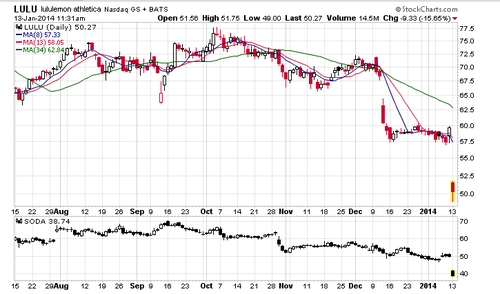
    In  TMP this weekend we suggested stocks look rather toppy. Just this morning Lulu and Sodastream are selling off. Read the link to see how news of lower eranings is causing unease among investors. This is why we study the construction of earning per share. 

    LULU SODA

    Screen Shot 2014-01-13 at 10.31.54 AM

    Students in my classes are aware that I have used LULU as a stock I thought was over priced for some time now. Finally the day arrives. IN the last month it has lost 1/3 of its value, down 15% just today. Sodastream is having about the same literal results at bottom. 

    What happened?  Social mood went from positive to negative, just that fast. There is an old saying that eventually the fundamentals, earnings, justify the technical outlook which is this stock was over valued. 

  • Professor Elam

    Monday January 13 2014

    Job Title: Accountant I or II
    Area of Interest: Accounting
    Position Type: Full-Time Regular
    City / Zip: San Antonio – 78259-1828
    State / Province: Texas
    Country: U.S.
    Job Posting Number: 4993
    Job Description: The Accountant position will be responsible for preparing monthly accounting journals for cost allocations, partner billings, and accruals; accumulating data for monthly and quarterly reporting; performing reconciliations and ad hoc analysis; analyzing operations project costs; coordinating accounting projects; and other tasks as assigned. This position will entail developing a well-rounded knowledge of the Company's operations, cost accounting processes and systems, and COPAS accounting guidelines with particular emphasis on joint interest billing, overhead calculation, and cost allocation requirements.
    Requirements: A Bachelor’s degree in Accounting is required. This position requires strong organization and interpersonal skills, attention to detail, and the ability to work independently in a fast-paced, dynamic work environment. Good computer skills and a proficiency with Microsoft Excel are also required. A minimum of one year prior accounting work experience is required. Preference will be given to experienced candidates with an upstream oil and gas accounting background. Position will be filled at the level commensurate with experience.

  • Professor Elam

    Thursday January 9, 2014

    Russell Blake was featured in a front page WSJ article this week.While his self publishing took a while to Screen Shot 2014-01-09 at 2.27.32 PMtake hold, now he is churning out a book a month and is one of Amazon's top five best sellers. He lives in Baja, Mexico with his dog. Sounds like a great career to me. I will shortly be reading his take on publishing titled.

    How To Sell A Gazillion eBooks In No Time (even if drunk, high or incarcerated), a parody of all things writing-related.


    Blake had no prior experience in writing before starting this new career. Sounds like a great gig if one can learn the secret to success. 

    Learn more at the Russell Blake Amazon page.

  • Professor Elam

    Wed January 8 2014

    A recent article asked why it was so hard to find another CEO for MSFT. I suggest the challenge if inding a better CEO for MSFT. 

    Alan Mulally at Ford says he will stay with Ford and has no interest in MSFT. Smart guy, that is not his background for starters. And as the article says, having two former CEOs  Gates and Ballmer on the Board, neither of who had much luck at their career end, is a turn off. 

    MSFT needs to get Gates and Ballmer off the Board and start fresh.