• Professor Elam

    Monday June 10 2013

    National Envelope files for bankruptcy, again. National Envelope makes some 37 billion envelopes a year,

    But in this e mail age that is not enought to rescue the firm. by the way NE is located in Frisco, Texas and employes 1600 people. Other names have had difficulty

    with the transition to the digital age in icluding

    Smith Corona typewriters

    Remington Rand

    Polaroid

    Xerox

    This is a good example that firms need to engage in long rage planning. Things change.

  • Professor Elam

    Monday June 10,2013


    Richard Jenkins Chapter  Sponsor of TAMUSA Toastmasters has met with local Toastmaster  Representatives. The TAMUSA officers are meeting now planning their first dress rehearsal and then the premier run through example of a meetubg  for area Toastmaster reps.

    This is planned for end of month June. Initial meetings are planned for Main
    Campus. Tuesday 7:00 PM  is the planned meting date but the room is not officially scheduled yet. Watch this space for announcements of the first meeting.

    Salvador Valdez is President, Ruben Medrano is the Treasurer, Allison Crofton is also an officer, Marie Leighton is Secretary, Richard jenkins is VP membership.

  • Professor Elam

    Monday June 10, 2013

    I have had fun pointing out the success of Lululemon, a purveyor of high priced yoga togs. Some of our female students have taken me seriously when I questioned whether they would be seen in an $18 Target tank top when the $50 Lulu version awaits at the Quarry. 

    This article on Lulu's price earnings ratio demonstrates what we are studying in ACCT 3310 and 3314 now. Lulu trades at 41.2 p/e, way higher than Nike at 23.3. Gap is only worth 2/3 more than Lulu but 

    Gap earnings were 4x higher

    revenue 11x higher

    retail floor space 60x higher

    how can this be?

    I spent an hour last week explaing hte implications of socionomics to my yawning ACCT 3314 class. But here it is in action. Lulu is fashionable among mutual fund managers, the buzz is on, and so a dollar of Lulu earnings brings 41x in  value while Adidas brings a mere 18x. How long can this last, until the mood changes!

  • Professor Elam

    Weekend June 8 2013

    A Chinese firm, Dalian Wanda, is set to buy British yacht maker Sunseeker for $300 million pounds.

    In my presentation on socionomics in class this past week I commented that positive social mood drives
    Screen Shot 2013-06-09 at 11.08.12 AM markets higher. The desire to dislay wealth is a part of this phenonenon. It is interesting that hte Chinese see the potential in luxury goods. 

    The line spans a range from 50 tp 150 feet. Examples of Sunseekers have been used in several bond films. 

    Just the thing for cruising the French Riviera I would think. Actually the prices were lower than I expected. A 92 foot model is about $4 M. 

    Start shopping for your favorite at the Sunseeker Site.

  • Professor Elam

    Thursday June 6, 2013

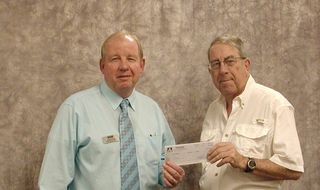
    IMG_0390Associate Professor Dennis Elam recently provided an Economic Update for HVAC Contractors of Johnstone Suppply. Johnstone is a major wholesaler of air conditioning equipment. Interestingly a plant in Houston, Texas produces a major supply line for  the company. 

    From left

    Syed Harun, Chair College Business TAMUSA

    Mike Wallace, Vice President Johnstone

    Dennis Elam Associate Professor TAMUSA

    David Pena, Marketing Director, Johstone

    in  appreciation for the presentation Johnstone made a monetary contribution to TAMUSA.

    Provost P6050004 Brent Snow acknowledges receipt of the check. This will fund the registration fee for a new Toastmasters Club at Texas A & M University – San Antonio. Business Communications Instructor Richard Jenkins is faculty sponsor for this group. We have already had an enthusiastic response from students. At least one student is already a Toastmaster member at another club in town. 

    Toastmasters International  is a non profit organization devoted to improving speaking and presentation skills. There are numerous clubs in San Antonio. 

    Thanks to Mike and David for helping us kick off another student resource at Texas A & M University – San Antonio!

  • Professor Elam

    Thursday June 6 2013

    The National Association of Security Dealers NASD had a proposal to required an internal audit function to list on their exchange. After receiving comments on the issue the NASD tabled the idea for the time being. Here is the responses from the head of the NASD. I agree with him that internal audit is hardly burdensome and would provide further assurance to stakeholders that someone was watching the hen house so to speak. 

  • Professor Elam

    Wednesday June 5 2013

     TAMUSA Acconting Students


    I have the application forms, see me if you are interested in applying.

    Dennis Elam

    PASSA Scholarship Program

    The Petroleum Accountants' Society of San Antonio (PASSA) will offer up to five $1,000.00 scholarships for
    the 2013-2014 academic year.


    The Mission of the PASSA Scholarship Program is to help those students seeking a career in accounting
    obtain their goals through higher education.


    Applicants are judged on financial need, community service, evidence of leadership and citizenship and
    academic record (minimum 3.0 GPA).


    Each scholarship winner will be eligible to receive $1,000 and funds must be used for college tuition, books,
    fees or room and board.


    Rules and guidelines:


    1. Applicant must be enrolled full time in a 4-year accredited college or university.


    2. Applicant must have completed their freshman year of college (24 hours) with a 3.0 GPA (or B average)
    and be in good standing.


    3. Applicant must be entering or currently pursuing a bachelor’s or master’s degree in accounting.


    4. Each scholarship recipient will be chosen by the Scholarship Committee made up of members of PASSA.


    5. The following criteria will be considered in selecting scholarship recipients: student’s academic standing,
    essay, personal circumstances, participation in school/community activities, two written recommendations
    by a professor, counselor, and /or community/club leaders. Student will submit a detailed application.
    Neatness and ability to follow instructions are very important and will also be considered by the selection

    committee. References and transcript are to be sealed and included in a packet with the application as
    indicated in #10.


    6. Each scholarship recipient and the scholarship recipient’s counselor will be notified by a PASSA
    scholarship committee member by telephone and by written correspondence through regular mail.


    7. Each scholarship will be paid directly to the College or University.


    8. Each scholarship recipient and parent(s) will be invited as guests of PASSA to a future regularly scheduled
    monthly meeting at the Petroleum Club to be officially introduced to the membership.


    9. College transcript is to be sealed and included in the packet with application and sealed references to the
    address provided.


    10. Student applicant understands that the scholarship is to be used for college tuition and fees, books, and/or
    college living expenses. According to the IRS, contacted April 2, 2001, and according to 1099 Section,
    page 24 (Miscellaneous); PASSA does not have to submit a 1099 to the student as long as it is for regular
    studies. A 1099 needs to be submitted only if the scholarship is given to be used as wages, such as studies,
    preparation of papers, or specific project, etc.


    11. The scholarships are not renewable.


    To apply, complete the attached application form, along with your essay, certified college transcript, and two
    reference letters from qualified persons no later than August 15, 2013. Any applications received after the due date
    and any incomplete applications will not be considered – NO EXCEPTIONS.


    PASSA Scholarship Committee

    c/o Will Kothmann

    100 NE Loop 410

    Suite 1100

    San Antonio, TX 78216

  • Professor Elam

    Tuesday June 4, 2013

    This op ed by Andy Kessler appeared in the WSJ Monday June 3 2013. Is an iPad really that different than a spiral notebook and a library book?  In other words, Mr. Kessler assumes ALL student are  compoletley capable of learning on their own, , forget the teachers and issue an iPad. Well then  why is it that incoming students in any class have not already been to the library, read up on the subject, and arrive prepared to engage in thoughtful discussion and problem solving? Earth to
    Andy, they don't!  Administrators thought television lectures would do the same back in the 16950s. it did not work out that way.

    Here is the op ed, I am interested in your take on this.

    Professors Are About to Get an Online Education

    Georgia Tech's new Internet master's degree in computer science is the future.

    By ANDY KESSLER

    Anyone who cares about America's shortage of computer-science experts should cheer the recent news out of Georgia Tech. The Atlanta university is making major waves in business and higher education with its May 14 announcement that the college will offer the first online master's degree in computer science—and that the degree can be had for a quarter of the cost of a typical on-campus degree. Many other universities are experimenting with open online courses, or MOOCs, but Georgia Tech's move raises the bar significantly by offering full credit in a graduate program.

    It comes just in time. A shortfall of computer-science graduates is a constant refrain in Silicon Valley, and by 2020 some one million high-tech job openings will remain unfilled, according to the Commerce Department.

    That's why Georgia Tech's online degree, powered by Udacity, is such a game-changer. For the same $7,000 a year that New York City spends per student on school buses, you can now get a master's from one of the most well-respected programs in the country. Moore's Law says these fees should drop to $1,000 by 2020—a boon for students and for the economy.

    Getty Images

    Sadly, MOOCs are not without controversy. Consider what happened at San Jose State after the university last fall ran a test course in electrical engineering paid for by the Bill and Melinda Gates Foundation. Students who worked with online content passed at a higher rate than classroom-only students, 91% to 60%. The course was so successful that the school's president decided to expand online courses, including humanities, which will also be rolled out to other California State universities.

    You'd think professors would welcome these positive changes for students. Some teachers across the country are, however cautiously, embracing the MOOC model. But plenty of professors smell a threat to their livelihood. In an April 29 open letter to the university, San Jose State philosophy professors wrote: "Let's not kid ourselves; administrators at the CSU are beginning a process of replacing faculty with cheap online education."

    In April, an Amherst faculty committee decided against online courses, since they apparently run afoul of the school's mission of "learning through close colloquy." As it happens, Amherst professors rank seventh in salary of top liberal arts colleges, pulling in $137,700. And at Duke, where my son is a student, a faculty council at the school's arts and sciences college voted 16 to 14 against granting graduation credits for taking a Duke MOOC. By the way, Duke professors' average salary is $180,200.

    I have nothing against teachers—or even high salaries, if the teachers are worth it. But half of recent college graduates don't have jobs or don't use their degree in the jobs they find. Since 1990, the cost of college has increased at four times the rate of inflation. Student loans are clocking in at $1 trillion.

    Something's got to give. Education is going to change, the question is how and when. Think about it: Today's job market—whether you're designing new drugs, fracking for oil, writing mobile apps or marketing Pop Chips—requires graduates who can think strategically in real time, have strong cognitive skills, see patterns, work in groups and know their way around highly visual virtual environments. This is the same generation that grew up playing online games like Call of Duty and World of Warcraft, but who are almost never asked to use their online skills in any classroom.

    MOOCs will inevitably come to K-12 education too. Everyone knows great public school teachers. But we also all know the tenured type who has been mailing it in for years. Parents spend sleepless nights trying to rearrange schedules to get out of Mr. Bleh's fourth-period math class. Online education is about taking the "best in class" teachers and scaling them to thousands or millions of students rather than 25-30 at a time.

    The union-dominated teaching corps can be expected to be just as hostile as college professors to moving K-12 to MOOCs. But a certain financial incentive will exist nonetheless. I noted this in a talk recently at an education conference where the audience was filled with people who create education software and services.

    I began by pointing out that in 2011 only 7.9% of 11th graders in Chicago public schools tested "college ready." That's failure, and it's worse when you realize how much money is wasted on these abysmal results. Chicago's 23,290 teachers—who make an average salary of $74,839, triple U.S. per capita income and 50% more than median U.S. household income—cost Chicago taxpayers $1.75 billion out of the city's $5.11 billion budget.

    Why not forget the teachers and issue all 404,151 students an iPad or Android tablet? At a cost of $161 million, that's less than 10% of the expense of paying teachers' salaries. Add online software, tutors and a $2,000 graduation bonus, and you still don't come close to the cost of teachers. You can't possibly do worse than a 7.9% college readiness level.

    When I made this proposal, only slightly facetiously, in a roomful of self-described education entrepreneurs, it was if I'd said that Dewey had plagiarized his decimal system. I was upbraided for not understanding the plight of teachers. The plight of students, as is too often the case in discussions of education, didn't seem to rate the same concern.

    It's still early. We need experiments. Much as early movies were made with cameras in front of Broadway shows, current MOOCs are mainly professors droning into a camera. There will always be a place for real, live teachers in classrooms, perhaps more as tutors than lecturers. But online education is going to happen—and it has the potential to be the next great export market. The smart teachers, the good ones, would be well-advised to embrace the change.

    Mr. Kessler, a former hedge-fund manager, is the author most recently of "Eat People" (Portfolio, 2011).


  • Professor Elam

    Monday June 3 2013

    Racquetballis a game played on a closed court with a racquet and a bouncing rubber ball. Tennis by contrast requires two players with a high skill level, or the two just pend their time chasing the ball that is now off the court. Tennis requires one to 

    hit the ball over the net

    and into the court

    which is a lot harder than it looks. 

    CourtwIn r ball, you just have to hit the front wall, which after all is 20 feet high, funny that turns out to be harder than it looks. But we have a r ball court at the gym just east of our campus building on Brooks. 


    Here is the basic idea of the game. The good thing about r ball as an aerobic exercise is

    you need only find an opponent whose skill level matches yours, in that case you both get a great work out and can have some fun trying to win

    like basketball and unlike baseball or gold, you spend most of the time at a high level of aerobic exercise with an elevated heart rate, and yes, plenty of sweat, the point of exercise after all.


    And yes this is a game for men and women. 

    Notcie 1 (5)

    Notice this young lady had the physique of a tennis player, this is not a game for weight lifters, it emphasizes speed and reaction. 


    1 (17)I played a lot in the 1980s and am enjoying getting back into the game again. This image at right emphasizes the physical action of the game. Note these photos were not taken at Brooks City Base Gym.

    Learn more about Brooks City Base Gym here.

    This was the gym for the Brooks Air Force Base and as such it is truly a first class facility. There is a

    weight room

    Aerobic machines such as stair climbers

    a soccer field and track for walking or jogging

    very well maintained locker rooms and showers

     Andthe best part is – membership is free to TAMUSA sutdents and faculty. One need show a TAMUSA ide card and proof of paid enrolllment for the current period.

    At any rate Ruben Medrano and I encourage  participation. 

  • Professor Elam

    Monday June 3 2013

    Republican lawmakers briefed on the report on conference spending released details from select portions, highlighting a $4 million gathering for 2,600 managers at three hotels in Anaheim, Calif., in August 2010. Several IRS employees stayed in presidential suites, the House Oversight and Government Reform Committee said. About 15 outside speakers were paid $135,000.

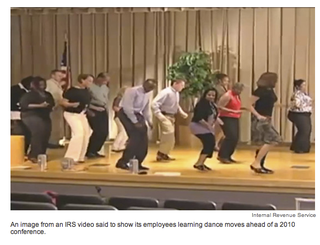
    The report includes details about IRS training videos that were produced ahead of the conference. One
    Screen Shot 2013-06-03 at 7.27.04 AM video features IRS employees learning the "Cupid shuffle" line dance. The IRS in a statement said the video "was unacceptable and an inappropriate use of government funds."

    In advance of the report's full release, Danny Werfel, the IRS acting commissioner, said the conference spending "should not have occurred." He added that new spending restrictions have led to an 87% drop in conference costs from fiscal 2010 to fiscal 2012. Mr. Werfel also referred to the Anaheim event as "an unfortunate vestige from a prior era."

    Monday June 3 WSJ Page A4


    Remember the revelations over the GAO pulling similar stunts with lavish conferences in Hawaii?  Well here we go again. In the Accounting Ethics course I teach we emphasize that the tone is set at the top. Well here is tone on display.

    The WSJ has an excellent half hour show Saturday 1 PM and Sunday 2 PM on Fox in our market. They pointed out this weekend that the IRS is such a target of disdain the brou haha continues to grow.

    There is of course no accountability at the Federal Government level. No one has lost their job over delaying approval for 501c4 status for groups.

    I wonder if the dance instructors were staff employees or contractors, inquiring minds want to know.

    I am recommending that you take advantage of the heavily discounted WSJ student subscription, good stuff in that paper every day.