• Professor Elam

    Thursday August 23, 2012

    This author admits parents worry over rising tuition. He then concludes that 'a college degree' is still a great deal, needless to say he works at a college. This article makes the typical mistake of lumping all college degrees in the same category. This is incorrect. I like history but the chance that you will be as employable as an historian versus an accountant is pretty slim. 

    He also makes the mistake of simply saying that all education results in better job prospects. The correct view is that an employable skill set in demand results in job opportunities. I regularly beat the drum about the importance of obtaining certifications to set yourself apart from the crowd. That continues to be more and more important in a tight job market. Indeed right here in San Antonio I am hearing from students that they are being told to obtain a certification before applying for a job. You heard it here first. 

  • Professor Elam

    Note to readers, this is my recent column which runs in two Texas newspapers. 


    The concept of what college is or should be is undergoing re-examination. It’s time for a re-think of just what we want a college degree to be, and what we as a society want to spend in support of that notion.

    Texas will cut is Higher Education Budget  7.6% for 2012-2013, still spending $21.1 billion dollars.  In 2012, the latest year I can find on the THECB website, there were 1,505,449 students enrolled in community colleges and universities in Texas. As employers still report they cannot find adequate technical or university graduates for many positions, we might well ask, exactly what outcome are we getting for $21.1 Billion? By the way that is simply what the State of Texas sends to Higher Ed. The overall Higher Ed budget for all school includes tuition, fees, grants, you name it, pushes the total expenditure well over $100 Billion.  Private schools push the number even higher.

    Let me provide a totally non-scientific anecdotal example in answer to my question. One of my students recently began an essay with the rather famous quote, ‘It was the best of times, it was the worst of times.’ I quickly interjected,  in two of my junior level classes, who wrote that, what was the subject, and the title of the publication? Only one person had the right answer. The guesses, such as  Shakespeare, were even worse.  This is the opening quote from A Tale of Two Cities written by Charles Dickens concerning the French Revolution.

    Everyone in those classes presumably completed English Literature in both high school and at least two semesters, if not four, in college prior to my class. Yet 98% could not score on the simplest of Jeopardy questions.  I am going somewhere with this….

    One fellow in my senior high school English class declared that he enjoyed Julius Caesar much better than MacBeth, because he had finished with Caesar in the eleventh grade. In a related sense, I am, yes, suggesting that there is little point in  requiring students to ‘learn material’ (which they don’t) that is not directly relevant to their desired outcome. And frankly it is a complete waste of time for the teacher and those that are interested, in this case, in British Literature.

    High schools are now experimenting with various programs enabling students to simultaneously complete junior-senior high school requirements as well as freshman-sophomore requirements. At the end of high school they are junior class ready. Most students have complained that the first two years of University studies pretty well re-hash high school anyway.

     Another problem is the extremely high drop out rate. Even at the best of our state universities, the completion rate for six years is about 65%. The numbers drop from there, to usually below 45%.

    And the community colleges still struggle to gain broader acceptance of the Associates Degree. Worse, only a small fraction of students attain that outcome.

    My sense is that with colleges on every corner, both state, private, and on-line, there is growing skepticism of the final product. As a result, there are more and more certifications in virtually every field. Examples  in my field of accounting include  the traditional Certified Public Accountant as well as Certified Internal Auditor. More and more employers are now demanding a certification either prior to or soon after as a condition of continuing employment.

    I propose creation of  a series of Chartered Community Colleges.  Admission standards would include timed  exams in that field of study. A majority of instructors would be full time and drawn from the fields in which a student would be certified. The college would only grant degrees that would result in one obtaining a specific certification.   Like classes in the military, student could fail.  The Vision would be a college system specifically geared to an employable certification. The Mission would be the creation of an affordable college tied to the work place. The Outcome Measure would be the success rate of the graduates on said certified exams.

    Handily such a model already exists in the community college system-nursing. Let’s add plumbing, accounting, pharmacy tech, and a host of others to the list.   Colleges have given up offering an education but instead claim higher lifetime earnings, regardless of the degree one receives. This is simply not true. The  field of study matters. And they will all matter at the Chartered Community College.

    Dennis Elam Phd CPA  completed his Doctorate at the UT Community College Leadership Program and has taught in  four different universities.  He blogs at http://www.professorelam.typepad.com


  • Professor Elam


    Tuesday August 21, 2012

    Now the FEDS are with holding SS payments on recipients that have not paid their student loans. In some cases these are grand parents that borrowed to help grand kids. 

    I hve repeatedly warned that the Student Loan Crisis would be one of the factors in the next market meltdown. This has a parallel in the previous era of stagnation from 1966-1984. Then many young men fled to Canada rather than 'pay their fair share'  by being drafted into the Viet nam War. This conflict was resolved when Jimmy Carter gave them all amnesty allowing them to return home without penalty. 

    This is embelmatic of the fight for survival that is coming. My concept of the New Civil War has pitted the North against the South. Now the Federal government becomes a third player. No end of fronts in this war

     A student asks Romney Ryan about student loans.

  • Professor Elam

    Weekend August 18 2012

    India only won six olympic medals. This article makes the point that the Olympics only seem imortant for countries like Britain and the US, or one like, uh, North Korea. Read why here. 

    Okay so Mike Phelps is a great swimmer. What will he do with that accomplishment?  Coach other swimmers I would guess. Does it make sense to put a lot of time and money into training someone to throw the shot put?  What is your take?

  • Professor Elam

    Weekend August 18 2012

    Kyle Bass, no relation to the Fort Worth Bass Family, bet big that European debt values would collapse. He Screen shot 2012-08-18 at 4.35.26 PM is featured in the intro to Boomerang by Michael Lewis.  I am reading Boomerang now, are you?

  • Professor Elam

  • Professor Elam

    Friday August 17 2012

    Matt Taibbi has written extensively on Wall Street misdeeds. His profile of the DOJ is pretty much what I encountered when presenting a case to the DOJ reagarding fraude when I served as a Federal Bankruptcy Trustee. Our work was met with a big yawn. Note, Jon Corzine walks.


  • Professor Elam

    Friday August 17, 2012

    The GM CEO is following Alan Mullaly's lead at Ford trying to establish a Global Organization.

     Now from The Market Perspective.com

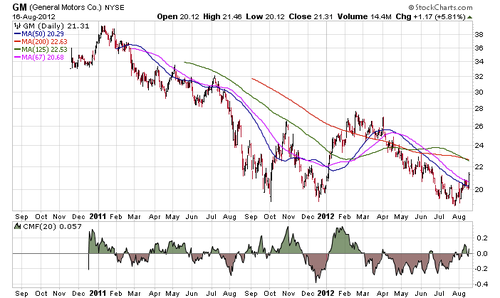
    THis article on GM this afternoon  cannot figure out why the volume jumped to 12 million from a normal 7 million, no particular news. Well duh guys, GM has $20 bucks a share in cash so one is buying the entire company essentially for free. They have enough tax credits to avoid paying any federal taxes for years. GM trades for a paltry 6 times earnings, Toyota has a P/E three times that. If GM traded at the same P/E as Toyota, it would be a $59. stock. This is an election year, the US government owns millions of shares, Obama touts the bailout as a a great example of helping the average worker. We aren't conspiracy theorists here but gee, imagine how a huge rally in GM would be a centerpiece of Obama's compassionate government intervention at just exactly the right time in the campaign in contrast to Romney's let go bust and the creditors pick up the pieces theory. Don't count that scenario out, Wall Street would gladly bid up the price if everyone is in on this game to move the price sharply higher. I grant that is sheer speculation on my part, but not far fetched speculation. A return to $34-36, the price GM came public in 2011 would only require a 10x P/E. Again this is sheer speculation but something is up. Note the triple bottom formation, it seems reasonable that all the sellers are out of GM. GM dropped from 32 to 20 in three months last year, could it advance that fast. Okay we do not normally engage in such rampant specuation but we will know in 85 days if this theory has anything to it. I am long 700 shares.

    GM

    Screen shot 2012-08-16 at 3.50.42 PM

  • Professor Elam

    Wednesday August 15 2012

    Back in the day to boost Saturn sales, GM would book a sale when they shipped a car to a deaaler. Huh?

    Now, BMW offered a substantial discount on the immediate purcase of cars to be used as demonstrators. The cars are still in the dealer showrooms but listed as demonstrators. Was that a sale?

    Or as Gene Wilder qiupped in The Producers  way back in 1968, I cooked the books!

    We study end of period cut offs, what should be in sales and purchases according to proper accounting doctrine. There are lots of ways to twist the numbers. How did JPM manage to hit their earnings target even after losing $2 B in the Whale Trade, a number that has since grown to over $5 B?

    clever accounting, eh?

  • Professor Elam

    WednesdayAugust 15, 2012

    How Japan Lost Its Electronics Crown is an all too familiar story of how winners lose their way. 

    Let me take you back a few decades. Soldiers returning from Viet Nam in the1960s and 1970s often brought back  fancy component stereos made by Sansui or Yamaha or Kenwood. The only thing comparable in the US was either the expensive but high quality MacIntosh or the assemble it yourself Dynakit.  Sony made the best television at that time, with its three color gun Trinitron. And so the idea that Japan equalled quality became embedded  in the American buyer. American dealers were aghast when Sony announced it would start building the Trinitron in the US to better meet demand. The US dealers were certain quality would suffer. 

    Now fast forward a few decades. Samsung, a Korean company, is  a major player. Hyundai and Kia produce startling designs looking for all the world like the much more expensive Mercedes sedans. 

    We study such concepts in managerial cost accounting. Now Ford GM Chrysler are catching up in both quality, power, and fuel economy with Honda and Toyota. 

    As George Jones might say, the race is on.