• Professor Elam

    Monday 12/11/23

    WSJ Today Page B1

    The U.S. Treasury prefers its debt sales to be humdrum affairs. Lately, they are sparking fireworks in markets.  

    Scrutiny of Treasury auctions—whereby the government funds operations by selling the world’s safest bonds to big banks and dealers—has grown alongside their size. For years, many in Washington and on Wall Street assumed that investors would buy any number of bonds the government issued, no matter the fiscal outlook. Testing that assumption: the sale of $20.8 trillion of new Treasurys in the first 11 months of the year—set to surpass 2020’s record of just under $21 trillion.

    Whether the market can absorb the rolling waves of debt without disruption is the biggest question on Wall Street ahead of this week’s planned Treasury auctions. A combined $108 billion of 3-year, 10-year and 30-year bonds hit the block Monday and Tuesday, along with $213 billion of shorter-term bills. The last 30-year auction was so poorly received that it rattled other parts of the markets. Investors fear that signs of weak demand might spread similar tumult, raise the cost of government borrowing and hurt the economy.  

    Here’s what to know:


    How Treasurys are sold

    The Treasury Department auctions off bonds in chunks by maturity at monthly intervals. Everyone from individuals to foreign banks can buy them in exchange for reliable coupon payments and the government’s guarantee that they’ll get their money back when the bond matures. 

    The government announces its borrowing plans each quarter, but waits to schedule individual auctions until a few days ahead. Among the main participants are so-called primary dealers—banks that can trade with the Fed. They are required to bid at auctions and often end up buying more bonds when demand is weak. 

    Wall Street covets brand-new bonds because they are the easiest to trade. Rates are determined at auction. Advanced trading by the primary dealers helps set expectations for the new bonds’ yield—or the average annual return investors will receive until maturity, based on the bonds’ price and coupon. So-called when-issued trading accounts for more than 10% of all Treasury transactions, according to New York Fed research.

    All prospective buyers then place competitive bids, telling the government the payout they want to receive. The Treasury first accepts the bids with the lowest yield (which would cost the government the least), then the next-lowest, scaling the ladder toward its borrowing goal. The highest rate needed to complete the auction—the so-called high yield—is what all bidders receive.

    An auction is considered weak when the government ends up having to offer investors much higher yields than the market expected, or when primary dealers have to buy a lot. If yields come in below expectations, Wall Street is encouraged by the strong demand.

    Individuals at home can also buy Treasurys at auction by making an account at the TreasuryDirect website.

    Why investors are on edge

    Wall Street has its own lingo to describe how an auction went. When the yield is higher than expected? Investors call that a “tail.” When it’s lower, that is a “stop-through.” Auctions that meet expectations are said to be “on the screws.”

    Last month’s 30-year auction had a massive tail by historical standards. Primary dealers bought nearly a quarter of the issuance, more than double their average. The previous 30-year auction also didn’t go well.

    Few fear an outright auction failure. That is an unlikely scenario that analysts said could potentially kick off prolonged and catastrophic market turmoil. 

    Gauging demand

    Investors gauge demand at an auction by looking at the “bid-to-cover” ratio. That measures the size of buyers’ orders—or bids—against how much money the Treasury is looking to raise. The higher the ratio, the better. There are always enough buyers; the worry is that they’ll demand elevated payouts. 

    (All Treasury securities are generally known as bonds. But to traders, “bonds” are debt instruments with maturities longer than 10 years; “notes” are those that mature in two to 10 years; and “bills” have maturities of a year or less. To make it even more complicated, bills don’t pay coupons—investors buy them at a discount and redeem them at par. So everything maturing in more than a year is often known as a “coupon.”)

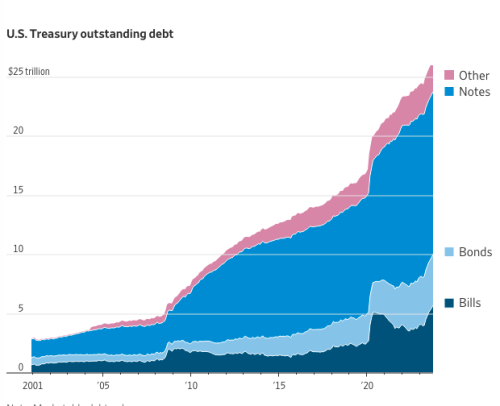
    Enthusiasm for longer-term bonds has waned. After long-term yields rose to 5%, the Treasury Department decided to sell fewer than analysts expected. Instead, it chose to continue pumping out Treasury bills at a pace typically associated with recessions or extraordinary borrowing needs: more than half of all issuance. T-bills are much less volatile because they come due so quickly. 

    The government has been advised to maintain T-bills at around 15% to 20% of the overall debt load. As of the end of November, bills make up 21.6% of the $26.3 trillion of U.S. debt.

    Many analysts expected a return to typical bill issuance levels this year. The Treasury Department issued $824 billion of T-bills from July to September, the majority of its $1.01 trillion borrowing spree. Much of that issuance was used to quickly refill the government’s coffers after Congress finally raised the debt ceiling.

    Now the Treasury Borrowing Advisory Committee suggests that the government be mindful that demand for its debt is waning and consider exploring “if more meaningful deviations are necessary.” 

    How Wall Street reacted

    Investors were so encouraged by the borrowing plans that they scooped up stocks and bonds, propelling markets higher. The stock market prefers this approach right now because prices of longer-term bonds are more sensitive to changes in interest rates

    “We’re getting lower bond issuance than we expected, meaning there’s pressure off bonds in the near term,” said Andy Constan, chief executive of Damped Spring Advisors, a consulting firm for macro hedge funds. “But the federal deficit isn’t going away. Quantitative tightening isn’t going away. Those are things which need to be financed—which requires bonds.”

    “The longer they wait, the bigger the issue becomes,” he said.

    That leaves the Treasury at a crossroads. It can issue more long-term debt and lock in high borrowing costs for years. Or it can stick with short-term Treasury bills and promote risk-taking on Wall Street. For now, it is opting for the latter.

    Why people are still worried

    Wall Street has a limited capacity for how much risk it can take. Bonds sap some of that risk budget. But because T-bills are effectively treated like cash, absorbing bills rather than bonds gives investors more room to buy riskier assets such as stocks.

    Many worry the flood of long-term bonds is outstripping demand for them. Bond yields surged this summer after the Treasury surprised Wall Street by announcing it would borrow roughly $1 trillion in the year’s third quarter, more than a quarter trillion dollars above previous expectations.

    Some analysts say that the Treasury’s new plan just kicks the can down the road, exchanging calm today for the risk of resurging inflation and market pain later.

    “Increasing bill issuance effectively stimulates the economy by pumping markets higher,” said Stephen Miran, co-founder of asset manager Amberwave Partners and a former senior adviser to the U.S. Treasury, where he assisted with the Covid-19 response. “The inflation genie is out of the bottle, and stoking easier financial conditions isn’t going to help put it back in.”

    Many of the investors who were betting bond yields would go higher as prices fell were forced to quickly exit those trades as yields sank, according to Miran. He said that reversal has helped bond prices rally alongside encouraging inflation prints showing that price pressures are subsiding. 

    But fundamental problems remain.

    The decision to sell more bills and less long-term debt comes at an unusual time, while the Fed is paring its bondholdings through its quantitative tightening program. The central bank is seeking to tighten financial conditions and limit other risks that Wall Street can take. By reducing the supply of bonds and notes relative to bills, the Treasury is, in essence, complicating the Fed’s inflation fight and precipitating more speculative bets.
    Screenshot 2023-12-11 at 8.14.02 AM


  • Professor Elam

    11/30/23


    Birth rates are falling across the world. Click to earn the consequences

  • Professor Elam

    11/0/2023

    I am asking Mike if this is available later on


    an Antonio Chapter

    Members,

    We had a GREAT Lunch N Learn session yesterday with excellent turnout!  We had quite a few members on-line whose schedules don't easily accommodate our regular evening events.  Thanks to Lawrence Coffee for the insightful info.

    In addition to our 2 remaining activities for the year (details at bottom), IMA is promoting a FREE CMA review session THIS Saturday morning – 8am CT!

    Seats are limited, register now: https://bcertifiedpro.com/courses/cma-usa/
    Email us: support@bcertifiedpro.com

    CMA Part 1: Saturday, December 02, 2023 from 8 AM to 12 PM CT 


    Sessions include:
    – Strategies to answer MCQs and Essays in less time & score high.
    – Practice with candidates' MCQs and Essays and guide them through each exam question.
    – Go through the right way to approach MCQ and Essay questions using retired actual exam questions as well as simulated tricky questions.
    – What to do and not to do on the exam while going through each question.

  • Professor Elam

  • Professor Elam

    11/23/2023

    Arnold on his first Thanksgiving and positive thoughts – notice this guy started with nothing and now lok

    _________

    From Arnold: Happy Thanksgiving

    This is a special version of the newsletter. We won’t have the normal three items, but I do want to share an important story.

    It’s Thanksgiving for all of our American subscribers today, so I wanted to let you off the hook before you start eating everything in sight and let you know it’s perfectly OK to go wild. And I wanted to tell you about my first Thanksgiving, and why it is so important to me.

    I moved to America in 1968, just before the holidays. I had no idea what Thanksgiving was. I learned quickly.

    One of the guys I trained with, Bill Drake, found out I had no plans. He told me I had to come to his parent’s house, and I had my first-ever Thanksgiving dinner. They treated me like I was part of their family, even though I barely spoke English and had a few language screwups at the meal that were very funny.

    Around that same time, the guys at the gym found out I lived in an apartment with basically nothing. Then, like a strange group of really buff, shirtless elves, they showed up one after the other. Pillows, sheets, utensils, plates, a black and white TV, and a wooden clock radio I keep by my bed today as a reminder of the kindness I found here. They brought me everything I needed.

    That’s why I give back every year around this time and donate turkeys and toys and hand them out at the Hollenbeck Center in East LA, and why I still have some of the gym crew over for Thanksgiving if they don’t have anywhere to go. I know what it meant to me. You never know what it means to someone to offer them a meal or really anything that shows you care.

    Today is about more than eating delicious food and lying on the couch.

    So, I also want you to know that I’m thankful for all of you. There are almost 600,000 of us in this village. Every day, we are filling the world with more positive people who know that there are plenty of problems in the world, but we won’t solve them by being angry and complaining about them.

    I can’t believe the positivity I see every day in the replies to this email, and I am still in shock when I look at The Pump app’s community even after we opened it to all of you in the newsletter village and see that there still hasn’t been a single negative comment. We have never had to use our power to delete anything — what other app could say that? We are proving that positivity can work online. That’s because of the positivity of all of you lifting yourselves and each other. So thank you, thank you, thank you.

    Now, I am giving you a free pass. Not just today but for the celebrations to come. Don’t hold yourself back. Eat that pie. The reason we are healthy almost every day is so that we can let go on days like this. Remember that. We aren’t living lives of subtraction. We’ve added health and fitness to our lives so that we can also add some ice cream or mashed potatoes without guilt.

    Let go a little bit. Your healthy diet will be waiting for you. Just remember it is there, and don’t let a day or a weekend turn into a month of saying, “Arnold gave me a free pass.”

  • Professor Elam

  • Professor Elam

    1/22/2023

    Here is an ad from the internet, note the store o[ens at  5 00 AM!


    Screenshot 2023-11-22 at 11.28.49 AM

  • Professor Elam

    11/20/2023

    Members,

    The San Antonio chapter has 3 exciting events in the next 3 weeks!  All details are posted to the website – https://SanAntonio.IMAnet.org.  As always, these events are open to non-members.  So please invite a colleague!

    Wednesday, Nov 30th – Lunch N Learn (100% virtual, 1 hr CPE, 12-1pm CT, totally free!): 
    AI and Accounting:  Building Better Systems for the Future – presented by Lawrence Coffee

    Learning Objectives: 
    • Understand the basics of Automation and AI Use Cases in Accounting from Small Business, scaling to Enterprise.
    • Challenges facing Data Quality and Self Service in the AI era.
    • The Case for AI Governance and the evolving AI Regulatory Landscape.

    Friday, Dec 8th – Lunch N Learn (100% virtual, 1 hr CPE, 12-1pm CT, totally free!):
    Excel 301 (Intermediate Excel Tips & Tricks) – presented by Brian Butler
    Learning Objective: 

    • Gain an understanding of how certain Excel functions can be used to establish a DATA FOUNDATION that will result in a meaningful analysis in virtually any setting.

    Wednesday, Dec 13th – regular chapter meeting (in person 5:30pm-8pm CT/virtual 6-8pm CT, 2 hrs CPE):  
    NOTE THE unusual date:  2nd Wed instead of 3rd Wed due to holidays!
    Bending the Curve:  Leading in Unprecedented Times – presented by Michael Loschke
    Learning Objectives:

    • TBD

    Tax Update for 2024 (Federal & Corporate) - presented by Jennifer Larson (former SA Chapter President!)
    Learning Objectives:

    • TBD

    – Mike Lovelace, CMA
    co-VP of Member Engagement

  • Professor Elam

    11/17/2023


    Alert  student Ana Montalvo posted this review of the 1/15/2023 SA IMA meeting.

    ________


    Yesterday I attended the monthly CMA meeting. I really enjoy attending these meetings because I get to meet new people in the accounting field in San Antonio and I also get to hear from speakers on very relevant topics. One of the presenters was Craig Stanland, he was a fraudster who went to prison his crimes, he shared his story, a very familiar story to us now because of all the fraud stories we hear in class every week.


    Craig was working for a company who was a client of Cisco as an account manager. At first, he was doing very well and making a lot of money just doing his sales job but with time, the market got more competitive, and he wasn’t selling as much, and he wasn’t making the same commission he was used to. He found out that by taking advantage of Cisco’s warranty policy he could gain more money. He operated a service contract fraud in which he managed service contracts for Cisco networking parts. He made up hundreds of fake service requests to Cisco to replace “defective” parts. Cisco would then ship these parts to different addresses that Craig had access to. He would send back older or third party parts to Cisco, he would find these parts on Ebay and buy them very cheap. Afterwards, he sold the new parts for more money. Craig was not justifying his actions, but he was speaking to his state of mind during those moments. He said he felt like he needed to keep up with his lifestyle and felt a lot of pressure to keep making more and more money. He knew he was doing wrong but he kept going.


    Eventually, he got sloppy, and Cisco found out what he was doing, he was caught and found out when the FBI raided his house and charged him with one count of mail fraud. He was arrested and sentenced to 2 years in federal prison, 3 years of supervised release, and payment of $834,307.00 in restitution.


    Like your interview with Aaron Beam from Health South, Craig Stanland’s presentation was very effective. Hearing from the fraudster’s mouth why they did what they did was a different perspective. I like that he did not try to sugarcoat it, he explained the way he felt at the time, but he now takes responsibility for his actions and has been sharing his story ever since he got out of prison.

  • Professor Elam

    11/17/2023


    I believe I have posted this every year before Black Friday since the blog began in  2009. It was written in  1844 but may be even more relevant today in this world of advertising and credit cards.  I urge you to read this and think about the meaning of the Holidays.


    ____________________

    It is said that the world is in a state of bankruptcy, that the world owes the world more than
    the world can pay, and ought to go into chancery, and be sold. I do not think this general
    insolvency, which involves in some sort all the population, to be the reason of the difficulty
    experienced at Christmas and New Year, and other times, in bestowing gifts; since it is
    always so pleasant to be generous, though very vexatious to pay debts. But the impediment
    lies in the choosing. If, at any time, it comes into my head, that a present is due from me to
    somebody, I am puzzled what to give, until the opportunity is gone. Flowers and fruits are
    always fit presents; flowers, because they are a proud assertion that a ray of beauty
    from Essays: Second Series (1844)
    Type to enter text
    Gifts
    Gifts of one who loved me, —
    'T was high time they came;
    When he ceased to love me,
    Time they stopped for shame.
    Gifts – Ralph Waldo Emerson
    outvalues all the utilities of the world. These gay natures contrast with the somewhat stern
    countenance of ordinary nature: they are like music heard out of a work-house. Nature does
    not cocker us: we are children, not pets: she is not fond: everything is dealt to us without
    fear or favor, after severe universal laws. Yet these delicate flowers look like the frolic and
    interference of love and beauty. Men use to tell us that we love flattery, even though we are
    not deceived by it, because it shows that we are of importance enough to be courted.
    Something like that pleasure, the flowers give us: what am I to whom these sweet hints are
    addressed? Fruits are acceptable gifts, because they are the flower of commodities, and
    admit of fantastic values being attached to them. If a man should send to me to come a
    hundred miles to visit him, and should set before me a basket of fine summerfruit, I should
    think there was some proportion between the labor and the reward.
    For common gifts, necessity makes pertinences and beauty every day, and one is glad when
    an imperative leaves him no option, since if the man at the door have no shoes, you have
    not to consider whether you could procure him a paint-box. And as it is always pleasing to
    see a man eat bread, or drink water, in the house or out of doors, so it is always a great
    satisfaction to supply these first wants. Necessity does everything well. In our condition of
    universal dependence, it seems heroic to let the petitioner be the judge of his necessity,
    and to give all that is asked, though at great inconvenience. If it be a fantastic desire, it is
    better to leave to others the office of punishing him. I can think of many parts I should prefer
    playing to that of the Furies. Next to things of necessity, the rule for a gift, which one of my
    friends prescribed, is, that we might convey to some person that which properly belonged
    to his character, and was easily associated with him in thought. But our tokens of
    compliment and love are for the most part barbarous. Rings and other jewels are not gifts,
    but apologies for gifts. The only gift is a portion of thyself. Thou must bleed for me.
    Therefore the poet brings his poem; the shepherd, his lamb; the farmer, corn; the miner, a
    gem; the sailor, coral and shells; the painter, his picture; the girl, a handkerchief of her own
    sewing. This is right and pleasing, for it restores society in so far to its primary basis, when a
    © 1996-2019 EmersonCentral.com Page of 2 5
    Gifts – Ralph Waldo Emerson
    man's biography is conveyed in his gift, and every man's wealth is an index of his merit. But
    it is a cold, lifeless business when you go to the shops to buy me something, which does not
    represent your life and talent, but a goldsmith's. This is fit for kings, and rich men who
    represent kings, and a false state of property, to make presents of gold and silver stuffs, as a
    kind of symbolical sin-offering, or payment of black-mail.
    The law of benefits is a difficult channel, which requires careful sailing, or rude boats. It is not
    the office of a man to receive gifts. How dare you give them? We wish to be self-sustained.
    We do not quite forgive a giver. The hand that feeds us is in some danger of being bitten.
    We can receive anything from love, for that is a way of receiving it from ourselves; but not
    from any one who assumes to bestow. We sometimes hate the meat which we eat, because
    there seems something of degrading dependence in living by it.
    "Brother, if Jove to thee a present make,
    Take heed that from his hands thou nothing take."
    We ask the whole. Nothing less will content us. We arraign society, if it do not give us
    besides earth, and fire, and water, opportunity, love, reverence, and objects of veneration.
    He is a good man, who can receive a gift well. We are either glad or sorry at a gift, and both
    emotions are unbecoming. Some violence, I think, is done, some degradation borne, when I
    rejoice or grieve at a gift. I am sorry when my independence is invaded, or when a gift
    comes from such as do not know my spirit, and so the act is not supported; and if the gift
    pleases me overmuch, then I should be ashamed that the donor should read my heart, and
    see that I love his commodit
    y, and not him. The gift, to be true, must be the flowing of the

    © 1996-2019 EmersonCentral.com Page of 3 5
    Gifts – Ralph Waldo Emerson
    giver unto me, correspondent to my flowing unto him. When the waters are at level, then my
    goods pass to him, and his to me. All his are mine, all mine his. I say to him, How can you
    give me this pot of oil, or this flagon of wine, when all your oil and wine is mine, which belief
    of mine this gift seems to deny? Hence the fitness of beautiful, not useful things for gifts. This
    giving is flat usurpation, and therefore when the beneficiary is ungrateful, as all beneficiaries
    hate all Timons, not at all considering the value of the gift, but looking back to the greater
    store it was taken from, I rather sympathize with the beneficiary, than with the anger of my
    lord Timon. For, the expectation of gratitude is mean, and is continually punished by the
    total insensibility of the obliged person. It is a great happiness to get off without injury and
    heart-burning, from one who has had the ill luck to be served by you. It is a very onerous
    business, this of being served, and the debtor naturally wishes to give you a slap. A golden
    text for these gentlemen is that which I so admire in the Buddhist, who never thanks, and
    who says, "Do not flatter your benefactors."
    The reason of these discords I conceive to be, that there is no commensurability between a
    man and any gift. You cannot give anything to a magnanimous person. After you have
    served him, he at once puts you in debt by his magnanimity. The service a man renders his
    friend is trivial and selfish, compared with the service he knows his friend stood in readiness
    to yield him, alike before he had begun to serve his friend, and now also. Compared with
    that good-will I bear my friend, the benefit it is in my power to render him seems small.
    Besides, our action on each other, good as well as evil, is so incidental and at random, that
    we can seldom hear the acknowledgments of any person who would thank us for a benefit,
    without some shame and humiliation. We can rarely strike a direct stroke, but must be
    content with an oblique one; we seldom have the satisfaction of yielding a direct benefit,
    which is directly received. But rectitude scatters favors on every side without knowing it, and
    receives with wonder the thanks of all people.
    © 1996-2019 EmersonCentral.com Page of 4 5
    Gifts – Ralph Waldo Emerson
    I fear to breathe any treason against the majesty of love, which is the genius and god of
    gifts, and to whom we must not affect to prescribe. Let him give kingdoms or flower-leaves
    indifferently. There are persons, from whom we always expect fairy tokens; let us not cease
    to expect them. This is prerogative, and not to be limited by our municipal rules. For the rest,
    I like to see that we cannot be bought and sold. The best of hospitality and of generosity is
    also not in the will, but in fate. I find that I am not much to you; you do not need me; you do
    not feel me; then am I thrust out of doors, though you proffer me house and lands. No
    services are of any value, but only likeness. When I have attempted to join myself to others
    by services, it proved an intellectual trick, — no more. They eat your service like apples, and
    leave you out. But love them, and they feel you, and delight in you all the time.
    © 1996-2019 EmersonCentral.com Page of 5 5
    © 1996-2019 EmersonCentral.com