• Professor Elam

    Thursday April 1 2010

    Janet calls for a ban on Credit Default Swaps by all countries. As she says, if traders do not believe the US is going to default, why are they trading CDS on US Debt?  The answer is that this is just another form of gambling in the derivative market. 

    Read more about Janet here. 

  • Professor Elam

    Thursday April 1 2010

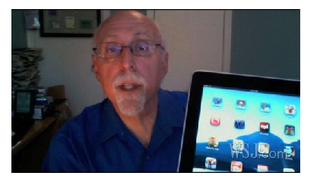
    Picture 2  Walt Mossberg reviews high tech for the WSJ, here is his review of the iPad. 

    Kindle from Amazon is catching on, Barnes and Noble as well as Sony all have readers out, all are incompatible with one another, hello personal computers of 1981, so if there will be a game changer this is it. 

    Personally, I don't see a friendly way to hold it, books are smaller, laying on a table will be hard to read, there is a stand with a USB I think but that is just more stuff to lug around.

    Anyway Apple is selling a bunch of them and the stock price just went to a new high. We report, you decide. 

  • Professor Elam

    Wed March 31, 2010

    Mish (see link at left) reports the following on state pension plans.

    His point is that these defaults will be deflationary, expectations of future income will not be met. This means less money to spend in the future on everything from eating out to vacation cruises. And it means a lot of very unhappy pensioners. The reactions we can expect are on display in Russia and Greece now. 

    Fictitious Accounting 

    Fictitious accounting allows states to pretend their pension plans are in better shape than they really are. Hawaii, Montana, New Jersey, Illinois, Mississippi, Ohio, New Mexico, Rhode Island, and Alaska all have unfunded liabilities of 50% or greater. 20 states have unfunded pension liabilities of 40% or greater.

    Most states have pension plan assumptions that assume a 7% rate of return or higher. Such returns simply will not happen. Worse yet, another downturn will cripple states.

    $5.17 trillion in pension obligations is a hell of a lot of money. How will it be paid? The answer is it won't.

  • Professor Elam

    Tuesday March 30 2010

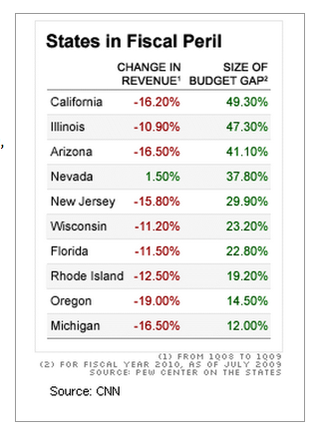
    Picture 3 Last night in class I mentioned pensions woes in various states were causing problems. Here is the extent of the problem and it is serious.  In addition to overly generous pension promises, property and sales tax revenues have fallen as the states continue to spend more money. The November elections should be interesting. IL is a bit larger than Greece, CA is about the size of Spain or Russia. 

    The accounting link here is that governments and business have hidden long term liabilities off their balance sheets. Now those liabilities are becoming more evident. Fitch downgraded IL to A- yesterday. 

  • Professor Elam

    Monday March 29 2010

    My classes are no doubt weary of hearing me say that they must immerse themselves in the study of accounting. My parallel is the example of Mike Phelps, Olympic swim champ, practicing every day. Here is the same idea expressed by no less than Michael Jordan. 

    Or

    the race is not always to the swift or the strong, but that's the way to bet

    Damon Runyon

    Practice Doesn’t Make Perfect, but It Comes Fairly Close
    “I’m not out there sweating for three hours every day just to find out what it feels like to sweat.”
    (Michael Jordan, 1994)

    Stillwater, OK—March 29, 2010We are not all blessed with the brains, beauty, luck, and capital that we associate with highly successful business people or entrepreneurs. Although most new business ventures fail, a few prosper and grow rapidly. A new article from theStrategic Entrepreneurship Journal demystifies this game of success, and shows that exceptional performance is not necessarily the direct result of special talent, experience, or sheer luck. 

    Instead, it derives from engaging in sustained, intense, and deliberate practice in a particular area of expertise, in order to improve performance and cognitive thinking levels. Lead author Dr. Robert A. Baron says, “The same principles that apply to starting a new venture, such as self-regulatory mechanisms, and delaying gratification for a more long-term goal, apply to the process of getting in shape athletically. Through a sustained, intense effort someone can build the strength of their body or their business.” 

    The authors show that across many fields of expertise most people work only “hard enough” to achieve a level of performance that is deemed “acceptable” by themselves and others, with no further gains. Through the principle of deliberate practice most anyone, the authors claim, can rise above this plateau to true excellence. 

    Entrepreneurs can acquire new capacities that can assist them in starting or running a new venture, or allow them to adapt to unforeseen circumstances, such as a drop in the economy, or PR crisis. These capacities include an ability to zero in on the most important information in a given situation, and more easily access valuable information stored in the long-term memory, or by increasing the capacity of short-term working memory. These factors also help secure a positive outcome: preparation, repetition, self-observation, self-reflection, and continuous feedback on results. These efforts lead to a healthy self-efficacy, or an individual’s confidence in their ability and what is known as mature intuition. 

  • Professor Elam

    Monday March 29, 0210

    We are studying the calculation of pension costs. Vallejo, as Mish says, was the first city to take bankruptcy, in the latest financial crisis. But BK is all about a fresh start, that is hardly the case here. Too many places have off balance sheet liabilities far exceeding their ability to pay. This is the big problem and it must be addressed this year.

    From  Mish Shedlock, today

    In 2008, Vallejo, Calif., was nearly broke. Faced with falling tax revenues, rising pension costs, and unmovable public-employee unions, the city was unable to pay its bills and declared bankruptcy. Now, as it prepares to emerge from Chapter 9, officials in Los Angeles, San Diego and other cities across the state are looking to see if Vallejo has blazed a trail for them to get out from under their own crushing pension costs. What they're finding is that even bankruptcy may not be enough to break the grip unions have on the public purse.

    A report issued by the Cato Institute last September noted that 74% of the city's general budget was eaten up by police and firefighter salaries and overtime along with pension obligations.

    The study also found that lavish pay and benefit packages were a root cause of the city's problems. In Vallejo compensation packages for police captains top $300,000 a year and average $171,000 a year for firefighters. Regular public employees in the city can retire at age 55 with 81% of their final year's pay guaranteed. Police and fire officials can retire at age 50 with a pension that pays them 90% of their final year's salary every year for life and the lives of their spouses.

  • Professor Elam

    Monday March 29, 2010

    Trump Soho is a multi story hotel condo in NYC, but the rooms did not sell. Now the lenders are selling their mortgages on the property, cheap.  The Donald of course was smart enough to talk the lenders into going it alone, no capital from  him, note to lenders, watch The Apprentice….it's cheaper than learning the hard way, story in the WSJ

  • Professor Elam

    Sunday March 28 2010

    Camera,
    Gustavson, Todd,ISBN 978 1 4027 5656 6,2009

    This
    is a ‘coffee table book’ large, heavy, and replete with interesting photographs
    of people and the cameras that took the photos.  Gustavson is the curator of the Eastman Camera collection.
    Naturally the book had the ‘kodak’ point of view.   A few observations from reading the book


    ·     
    As always, breakthrough inventions seem to be the work of one or two
    people, even today, as Steven Sasson at Kodak saw the future of electronic
    imaging, Kodak makes such sensors now

    ·     
    Once Gladwell’s Tipping Point is reached a new technology takes off,
    Brady opened his studio in NYC in 1844, Lincoln partially credited his Brady
    photograph for making him President

    ·     
    Cameras of the 1800s reflected the craftsmanship rather than mass
    manufacturing of that day with gorgeous walnut bodies and brass encased lenses

    ·     
    The French were active in science and manufacturing until 1900,
    apparently WW I and the socialist state mindset only allows for cheese, wine
    and fashion, forget cameras (okay Bugatti had  a fling in the 1930s with cars)

    ·     
    Eastman Kodak saw the virtue of mass marketing in 1900, and that the
    money was in the software, the film, not the camera

    ·     
    The name Brownie did not come from Brownell who made the cameras for
    Eastman but popular characters from a children’s book by Palmer Cox,, nothing
    new about Buzz Lightyear eh?

    ·     
    Kodak was still making a serious camera after WW II but the book
    glosses over the fact that Kodak exited serious cameras for the far more
    lucrative venture of processing the film for all camera makers

    ·    Picture 2   
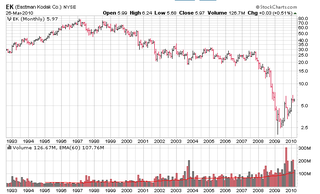
    The book makes no mention of the financial difficulty EK has had moving
    to digital imaging.  While there
    are Kodak machines seemingly everywhere, the stock has not recovered trading at
    $6, the firm has negative equity and is not producing cash flow. Hmm, it will
    be ironic if the firm that got America taking pictures and that first made
    electronic sensors goes bankrupt but it certainly looks that way. 

      We will shortly be studying earnings per share and cash flow. Go to finance.yahoo.com and look a at the income and cash flow statements for EK. Now look at the equity sections over the last few years of the balance sheets. The deterioration is evident, as seen in the stock price. EK is not producing income, not producing cash flow, and the OE of A = L + OE is now negative. This will not last, apparently the slowdown in the economy has affected the number of photos processed at EK booths across the country. 
  • Professor Elam

    Friday March 26 2010

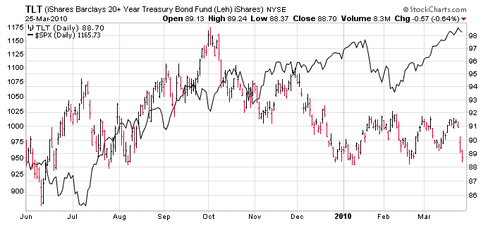
    Bill Gross runs the largest bond funds on the planet at PIMCO. Yesterday he said the three decade bond party, lower yields, higher prices, had finally ended. PIMCO that has only offered bond funds is now offering stock funds, so investor sentiment is completely opposite what it was a year ago. 

    Below stock prices shown by the SPX in black are headed up., Bond prices in red and black shown by the TLT fund, are dropping fast. This is the same scenario we got in 1987, at least until October when stocks crashed and bonds rallied, hmm, history repeats?  We have mentioned this numerous times and will continue to track it closely.

    Picture 6
     

  • Professor Elam

    Wed March 24 2010

    Picture 6 


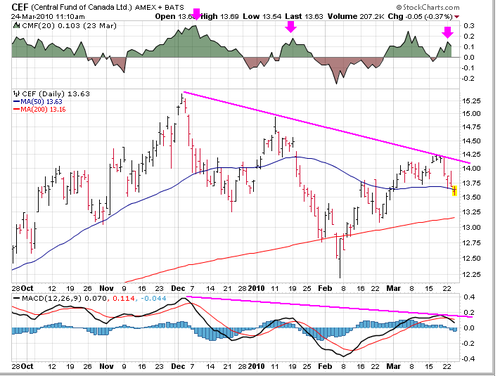
    We made the case this past weekend that it was not yet the
    time to buy gold, that  is being
    born out in trading this week. We prefer to look at CEF as it represents real
    market buying and selling in gold rather than the commercial specs shorting at
    the FED versus the public in the commodity gold market. Here money flow at top
    continues  to deteriorate. The
    dollar is up again today but there is only so much we put in one graph.   CEF is recording lower highs and
    lower lows, a bear market since its top in December. The same if true for ASA
    and GDX.

    There will be a time to move to gold but we are not there
    yet.