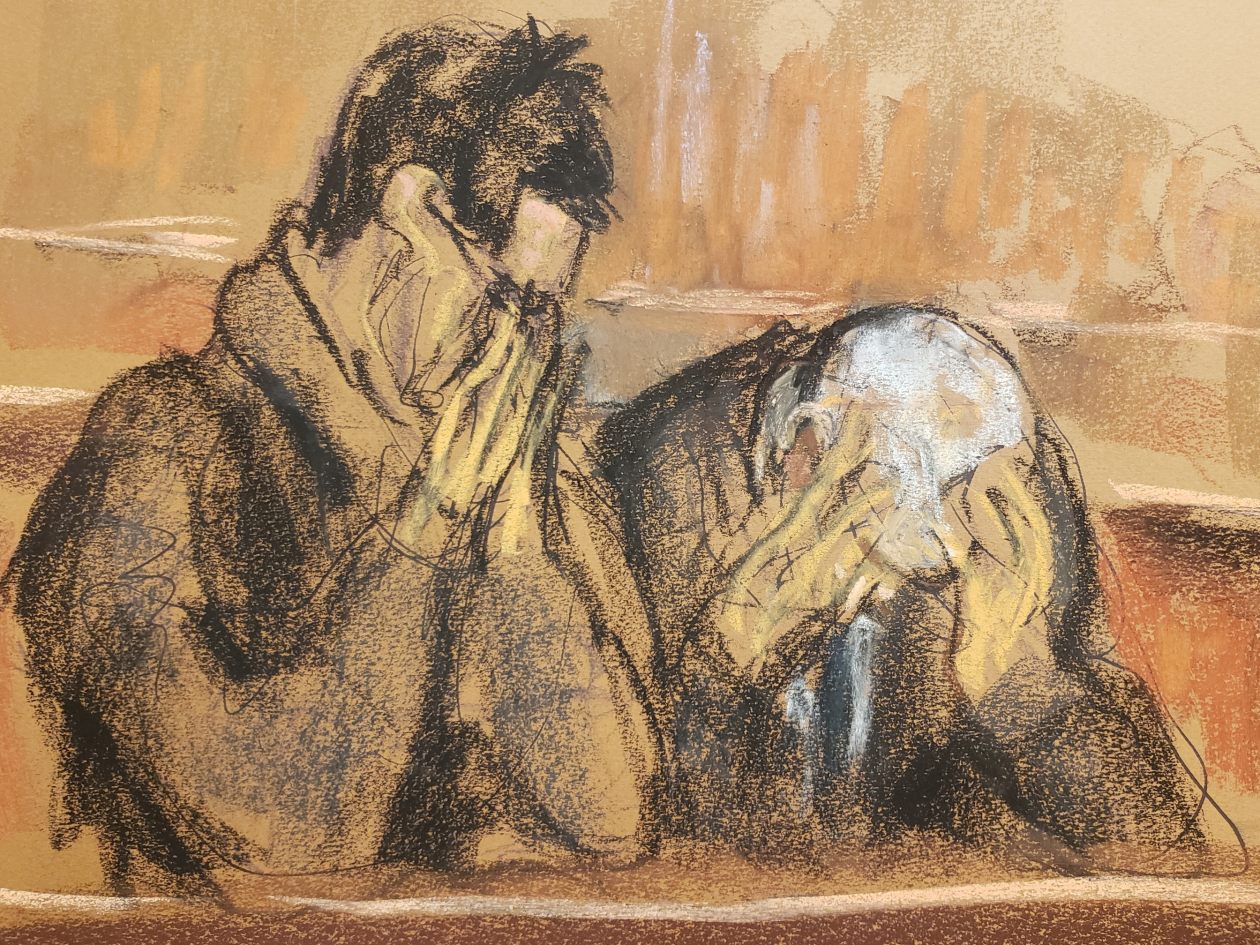
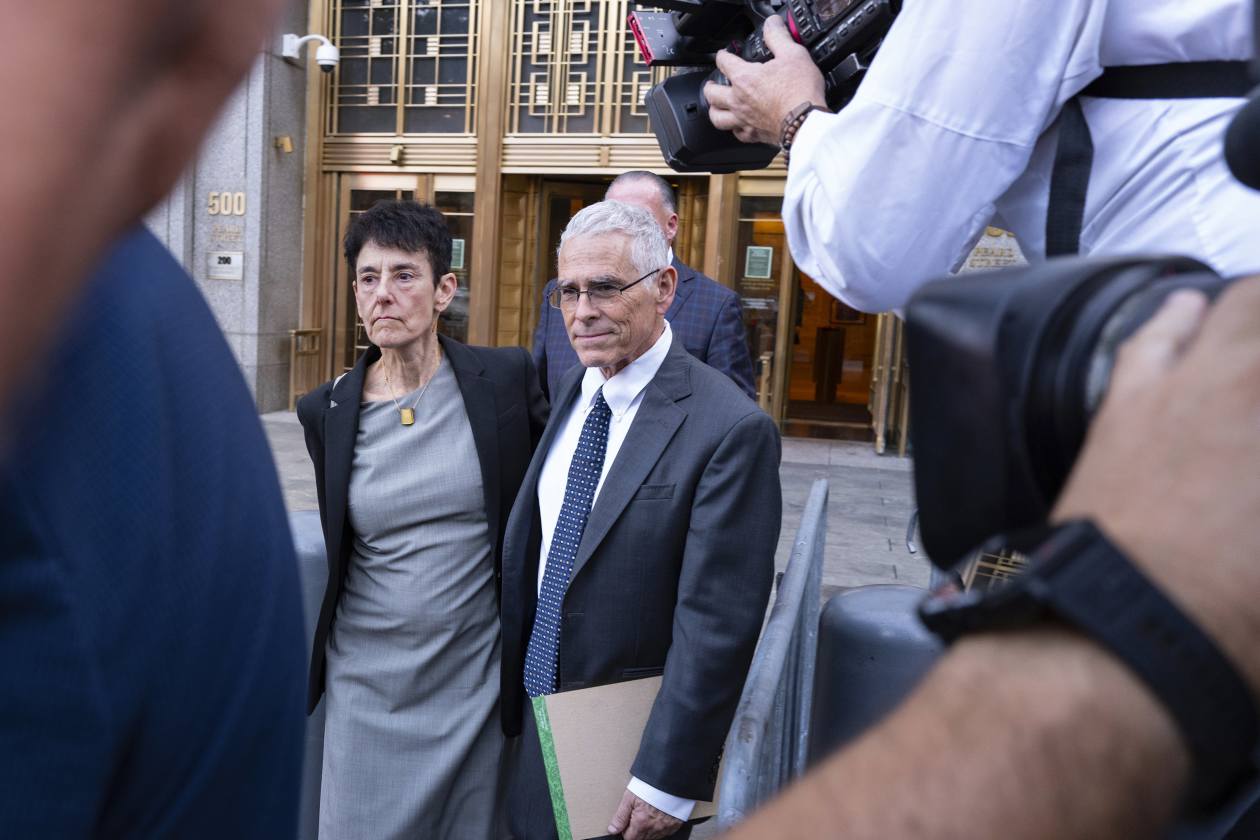
During the trial for disgraced crypto-wunderkind Sam Bankman-Fried, the courtroom artist did an inspired, almost abstract evocation of his parents at the moment of the crushing verdict. His father is bent over, white head in his hands, his mother is covering her face; the shadowing of their dark clothes merges them into a single mountain of unspeakable grief. Journalists in the room were equally riveted by their reaction, writing about Barbara Fried “crumpling” and Joe Bankman “doubling over” and of them “holding each other up.” Covering their faces would not shield them from the intense scrutiny aimed in their direction.
As Stanford law professors, they are an unlikely couple to be watching their son remove his tie and shoelaces as he is taken off to jail. Fried taught legal ethics, and Bankman has focused on financial regulation—details that would seem a little heavy-handed in their irony if they were in a novel someone was writing.
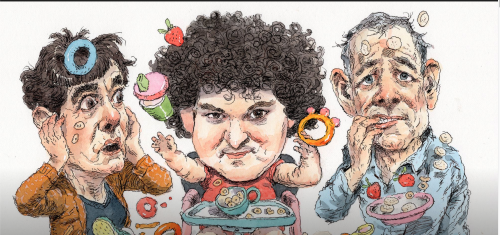
The wildest dreams and worst nightmares of a certain type of parent are entangled in the SBF story. Their child succeeded beyond their expectations and rebelled slightly by entering the world of finance, but upheld their beliefs by giving away huge portions of that money, but then flouted those expectations again by becoming a convicted criminal.
Even as the evidence against him mounted, his mother’s fierce faith in him was absolute. As she told Sheelah Kolhatkar of the New Yorker in a lengthy piece last September, the whole family cares “about only one thing, which is Sam’s innocence.” She was so certain of his innocence that she didn’t even ask him if he did the things he is accused of. Over the course of the ordeal, she lost 10 pounds.
It was astonishing to think of these very smart people sitting through the trial and continuing to believe their son is innocent in the face of overwhelming evidence to the contrary. Avid trial watchers were gripped by the immensity of the self-deception, by how completely impossible it seemed for them to see their son with anything like rational judgment. Bankman said, “I think most parents would much rather die, frankly, than see their child accused of such horrible things.”
Part of the fascination of the trial was the inevitable confrontation between parental love and harsh reality. There was, in the press and the public, a hunger for Bankman and Fried to process that their son had committed the crimes he was accused of, which, of course, they may never do. In the Verge, a reporter actually asserted, “Whatever delusions they may have had about their son’s innocence dissipated over the course of trial,” but there is no evidence that this is true.
The spectacle raises the unsettling question: Can any parent see their child clearly? One wonders if the idées fixes we have about our children—“Sam will never speak an untruth. It’s just not in him,” Fried said—are often delusions or fantasies. If we are all this blinkered or blind on the subject of our sons and daughters. If we will follow them to any dark place they go. Sam was pretty conspicuously and flagrantly lying on the stand, but his parents may never believe that.
The story of SBF’s parents shows us how deranging parental love is. The values they held were upended. Their entire selves were reorganized by this calamity. They have been forged into different human beings.
Bankman and Fried’s friends and colleagues are often quoted calling them “ethically fastidious” or “deeply ethical,” but these ethics seemed to fall away in the face of their son’s improbable success. The couple had not become partners in big law firms; they had chosen a less lucrative, more intellectually stimulating, principled path. And yet, the proximity to enormous, dizzying sums of money seemed to stir their imaginations.
Even before SBF was appearing on the cover of magazines as one of the world’s youngest billionaires, the father began working for his son’s companies. Bankman liked to say that he was “the adult in the room,” but he was also the lawyer in the room. Former employees were quoted by Bloomberg saying that SBF “consulted his dad constantly,” and he was on several group chats charting the demise of FTX.
There was talk in the trial about how the company didn’t have a “risk-management team,” but aren’t your parents supposed to be your risk-management team? Why didn’t Bankman see what was going on or pressure Sam to put lawyers with regulatory experience in place to make sure everything was above board? One answer that suggests itself is that he was blinded by the huge, disorienting amounts of money; he didn’t want to see what was going on.
Bankman told the New Yorker that he and Fried signed the deed to a $16 million oceanfront Bahamas house “in error.” But for Stanford law professors to sign a document like that by mistake stretches credulity. According to their representatives, they later had the company assure them that it would take ownership, but the excitement of the fabulous property seems to have temporarily addled their judgment. There is also the now infamous email in which Bankman complains to his son (“Gee Sam, I don’t know what to say here”) about his $200,000 salary, saying he was expecting a million dollars. This does not sound like someone leaning toward the austere intellectual pleasures of principled, academic life.
One has to imagine that the celebration of Sam’s wild and bewildering success contained within it a feeling of relief. There had to be points in Sam’s childhood where his parents were worried about him. He had no friends. He did not seem to be neurotypical (Sam had to teach himself to smile so other people wouldn’t be put off by him, according to Michael Lewis’s new book). He was dangerously bored by school. He played too many videogames. They must have worried about how he would find a place in the world, if someone could love him or he could love someone else, if he would ever have friends. One moment where Fried broke down was when the prosecution showed a photograph of her son and his friend Gary Wang at happier times at college, before Wang betrayed him by testifying for the government.
One can imagine Bankman and Fried reassuring each other about young Sam late at night: He’s so smart, he’ll be fine. They were the kind of parents who believe in the transcendent power of intelligence, that it operates as its own kind of protective charm or salvation. He would find his way because of that.
They also must have had faith in the ability of their world to protect him: the house on the Stanford campus nestled in the redwoods and cactuses; the crowded dinners with academics debating philosophical tenets and discussing the news over plates of pasta; the math camp in summers, “math circle” on Saturdays; the enrichment classes before school. They must have felt that their resources, their intelligence, their dedication to causes outside themselves would protect this slightly unusual child.
But now they, like the rest of us, are reading headlines like “How Sam Bankman-Fried’s Elite Parents Enabled His Crypto Empire.” Their son is facing a maximum of over 100 years in prison, and it seems unlikely that they will see him sitting around a dinner table again, let alone holding his first child.
One fascination of this operatic family saga is what it reveals about the ultimate futility of privilege and the limits of our ability to truly save or even help our children. You can do all the right things, correctly identify and nurture your child’s strengths, infuse in them morally upstanding values, and they can still crash and burn. What we are seeing in this story is the failure of good intentions, or good values or substantial resources to protect a young person.
The chatter surrounding his parents necessarily involves a lot of speculation and armchair critique. Did they ignore some warning signs about his challenges? Did the philosophical back and forth at the dinner table detach him from certain realities? Did they fail to impress upon him the consequences of his utilitarian ideas—to instill the principle that the ends don’t always justify the means—because they were so proud of his precocity? Was their sin the blinding pride they took in their extraordinary child? Did they give him too great a sense of his own specialness? Should they have made absolutely sure he understood the difference between the videogames he was constantly playing and the money he was moving around in real life? Did they allow him out into the world with too much confidence?
Many of us long to discover some fatal misstep, something Bankman or Fried did wrong as parents, some way in which they could have acted differently to save their brilliant but dangerously arrogant son. Say, limiting his screen time or communicating more clearly that rules apply to everyone, even the children of Stanford professors.
Yet we may only find how helpless parents are to ensure the happiness or even basic well-being of their child. “Saving Sam is the major project of our lives,” Fried said, and it is also the project at which they will most spectacularly fail.
Katie Roiphe is director of the Cultural Reporting and Criticism Program at New York University and writes the “Personal Space” column for The Wall Street Journal. She is the author, most recently, of “The Power Notebooks.”





 Professor Elam