• Professor Elam

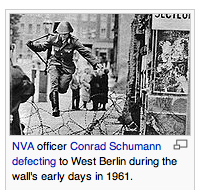
    Picture 1  A pro photographer has created an application to enhance picture taking with an iPhone. As he says, the best camera is the one that is with you. Chase Jarvis is right, capturing the moment is the thing. This may be a photo of your kid at a ball game or a shot like this one fifty years ago along the then newly constructed Berlin Wall.The photograph is a visual statement that no matter what the Eastern Block did, there was no putting a lid n a person's desire to be free. The fact that I easily found the image speaks to its timeless nature. 
    Picture 3

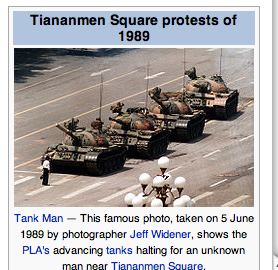
     Such shots were taken on the spur of the moment without thinking about idea camera settings.  The image of one person  standing against the tank in Tieneman Square is another example. 

    Where am I going with this?  When I was trading the bond market in the 1980s. computerized charts were the purvey of only the high end firms that could afford such technology. Indeed I spent a day in the Merrill Trading room in New York City and saw a computerized real time graph of the bonds as traded in Chicago. But back then such tech was only found in exotic spots like the Merrill trading room. 

    Now I have have the same technology for a few bucks a month. But did I get any better at trading? Uh, no. 

    Back then I subscribed to a paper chart service that was updated once a week. During the week  I would study the last week's  chart, mentally or possibly making a few pencil marks for the progress of this week. Perhaps that level of concentration made me think more about what might happen that week.  I did not have computer updates, this was 1984-87. So to stay current I bought two 19 inch tvs, and put CNN news on one and FNN (the forerunner to CNBC) on the other. FNN updated the bond market every half hour and I knew if anything really big broke, one or the other would tell me about it. That system worked. Let's remember that Newton had neither a calculator nor a computer when he essentially invented calculus. The Greeks had no cad cam computers in designing the parthenon, the Romans likewise lacked computers  in designing the coliseum, the cathedrals in midevil Europe were likewise constrained. 

     Kirk Tuck a pro photographer in Austin makes the point that a zoom lens makes us lazy as a photographer. With a zoom the photographer does not have to move A fixed perspective  or prime lens forces us to move is we want more or less in the picture frame. (35 mm cameras used to come standard in film days with a 'norman' 50 mm lens)  Kirk makes the point that forcing one to move forces one to consider different perspectives in a way that a zoom lens never will. 

    Power Point has more possibilities than I can learn. But dazzling the audience with various fades and dissolves will not likely make the lasting impression that say either of these images do above. For example, a Navy Vet in my class one showed us a night satellite photo of the Far East. One could easily make the outline of Japan and the coasts of Korea, China, Russia. But when one looked at the area of North Korea, all was dark. His point was dramatic and clear, there is no light in North Korea. That was literally true, and metaphorically true for its oppressed citizens. To this day that was one of the most memorable presentations in the ten years I have taught college. 

    So go for a statement, keep it simple, Hannibal used elephants to cross the Alps, Matthew Brady photographed the Civil War with a giant still camera, both made history. 
  • Professor Elam

    Sat Dec 26 2009

    They just fail to plan, so goes the axiom in the life insurance industry.

    Arrow Trucking of Tulsa OK apparently did both, Arrow cancelled the gas credit credit cards of its truck drivers this past Tuesday.This left drivers stranded across the country.  Worse, drivers received bus tickets to get home

    As the article says, a company with hundreds of trucks would normally have  a planned bankruptcy. It sounds as though the company delayed making a decision until there was literally nothing left. We study budgets and planning in cost accounting. This is a tragedy for Arrow, and even more so for its employees.

  • Professor Elam

    Now CPA seeks $32 B from former, am I reading this right, partners?

    this is shaping up like a great potential ethics class, no lack of things to discuss…

  • Professor Elam

    Bexar County Democrats are coming to grips with a bad decision. Dwayne Adams has apparently embezzled $200,000 of his party's money. As I put together the syllabus for the Accounting Ethics class, It is always interesting that there are plenty of current ethical failings to serve as examples. I never need to go back to a previous class. 

    I went to the SA Express News Article on line, click and read the comments about Dwayne Adams, not to mention the overall incompetence of local government. 

  • Professor Elam

    No Such Thing as Non Profit!


    Are
    you involved in a non-profit organization? Do not confuse non-profit   with failing to generate cash!
    The use of the term non –profit regrettably has many executives in the industry
    deluded that they actually turn a profit. Nothing could be further from the
    truth. The downturn in the economy makes understanding this distinction more
    important than ever.

    One
    becomes a non –profit by qualifying under Section 501 c3 of the Internal
    Revenue Code. Such qualification means that the organization files a different
    tax return than organizations paying income tax.  The tax code is not our topic today. It will be vital that
    non-profit executives understand the origins of their cash flow to navigate the
    downturn in the economy.

    Accountants
    prepare three statements, a balance sheet, an income statement, and a cash flow
    statement. The cash flow statement is the most important in terms of the
    survival, of your non-profit. Let’s examine the three sections of the cash flow
    statement.

    Cash
    is generated from three sources. The first is Operations. Fund raising should
    generate more cash inflow than outflow. In that case Operations show a positive
    result. It is vital to understand that for some periods the organization may
    not generate sufficient cash flow to fund Operations. In that case, there are
    two other sources of cash.

    The
    second source (and use!) is investments. Cash not used in current operations
    may be invested in certificates of deposit or treasury bills, known as cash
    equivalents. These may be liquidated when needed. Other Investments include
    capital items like the truck to deliver meals on wheels or the kennel to house
    rescued animals. Clearly it is not in the interest of the non-profit to sell
    these assets for cash! Yet many companies are now selling valuable property to
    stay in business. Ford’s sale of 
    British Aston Martin is an example. GM’s failure to  Swedish Saab is a negative example. 

    If
    neither of those avenues are producing cash, the third alternative is
    Financing. Financing consists of borrowing from stakeholders, church bonds are
    a good example. Or bank loans may be employed. It is imperative to understand
    that this source of cash must be repaid. The inability of GM and Chrysler to
    meet their requirements finally exhausted the ability to raise cahs  in this third category. Had the
    government not come to the rescue, they would be out of business today.

    It
    is imperative to understand that the budget must plan for re-payment of
    borrowed funds (Financing). In addition it must provide for acquisition of
    assets (Investments) needed to fulfill the mission of the non-profit.  Successful companies like Google
    produce the cash they need from Operations and stock sales. Cash generators like
    National Geographic have multiple operations from magazine sales to television
    to fund projects.

    Yesterday
    the Salvation Army, one of the best managed non-profits, announced that Kettle
    Collections are down 20% from last year. Former donors are now in need of the
    Army’s services. This will clearly impact on its cash flow from operations. It
    may require additional financing. But the point is to make the right decision
    now.  Our point is Cash Flow has
    the attention of the Salvation Army; it deserves your attention too.

    Successful
    administrators are familiar with their cash flow statements. Like Santa, they
    will be checking them twice in these tough times. Make sure you avoid GM type
    problems by knowing your cash flow

  • Professor Elam

    US firms have had the largest dividend cuts since the 1930s. 

    NOw think what this means for stock prices. Yields therefore, dividend divided by stock prices have dropped. For yields to return to 'normal' levels, either dividends will have to be restored or prices will have to drop. 

    As stock prices have risen, price earnings ratios have risen. The higher the p/e the more risk investors are assuming, and for lower than ever dividend yields. No wonder insider selling at companies continues at a furious pace. 

    "It's not a very complicated story," said Charles Biderman, who runs market research firm Trim Tabs. "Insiders know better than you and me. If prices are too high, they sell."

    Biderman, who says there were $31 worth of insider stock sales in August for every $1 of insider buys, isn't the only one who has taken note. Ben Silverman, director of research at the InsiderScore.com web site that tracks trading action, said insiders are selling at their most aggressive clip since the summer of 2007.

    For those keeping track, the stock market peaked in the fall of 2007. 


  • Professor Elam

  • Professor Elam

    Picture 9

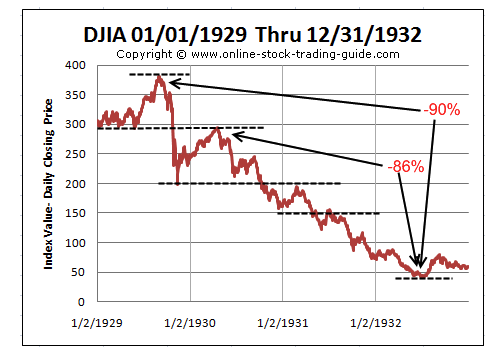
    We regret that stockcharts.com does not have data for the 1930s. Here is however a linear graph of what happened. THe market topped in 1929 and crashed that fall. 

    High 390

    Low 196

    Recovery 294

    At the recovery high everyone then, Hoover among them assumed things were back to normal. We are experiencing the same deja vu now, politicians are declaring their heroic efforts have saved the day. 

    But as the chart shows, the market rolled over and then really crashed over two years losing 86% of its post crash high! So where are we now?

    Picture 8 

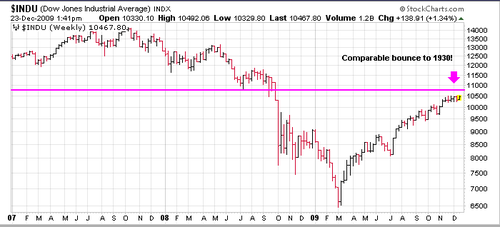
    One has to go back to October 2007 to pinpoint the pre crash high. THe market wandered for a longer period but finally settled down and crashed from 11,000 in the fall of 2008. It recovered this year and appears it will still be doing so into the spring, So the time horizon has been lengthened this time. The purple arrow and line duplicate the line at 300 shown on the top graph. 

    Note at top it took two years from that spring to find a bottom at 41! 1972-74 offers another parallel.

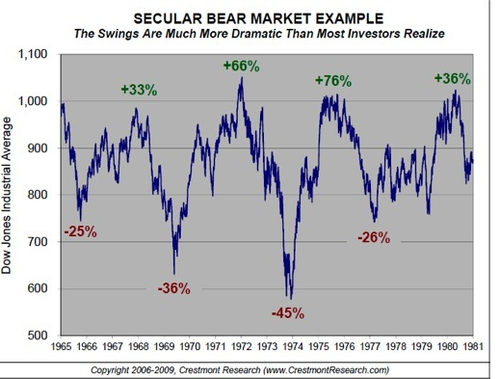
    Dow 66-82 

    The stagnation of the 1970s presents the same picture, huge rallies followed by huge declines. 

    We expect this will continue the next few years. The unemployment, the  negative equity in real estate, the weak bank sector all speak to problems to be addressed. 


  • Professor Elam

    Wednesday Dec 23 2009

    Banks got  a reprieve from raising more capital to offset, well read the article and you tell me what they are offsetting. The fact is that the banks need more capital and have instead questionable assets.

    The FDIC has granted more time but not the three years requested to implement new rules.

  • Professor Elam

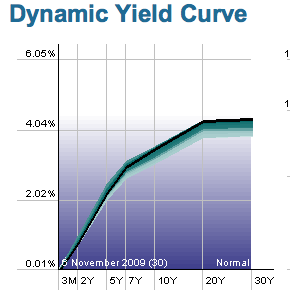
    Picture 3  The yield curve shows the difference in short and long term rates on one graph. The steeper the curve the greater the difference in short and long rates. Right now, long rates seem to be anticipating higher interest rates. Reports are that the difference in short and long rates has not been higher than it is now for many years. 

    An interesting graph is here. It allows one to see the yield curve at any point versus the S & P over the last few years. 

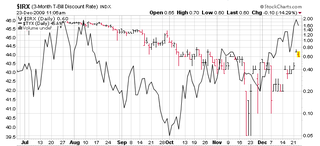
    Picture 5  We were surprised at the rise in very short term rates when we put this next  graph together. It compares the 3 moth T bill rate in black and red with the very long 30 year bond rate. 

    Point is, they are both going up. Bond holders and buyers are beginning to demand a higher interest rate to hold bonds issued by this government.