Japan was the envy of the world in 1989. Governors of US states trekked to Tokyo begging them to build plants in their states. Howard Davidowitz takes look.
Professor Elam
Accounting & Investing Info for San Antonio A & M
about
-
Professor Elam
-
Professor Elam
One of the most basic liquidity ratios is the current ratio, current assets versus current liabilities. Better yet, the acid test kicks out inventory and then looks at the debt. This author explains that ratio in terms of countries. Which is to say
"The minimum benchmark of reserves equal to at least 100% of short-term external debt is known as the Greenspan-Guidotti rule. Greenspan-Guidotti is perhaps the single concept of reserve adequacy that has the most adherents and empirical support."
My sense is that this Titanic headed to the iceberg scenario is off the radar screen for most students, and investors, it should not be, it will be the biggest thing to happen in your life, thus far.
-
Professor Elam
A junk bond has a rating below Baa, usually way below. The lure is the much higher yield compared to safer investments, the bet as Will Rogers said, is the return on your money versus the return of your money.
Investors have poured money into such funds since the crash, has the coyote run off the cliff after the road runner once again?
-
Professor Elam
This is interesting, CITI loaned Dubai $8 B last December 2008, after CITI received the TARP money. I guess things were not as difficult as we thought at the time. Dubai is that mid East city with the indoor ski slope, the Palm Island, and ahem, no oil. Can Mumbai and Shanghai be far behind?
-
Professor Elam
Meet Stuart Frankel. Stuart operates a Subway shop in south Florida. He hit on the idea of cutting the price of the foot long sandwich to $5 from $6. Hmmm, economic slowdown, cut prices, move more product. How difficult is that? AS you will see pretty difficult, at least to get headquarters on board.
We are discussing this article in cost accounting this week, I hope the adv class will read this before this evening's class.
-
Professor Elam
"It is not necessary to change. Your survival is not mandatory." – W. Edwards Deming
I found that Deming quote at Jesse's Cafe and it certainly describes GM today.
Fritz Henderson is out as CEO at GM. AS one observer remarked, it is not a good time to be an insider at GM, this is the time for an outsider.
As the article says the bankruptcy for years. There is an old expression in financial circles,
it's as though they were re arranging the deck chairs on the Titanic (thinking that would avoid the iceberg)
I frankly doubt changing faces at the top will drive more people to GM showrooms. And the truth is that we have more automakers than we need as America moves from buying 16 M to 10N vehicles a year.
Changing people will not change these realities.
-
Professor Elam
We have spotlighted the debt problem from California to Dubai, from the Cowboy Stadium to City Center in Las Vegas. We went micro and highlighted the Northeast ISD here in San Antonio, as well as a failed new museum. Here is a look at other debt bubbles. Note that the US is financiing more and more debt for shorter and shorter term. This is precisely what Bear and Lehman were doing with using commercial paper to leverage holdings of long term mortgages. When the mortgage payments fell behind, well, we were short a few musical chairs.
-
Professor Elam
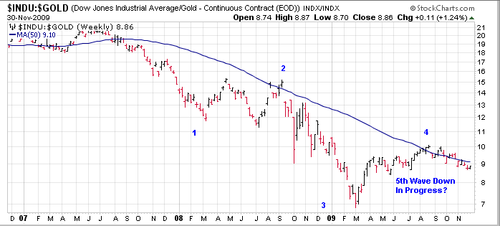
This is a ratio chart. It is a ratio of the Dow Industrial Average versus the price of gold. When the ratio direction is down, gold is net outperforming the Dow, which is the point of a ratio chart. It seems to me this displays a pretty clear elliott wave pattern. Wave two was sideways, wave four exhibits alternation by jumping sharply. Notably Wave 4 encountered resistance at the usual 50 week MA that turned the ratio back in fall of 2008. It would appear that a fifth and final wave to new Dow lows and new gold highs or of course come permutation lies ahead.
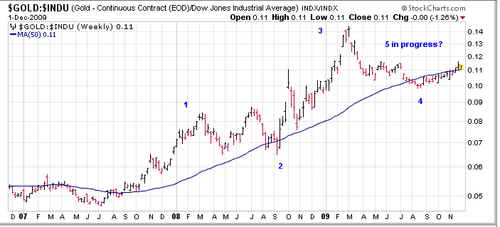
If readers prefer up to down, here is the same picture inverted. the chart looks like it is trying to go up to me. The Dow Average is being re priced in gold. -
Professor Elam
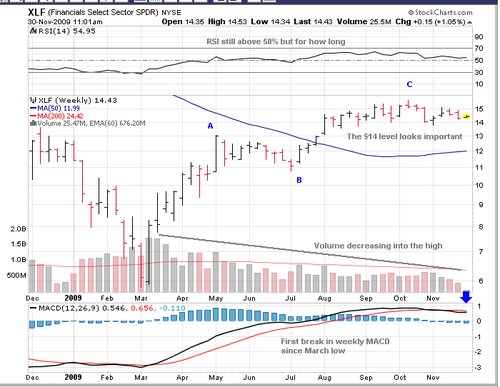
We are now in a corrective wave from the March lows. This is the bank or financial spdr,
after trillions of dollars of help we might add. Most of the comments are in the chart but here goesAt top RSI is still above 50% but for how long
The $14 level appears to be important for support for the
bank spdrVolume has been decreasing the entire way up
The MACD has turned negative for the first time since the
March low.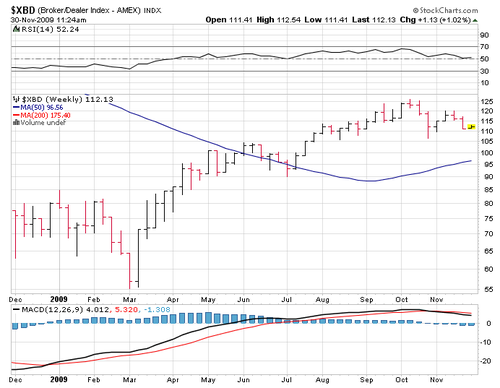
The chart for the brokers looks exactly the same, these two groups have had the benefit of billions of dollars of cash, the good news is in this market for now, they may have to make it on their own earnings for a while….
-
Professor Elam
Every so often a college professor wanders onto center stage with the public. This usually happens when he or she manages to actually connect some arcane theory with reality. A few examples
Harry Markowitz in the 1950s came up with his efficient frontier of risk and reward
Milton Friedman came up with Money Supply in the 1970s
Supply Side economics, the Laffer Curve got Reagan's attentino in the 1980s
The black Scholes model for option pricing won a Nobel Prize
And the guy with Freakonomics has sold a lot of books
Okay so what is the next brave new frontier of economics?
I think it is the first prof that points out the King has No New Clothes. Only manufacturing produces wealth. First we decided that the US would become a service economy. Then Jack Welch, the retired CEO of GE, started shipping intellectual property work overseas to China and India about 1989. So no surprise, we then decided to get rich investing in the stock market and playing state lotteries, indeed over 30 states now have lotteries, my take is that this is the only way citizens will continue to pay taxes.
BUt I digress. We have followed the stories of how make believe economies, Vegas, Dubai, Macau are now falling apart. The King has no new clothes, those are ultimate swap dollar service economies. There is no real wealth created, they float on a sea of minimum wage jobs. Shut the hotel for a month and there is nothing left.
Meanwhile the Tigers of Asia have built manufacturing economies. It is true the iPod was designed here and it is true the profits show up on the Apple financial statement. But where does the wealth reside? It seems to me that at the end of the day, the real wealth statement is
Who is a creditor
Who is a debtor
Whole countries like the US and Western Europe have become net debtors for the simple reason that citizens did not want to get their hands dirty so to speak. What's that old saying shirt sleeves to shirt sleeves in three generations? At the end of the Monopoly game, the group with the most income wins the game. Now China is lecturing the US on how to run the US banking system, quite a shift for a country that was pretty much destitute when Nixon went to visit, no heat in the buildings, etc.
So a new model needs to b e constructed that would probably include
Some sort of net money supply but divided by net borrowing,
or perhaps we adopt sort of a cash flow think for a country, does the wealth come from
earnings, and if so manufacturing or intangibles like renting hotel rooms
borrowings
investing, ie selling assets, rather like cutting up the wooden boat to feed the steam boiler to get to port, will we run out of boat before we get there?
My point is that 1800s England, 1900s US, 2000 China and India and countries that produce wealth like S Korea
Nevada and California may well be the window on what the US becomes by 2015
 Professor Elam