• Professor Elam

    Cisco Kid

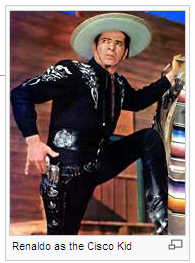
    As Toby Keith sings, I shoulda been a cowboy. And in the 1950s that is where the action was. Roy rogers, the Lone Ranger, Hop  a Long Cassidy, and yep, the Cisco Kid. Duncan Renaldo was an orphan but ended up playing the well dressed Cisco Kid on television.

    Hey Pancho, hey Cisco, the paif would exclaim!  ONe of those sidekicks with a funny name Toby sings about was Leo Carillo, or Pancho, cisco's sidekick.

    At a time when there were few Hispanic stars on television, the Cisco Kid  was a popular as any of them.

  • Professor Elam

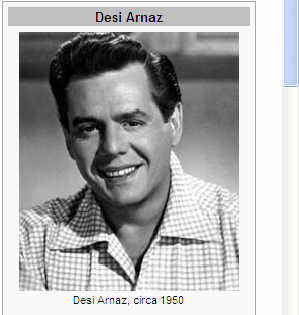
    Desi Arnaz

    Students are aware that I am a movie and film buff so no surprise. As this is Hispanic history month, my picks are those from the entertainment business.

    without a doubt, one of the more interesting books I ever read was Desi, the autobiography of Desi Arnaz. Desi and Lucille Ball single handedly created the modern television sittuation comedy. it has been said that someone somewhere  is watching an episode of i love Lucy at all times. click on  the hyperlink to read more about this remarkable Cuban band leader turned television producer. He and Lucy purchased the old RKO studio and renamed it Desilu. He was the first mega producer, he knew what America wanted to watch.

    Among his firsts, first mixed ethnic couple on television, first lady shown pregnant on television ( a big deal at the time), first live audience on a sound stage, the list goes on. While they were not able to live together,they stayed closed to the end.

    Lucy could not give up the role and continued trying to play it way beyond when she should have quit. Carol Burnet knew when to quit her series by contrast. At any rate, a landmark talen, check it out.

  • Professor Elam

    The New Civil War

    The Confederacy did not seek to actually overthrow the government of Washington, DC. Rather, the Confederacy wanted out of the arrangement to do as it pleased. Will we  shortly re-visit that old dissatisfaction?

    Consider three maps please. The first map is the Confederate States.

    The second map is the states that have adopted Right To Work Laws.  In those states one cannot be forced to join a union as a condition of employment.  

    The third map is the Red Blue State Map. This reflects states that have been predominantly Republican or Democrat in the last few elections. By this point the reader may have already realized that that yes, they are all the same map!  Now let’s look at the consequences of this long term split.

    Abraham Lincoln was the first Republican President. The South declared secession during his first term. At that time, and until the 1960s, the Democrats had the ‘solid south.’  This control was due to poll taxes and other  illegal devices to keep minority citizens from voting. In the 1960s that changed as Lyndon Johnson made Civil rights a Democrat Issue. The story of the Civil War was, like many wars, the story of a better industrialized North overcoming a much more rural South.

    That industry was still in the North as unions began forming in the 1920s-30s. With little heavy industry in the South, unions were simply not a southern issue. Today it is a very serious issue. The combination of entrenched management’s failure to respond to market change (Ford, GM, Chrysler) coupled with high union demands has sent, for example, the entire new auto industry to the South.

    Former economic backwaters like Alabama now sport billion dollar plants from Hyundai and Airbus, and their new workers. Notably, none are unionized. While Michigan’s Jeff Daniels begs industry to come to his native Michigan, it sports the highest unemployment of any state, over 15%.

    California, the eighth largest economy in the world, larger than Russia, is bankrupt. Payments to government union workers are routinely in six digits. New York City continues to raise taxes on its few thousand that actually support the City.

    Now the government is making subsidized jobs programs of former companies like GM. The giveaway of the company to the union, not the creditors, insures no one will invest heavily in such a union controlled venture ever again.  Toyota just left the California GM venture to re-locate Tacoma production to the new plant in San Antonio.

    As I write, Michigan and Nevada, union states, have managed to avoid the heavy taxes associated with the new health care legislation, thanks to their Senators. The question then becomes, just how long will the non subsidized workers in southern states support failed business models in the union shop states?  Clearly business is locating in the South, not the North.   

    Rasmusssen reports that only 16% of voters approve of the job Congress is doing. The disapproval of the President is now eleven  points higher than his approval ratings.    Fifty-nine percent (59%) of U.S. voters believe that the current level of political anger in the country is higher than it was when George W. Bush was president. This finding is in perfect synch with what one would expect in a recession, anger is growing .

    The longer this goes on,  the subsidies, the handouts to failed business models in states and cities, the higher the dissatisfaction will be.   The idea of a United States has considerable force but consider what happened recently in Quebec. The referendum took place in Quebec on October 30, 1995, and the motion to decide whether Quebec should secede from Canada was defeated by a very narrow margin of: 50.58% "No" to 49.42% "Yes".

    No doubt the politicians in Washington, viewing the dissatisfaction in town hall meetings dismiss such a possibility here. (Professor Igor Panarin ten years ago predicted a break up of the United States).  As Yugoslavia and the Soviet Republics broke off, and now even Scotland examines its ties to Britain, could this happen here? 

    Final Note, stocks and the oil price appear to be in topping mode for October…
  • Professor Elam

    The Div ersity Section meetingof the American Accounting Association AAA will be here in San Antonio Friday and Saturday October 2-3. It will be at the marriott Riverwalk.  THe AAA is the organization for academics as opposed to the Texas society of CPAs and AICPA for practitioners.

    The program is on line.

    I will be presenting Career Expectqations of Accounting Students from 2:00-3:30 PM Friday Afternoon.

    This paper has been posted on line at the Blackboard sites for my various classes.

    If you have never attended such a meeting you might consider coming to see some of the presentations.

  • Professor Elam

    Students

    I posted an academic paper I will be presenting at the Americn Accounting Association meeting at the downtown Marriott this next Friday or Saturday. If you can, I suggest you consider attending as this is the chance to see academics doing what they are supposed to do, present research.

    It is posted under Content for each course I am teaching this semester. Ladies, your interest in accounting fostered my interest in this paper, take a look, I encourage your responses. More on the time when I find out  this week.

  • Professor Elam

    We will be studying leasing, debt, and pension contracts in intermediate accounting.

    AN alert student spotted this article about ten companies that are potential bankrupts.

    Take a look, the list may surprise you.  

  • Professor Elam

     Note to Students

    I comment frequently on how social mood affects literally everything that happens. Here Bob Prechter, the creator of socionomics comments on how changes in the Beatles music caused him to postulate his social theories.

    Dennis Elam


    After college, Bob Prechter met Paul McCartney by chance in London and spoke with him briefly. The former rock-band drummer (Prechter not Macca, obviously) writes about going to a McCartney concert in Atlanta 34 years later in his current Elliott Wave Theorist:
     
    On August 15, I went to see Paul McCartney’s benefit concert at Piedmont Park in Atlanta. Given the current position of the Elliott wave structure of social mood, I suspected this might be my last chance to see him live, because Paul is a positive-mood performer, and the long-running positive mood is on its last legs. On that basis, the remastered Beatles catalogue, released on September 9, will probably turn out to be perfectly timed. –Excerpted from The Elliott Wave Theorist, Sept. 15, 2009
     
    What makes this concert particularly interesting is that it was the Beatles' music that first helped Prechter to make the connection between social mood and stock trends. Here's a Q&A that explains the connection.
    *****
    Excerpted from Prechter's Perspective, reissued 2004
     
    You were a musician back in the late 1960s and early 1970s. This background has obviously been an asset to you. Actually it helped the whole thesis gel in your mind! What prompted recognition of a connection between the trend in the market and pop music?

    Bob Prechter: Well, The Beatles’ Revolver album affected me viscerally. Although I have come to appreciate it since, I hated it when it came out. Sergeant Pepper was even worse. Besides two or three songs, where were the inventive melodies, harmonies, chord changes and joy that had made them stars? It was in thinking about that change years later that I realized that the melodic, energetic and rather innocent (at least in retrospect) music of 1958 to 1965, which included doo-wop, teen idols, girl groups, and particularly in the final two years, the “British Invasion,” stopped dominating the charts precisely at the end of Primary wave 5 in 1966. Quite abruptly, it nearly disappeared. Following the second peak in 1968, it was gone.

    You connected what you experienced musically to the trend change on the stock chart?

    Bob Prechter: Yes, and that’s what eventually triggered the realization that everything worked this way, all the time. Not just music. Not just in 1966.

    Did The Beatles change the public or did the public change The Beatles?

    Bob Prechter: Pop cultural heroes are made by the public, so the public mood determines who’s popular. The mood can also affect the creative direction of the heroes as well, so there are two effects.

    You have maintained that a song dominated by major keys, harmony, melody and musicality is representative of a bull trend while one dominated by minor keys, starkness and noise characterize a bear market sound.

    Bob Prechter: You can literally hear the difference between a bull and a bear market hit in the composition of the music.

    On The Beatles, which was known to most people as “the white album” of 1968, for instance, Lennon sang “She’s coming down, yes she is,” and on his 1980 comeback album, Double Fantasy, he declared, “Hard times are over, over for a while.” Applied to the stock market, those are two pretty good calls.

    Bob Prechter: Yes, but let’s not isolate a few lyrics to make our point. That’s a typical approach to cultural analysis, and it’s not scientific. Lennon wrote a lot of lyrics. But as a whole, your point is correct. His bull market lyrics stand in immense contrast to his bear market ones. What we need are objective statistics on pop music style and content and to see if the chart matches the stock market. I think it would demonstrate that mood and its expression through myriad outlets is an objective reality. It is difficult to prove because the social sciences are so primitive and data so scarce. Some day, people will start collecting the proper data. We may do it ourselves to prove the point.

    But people shouldn’t require data to understand what you’re talking about if they experienced the changes firsthand. Do you find that they can relate to the message on some basic level?

    Bob Prechter: Sure. Remember U.S. Secretary of the Interior James Watt’s embarrassment when he canceled the Beach Boys concert in Washington, D.C. in 1983 to keep out “undesirable elements”? Everyone laughed at him because they knew the Beach Boys don’t attract undesirable elements — they’re a bull market band. But no one could articulate that point; they just knew it was funny.

  • Professor Elam

     Note to Students

    I comment frequently on how social mood affects literally everything that happens. Here Bob Prechter, the creator of socionomics comments on how changes in the Beatles music caused him to postulate his social theories.

    Dennis Elam


    After college, Bob Prechter met Paul McCartney by chance in London and spoke with him briefly. The former rock-band drummer (Prechter not Macca, obviously) writes about going to a McCartney concert in Atlanta 34 years later in his current Elliott Wave Theorist:
     
    On August 15, I went to see Paul McCartney’s benefit concert at Piedmont Park in Atlanta. Given the current position of the Elliott wave structure of social mood, I suspected this might be my last chance to see him live, because Paul is a positive-mood performer, and the long-running positive mood is on its last legs. On that basis, the remastered Beatles catalogue, released on September 9, will probably turn out to be perfectly timed. –Excerpted from The Elliott Wave Theorist, Sept. 15, 2009
     
    What makes this concert particularly interesting is that it was the Beatles' music that first helped Prechter to make the connection between social mood and stock trends. Here's a Q&A that explains the connection.
    *****
    Excerpted from Prechter's Perspective, reissued 2004
     
    You were a musician back in the late 1960s and early 1970s. This background has obviously been an asset to you. Actually it helped the whole thesis gel in your mind! What prompted recognition of a connection between the trend in the market and pop music?

    Bob Prechter: Well, The Beatles’ Revolver album affected me viscerally. Although I have come to appreciate it since, I hated it when it came out. Sergeant Pepper was even worse. Besides two or three songs, where were the inventive melodies, harmonies, chord changes and joy that had made them stars? It was in thinking about that change years later that I realized that the melodic, energetic and rather innocent (at least in retrospect) music of 1958 to 1965, which included doo-wop, teen idols, girl groups, and particularly in the final two years, the “British Invasion,” stopped dominating the charts precisely at the end of Primary wave 5 in 1966. Quite abruptly, it nearly disappeared. Following the second peak in 1968, it was gone.

    You connected what you experienced musically to the trend change on the stock chart?

    Bob Prechter: Yes, and that’s what eventually triggered the realization that everything worked this way, all the time. Not just music. Not just in 1966.

    Did The Beatles change the public or did the public change The Beatles?

    Bob Prechter: Pop cultural heroes are made by the public, so the public mood determines who’s popular. The mood can also affect the creative direction of the heroes as well, so there are two effects.

    You have maintained that a song dominated by major keys, harmony, melody and musicality is representative of a bull trend while one dominated by minor keys, starkness and noise characterize a bear market sound.

    Bob Prechter: You can literally hear the difference between a bull and a bear market hit in the composition of the music.

    On The Beatles, which was known to most people as “the white album” of 1968, for instance, Lennon sang “She’s coming down, yes she is,” and on his 1980 comeback album, Double Fantasy, he declared, “Hard times are over, over for a while.” Applied to the stock market, those are two pretty good calls.

    Bob Prechter: Yes, but let’s not isolate a few lyrics to make our point. That’s a typical approach to cultural analysis, and it’s not scientific. Lennon wrote a lot of lyrics. But as a whole, your point is correct. His bull market lyrics stand in immense contrast to his bear market ones. What we need are objective statistics on pop music style and content and to see if the chart matches the stock market. I think it would demonstrate that mood and its expression through myriad outlets is an objective reality. It is difficult to prove because the social sciences are so primitive and data so scarce. Some day, people will start collecting the proper data. We may do it ourselves to prove the point.

    But people shouldn’t require data to understand what you’re talking about if they experienced the changes firsthand. Do you find that they can relate to the message on some basic level?

    Bob Prechter: Sure. Remember U.S. Secretary of the Interior James Watt’s embarrassment when he canceled the Beach Boys concert in Washington, D.C. in 1983 to keep out “undesirable elements”? Everyone laughed at him because they knew the Beach Boys don’t attract undesirable elements — they’re a bull market band. But no one could articulate that point; they just knew it was funny.

  • Professor Elam

    As students know I admire the writings of Prof Tom Sowell. This is a particularly good piece

    abotu being the undergod. I did nto know Prof Sowell was adopted.

  • Professor Elam

    These comments from Dave Rosenberg

    Market Musings & Data Deciphering
    Breakfast with Dave

    Read full article (PDF 435KB)

    September 22, 2009

    WHILE YOU WERE SLEEPING

    A freshly minted report from the Asian Development Bank forecasting faster-than-expected growth for the region — excluding Japan, growth is seen at 3.9% this year versus the March projection of 3.4%. This is having a fairly significant market impact this morning with credit risk declining, the U.S. dollar under renewed downward pressure (the Euro just crossed 1.48 for the first time in a year), commodities rallying right across the board, resource-based currencies, such as the Loonie and Kiwi (the latter also benefiting from a much lower current account deficit for the year ending June) and global equities, in most jurisdictions, in the green. U.S. equity futures are flying as the buy-the-dips psychology has become tremendously well entrenched — see Optimistic View on Rally on page 25 of the FT. A Barclays survey shows that bears are now capitulating en masse and now fewer than 1 in 5 believe this is a bear market rally ripe for correction.

    POST-CLUNKER ECONOMY LOOKING CLUNKY

    Edmunds.com just reported that U.S. motor vehicle sales so far in September are running at an 8.8 million annual rate — a 28-year low and a 38% plunge from the incentive-induced 14.1 million tally in August. If this is what autos do, imagine what housing does once the $8,000 first-time homebuyer tax credit expires (if it does) at the end of November (not to mention what the Fed does in terms of extending its mortgage purchase program beyond the December expiry too — it has had a hand in financing 80% of all new mortgage issuance. But look at the good news — at least we will be able to see what the economy can do without the walker.