• Professor Elam

    Gov Rick Perry says no to some stimulus money. He also made the point to Neal Cavuto on Fox yesterdayt that the Fed Govt would be in better shape if it followed Texas example of having some fiscal control, yikes!  What Next, A Don't Tread on Me Flag?  Barack, are you listening?

    My point is that the chorus of discontent with the bailoout is growing louder.

  • Professor Elam

    George Stephanopolous reports that the third choice for Treasury in one week has been rejected.

    Britain complains no one is answering the phone. No wonder…..

  • Professor Elam

    A Cato Institute writer questions the wisdom of the proposed tax policies of the new administration.

    The story of the golden goose is hardly new. Even Nancy Pelosi realizes that Silicon Valley is a Golden Goose, as does Barbara Boxer. But penalizing partnerships for accumulating wealth coupled with the ever increasing taxes of the Golden State, may see more firms packig off to say, Nevada or Texas.

    Tax Policy matters. Government does not produce or create jobs, it only moves the money around the same game board. Arguably the Far East produces the hardware as it has morphed from VCRs to iPods. But we produce the software be it movies or music. But wait, didn't Slumdog produced and made in India win the Academy Award this year?  My point is that the world is catching up, this is no time to punish the innovators.

  • Professor Elam

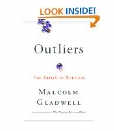
    Outliers 

    Outliers was rated by Tom Sowell as one of the most important books of 2008. I read it over the last two days, gee it certainly attracted my interest, and you should too. In fact I suspect we should shut down every class on campus and read and discuss this over the next week, it is that important. You can click and go to amazon and read about it. The essence of the book is that Gladwell examines successful people who stand out from the crowd, outliers as they are known statistically. These folks land two or three sigmas from the mean usually for 'inexplicable' reasons. Yet Gladwell digs to explain these anomalies. It turns out the explanation is usually simple. One the person is a product of timing, born at the right time. This may be a hockey player or a successful NY Jewish lawyer. Two, the culture brings a work ethic that other competitors simply do not have. Three, and this is very important, the person is the product of 10,000 hours of practice at their craft.

    This is easily understood in athletics. Individuals who show promise at athletics are showered with attention, usually from an early age. It is erroneously thought that individuals who show academic excellence at an early age are somehow 'gifted' and they too are showered with attention. Yet my own experience is that is not the case with students that have performed well in my classes. Too many have told me of mediocre previous school experiences. Once they begin again, as an adult, things change. They work harder, they focus, and they succeed.

    Gladwell manages to bring Chinese peasants, Eastern European tailors, Korean aircraft pilots, Bill Gates no less,  and immigrants from the Caribbean all under his microscope. The common threads of culture, hard work, timing, and success are amazing.

    Gladwell is also the author of the success Tipping Point.'

    I can readily see this in my own experience. I was a marginally successful debater in grades 10-11. Then things changed, a lot. I moved to another school district. The high school had a tradition of great success, they won the state championship the year before. We had hour long classes twice a day in speech. We attended every tournament of consequence in the area that year. The year before I attended two tournaments. IN the 12th grade for one stretch I attended one every weekend for six weeks. We read and studied the topic at least two hours a night. Guess what, I started winning.

    The same thing happened when I decided, finally, to study for the CPA exam, I had not been particularly interested in accounting previously, that changed. I immersed myself in it and passed the exam the first time.

    The same thing happened when I started studying bond market trading in 1984, not bond market accounting as we study in class, bond market trading, they are not the same. The result?   I became a successful bond trader.    Time spent studying  matters.

    Read this book.

  • Professor Elam

    Great Depression Survival Guide, Part II
    by Chris Mayer

    "Although most Americans think of the 1930s as a decade of economic stagnation, the period was far from being one of unalloyed decline." – Robert Sobel, The Age of Giant Corporations

    Robert Sobel's book is our chief guide for the second leg of the Great Depression Survival Guide. As his book's title lets on, it was the larger companies that did the best.

    To illustrate this point, let's start with the auto industry. In 1929, the auto industry sold more cars than it ever sold before – 5.3 million units. But the wrecking ball called the Great Depression hit the auto industry especially hard. By 1932, only 1.3 million units were sold.

    As you might imagine, plenty of automakers never made it out of the Great Depression. Moon, Kissell, Elcar, Marmon and others all disappeared. What they all had in common was that they were small. Some were specialty carmakers, serving a small niche that got a lot smaller – too small to make a business out of it. Novelties – like Franklin's air-cooled engines – were desirable when times were good, but no one wanted to pay for them when times turned bad.

    But the Big Three – GM, Ford and Chrysler – survived. In fact, the falling away of the competition helped that. It allowed them to fill in and consolidate markets. So we have our first takeaway.

    The survivors often had large-scale operations and were leaders in their industries. Smaller companies had a harder time dealing with the Great Depression, as Sobel shows in his book. But the sales and profits of the largest companies increased during the 1930s.

    What else did the Great Depression survivors have in common? Here are more of my thoughts based on Sobel's research…

    The survivors were self-financing. They didn't need their bankers as a source of funds. In fact, most of large Corporate America didn't need their bankers for loans. The flush times of the 1920s led to the near disappearance of corporate bank debt by 1929. Banks had to go elsewhere to find borrowers. They began to finance real estate heavily and broker loans for the purchase of stocks and bonds. Ultimately, the banks got in trouble with these bets, but most of larger industrial America stood on its own bottom.

    Take the Gulf Oil Co., for instance. In 1929, the company produced 90 million barrels of oil. It was like granite as far as financial strength goes. In the 1930s, Gulf was able to expand operations, gain a foothold in the rich Kuwaiti oil fields, increase its advertising budget, pursue undersea exploration and refinance what debt it had at attractive rates. "Most of this would have been impossible were it not for the firm's strong position on the eve of the Depression," writes Sobel.

    The winners also often had great leaders. GM had Alfred Sloan as its president through 1937. Sloan was a brilliant strategist and organizer. The harsh environment of the 1930s rewarded tight ships and the accumulation of small advantages. These were things at which Sloan excelled.

    In fact, Sobel goes on to say that GM actually benefited in a number of ways from the Great Depression. "A management aware of possibilities and [with] adequate financing could hold its own and even flourish during the Depression," Sobel writes.

    Sobel finds other examples in other industries, everything from American Can in the tin industry to the New York Yankees in baseball. "Good leadership and finances could expand and dominate in the 1930s," Sloan concludes. Hence, we reaffirm once again the value of a good operator, a point I stress in these pages.

    Industries that were hard to get into did best. Another other important point here is that Sobel finds industries with high capital costs that kept competitors out did better than those with low barriers to entry.

    This one also makes intuitive sense. In a depression, money is tight. And if it takes bucket loads of money to crack into an industry, it's not likely to happen. The chemical industry held up well in part because to get in the business required heavy capital spending on equipment and research and marketing. Companies like DuPont, Monsanto and Union Carbide held onto market-leading positions simply because there was no threat of new entrants.

    Oil refineries, too, were another example. Sobel estimates that one barrel of gasoline capacity required $240 of capital. By the end of the '30s, it would cost you $320 to add one barrel of capacity. On a per worker basis, the refinery industry was about 10 times more capital- intensive than the typical American manufacturer. Those high costs discouraged new competitors and kept prices for gasoline up. It's no surprise, then, that price of gasoline did not go down in the 1930s.

    Productivity gains helped. Since money was tight and business was slow, you had to be innovative to squeeze out profits. You had to husband your resources carefully, like a caravan mindful of its water supply as it crosses the Sinai Desert.

    In the oil business for example, oilmen got much better at finding oil. Necessity is the mother of invention, after all.

    Crude prices fell in the 1930s, from $1.27 a barrel in 1929 to only 67 cents a barrel by '33. So the oil biz had to rely on new technologies to improve results. And it did. For instance, in 1929, about a third of all drilling resulted in a dry hole.

    By 1937, that figure was down to 22%.

    That's just one example among many in the oil industry, and other industries as well. In general, Sobel finds that output per man – productivity – increased 20% in the 1930s.

    Expanding markets also helped. Despite what you might think, demand for everything didn't topple over in the 1930s. Demand for gasoline, for instance, declined only in 1932. From then on, the number of cars and trucks on the road went up every year. And so did the demand for gasoline. That helped the oil companies. Oil also got some help from other industries. The rise of aviation in 1930s required fuel. The oil companies made that fuel. And the demand for highways required asphalt, also made by the oil companies.

    Some industries today will also see expanding markets for their goods. It seems obvious, but the point was often overlooked at the time – and so, too, it is overlooked today: There is some base-line level of consumption for things like energy, food and water – even in depressions. This base-line consumption is bound to rise, if for no other reason than population rises over time. You can't say the same thing for decorative balls sold at Target for $4.99 a pop, or for fancy $30 candle
    holders at Pier 1. If you want to be sure your money sees the other side of this thing, stick with the necessities.

    "The principal preoccupation of almost everybody in the 1930s was getting by," the great A.J. Liebling wrote in May 1963.

    It's a good point to remember as you think about investing today. "Almost everybody" is key, though. For the companies that shared the characteristics highlighted above – such as the large-scale leaders with good financing and top managers in expanding markets – the 1930s was a time of opportunity.

    Regards,

    Chris Mayer
    for The Daily Reckoning Australia
  • Professor Elam

    Companies depending on retail discretionary spending may not make it.

    Note Landry's runs the restaurant on the San Antonio Hemisfair Tower as well as various seafood restaurants around Texas like Joe's Crabshack.

  • Professor Elam

    I am sure Facebook has a lot of socionomic implications


    I guess the obvoius one is what Dale Carnegie observed about us 70 years ago,
    we are the center of our own universe. While MSFT was operational software, Facebook is an extention of ourselves, our own personal coccoon on which we present ourselves to the world, the ideal platform  for the ME generation. And so everybody's doin' it, marketing firms, poilticians, you name it.
     
    The second slide in my derivative presentation is Zuckerberg  on the cover of Fast Company attired in a t shirt. Now with 175 Million users on  Fortune magazine , he is button downed all business. Gee what a difference a few years makes, and he is not selling to MSFT.
     
    When I was in college a Canadian named Marshall McLuhan made a big splash saying
     
    the media is the message, we will soon be a global village, Marshall was a man ahead of his time, the global village is now…
  • Professor Elam

    Texas Unemployment Fund is hundreds of millions of dollars below legally required levels.

    Students will recall that we studied employer SUTA State Unemployement Tax  requirements in Chapter 13 on current liabilities in Intermed Accounting. Read the article to get an understanding of what is about to happen.

    Employers lay off more workers.

    Workers file for unemployment benefits.

    The state fund runs low.

    Claims against employers as well as the new overall  low balance require the state to demand a higher percentage of the current payroll to be paid as potential state unemployment tax to replenish the fund.

    This could not be a worse downward spiral. At a time when we need more not less employment, employers are hit with more taxes to pay the unemployed which will act as a brake on hiring anyone else.

    The state plans on higher taxes and issuing bonds, really?  I have made the point that the munitipal bond market is going from bad to worse. This is already evident in California and New York. As I have mentioned it is only  a matter of time until the stronger states realize they are being asked to support the weaker, read bankrupt, ones. At some point taxpayers will realize it is every state for itself.

    Just this morning I heard someone saying we need prudent management of the problem. At the national level this guy's idea of prudent was $3 trillion of federal debt. Prudent?

  • Professor Elam

    Is there any name more synonymous with Texas wealth than Neimans?

    Click on the hyperlink to learn the details of Neimans $500 M + loss. DId Neminas really lose that much money? IN one quarter?  Well not exactly, the actual loss was more like $32 M, still substantial but not half a billion.  The rest is an accounting textbook lesson in how to read financial statements. Neimans had a half billion write down inimpairment charges and goodwill write offs. Neimans was purchased for by a hedge fund, another goldman deal, using you guessed it, lots of debt. Goldman peddled the debt to he public as a good deal.  If Neimans cannot make money during Christmas, remember their famous Christmas catalog, when can they make money?

    Write downs were taken on venerable names such as Horchow and Bergdoff Goodman.

    Here is a link to the designer names Neimans carries. How many of these will get marked down in the near future. This is what I meant that there are lots of derivatives in the marketplace. These names are a derivative in their value of the marketing cachet they carry. Of course when no one is shopping except at Family Dollar, the value of the cachet well drops….

    Expect that the impairment rules will require many more companies to take such 'losses.'

  • Professor Elam

    Ed Barnett wrote a letter to the Wichita Falls newspaper detailing the taxes he has paid.

    Ed says he will pay the IRS but in the meantime can he get the same treatement as a Cabinet Nominee?

    Ed is now a cause celebre for reflecting popular opinion on this matter. More signs of socionomic unrest…..