Chapter 11 is re organization is there anything left to re organize if they are going to close all the stores?
This illustrates the danger of making one big change across the entire organization.
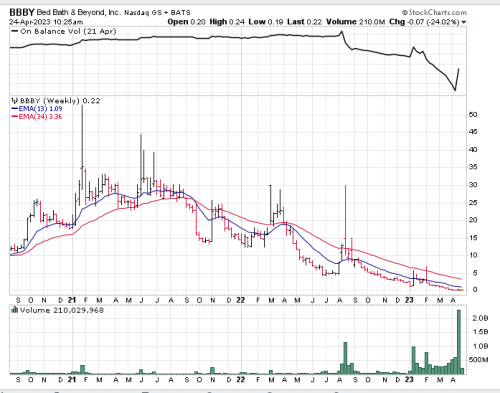
From $50 to zilch in less than three years. The new CEO dropped all name brand merchandise from the stores, Throw in covid absence of shoppers, debt and ka boom no more BBBY.
The same thing nearly happened to J C Penny. They let a new hire from Apple attempt to change all the stores at once. Apple sold about 20 items while JCP sold thousands, it nearly broke the chain. THey should have test marketed it i \t in a half dozen stores.
Japanese manufacturers have a phrase, kaizen. While it means continuous improvement it also implies making small not large changes all at once. In 5327 we discussed Deming's Total Quality Mangement philosophy last week. This is an extension of that same idea.
Example – the Toyota Camry mid size sedan was their best seller. Not it iw the Toyota RAV 4, a mid sized SUV. I drive a 2009. If you park mine beside a 20223, you can see they removed the full sized spre from the back door.Other wise it is remarkably similar, don't mess with success.
______________________
Kaizen (Japanese: 改善, "improvement") is a concept referring to business activities that continuously improve all functions and involve all employees from the CEO to the assembly line workers. Kaizen also applies to processes, such as purchasing and logistics, that cross organizational boundaries into the supply chain.[1] It has been applied in healthcare,[2]psychotherapy,[3]life coaching, government, and banking.
By improving standardized programs and processes, kaizen aims to eliminate waste and redundancies (lean manufacturing). Kaizen was first practiced in Japanese businesses after World War II, influenced in part by American business and quality-management teachers, and most notably as part of The Toyota Way. It has since spread throughout the world and has been applied to environments outside of business and productivity.[4]
Overview
The Japanese word kaizen means 'change for better' (from 改 kai – change, revision; and 善 zen – virtue, goodness) with the inherent meaning of either 'continuous' or 'philosophy' in Japanese dictionaries and in everyday use. The word refers to any improvement, one-time or continuous, large or small, in the same sense as the English word improvement.[5] However, given the common practice in Japan of labeling industrial or business improvement techniques with the word kaizen, particularly the practices spearheaded by Toyota, the word kaizen in English is typically applied to measures for implementing continuous improvement, especially those with a "Japanese philosophy". The discussion below focuses on such interpretations of the word, as frequently used in the context of modern management discussions. Two kaizen approaches have been distinguished:[6]
The Student Rating of Instruction (SRI) emails were sent to students today to their Jaguar email accounts. An announcement was also posted to Blackboard. Students can also access their SRIs via a link in Blackboard after they login. The SRIs are open now and will close on 5/8/2023 11:59 PM at 11:59pm.
Students have two options to access their Course Evaluations (please feel free to copy and paste the information between the bars into a communication to your students:
_____________
1.Blackboard. https://tamusa.blackboard.com/webapps/login/ Once you login you will see the "My Institution" page. Look for the “EvaluationKit Course Evaluations” module. Here the student will find their list of courses and the link for the course evaluations for each class the student is enrolled in.
2.Student Jaguar Email accounts. Student Jaguar Email link. Once you login to your Jaguar account, you will see emails sent by A&M-San Antonio Admin. You should have received one email for each class you are enrolled in. Links to the course evaluations are contained in these emails.
____________
We will be conducting a communication campaign to encourage your students to complete their SRIs. However, research indicates that the simplest and most effective way to improve your SRI response rate is to communicate with your students about why their feedback is important to you as an instructor, and to remind them about the SRIs at least twice.
Below is the announcement that was sent out to students. If you have any questions, please email Adam Sullivan, adam.sullivan@tamusa.edu.
Hector Barreto, 61, who led the SBA during George W. Bush’s presidency, pleaded guilty to one count of conspiracy to commit wire fraud and one count of conspiracy to defraud the U.S. government. The latter charge relates to conspiring to have nonprofits file false tax returns.
In exchange for the plea, prosecutors have agreed to drop four other charges against the California resident.
Barreto was charged with misappropriating hundreds of thousands of dollars contributed to two nonprofit organizations he once led. Most of the money was donated by prominent physician Dr. George Rapier III, the founder, chairman and CEO of San Antonio-based WellMed Medical Management Inc., either personally or through his charitable entities.
The wire fraud charge carries a maximum sentence of 20 years, while the charge of conspiracy to defraud the government has a maximum penalty of five years imprisonment. Under sentencing guidelines, which are recommended but not required, Barreto could face 33 to 41 months in federal prison when he is sentenced by U.S. District Judge Jason Pulliam on Aug. 2. Prosecutors will not oppose a sentence at the low end of the guidelines.
On a staff call this week, a senior Ernst & Young executive delivered an exhortation to the troops: Bill clients “every hour we can get our hands on.”
A failed breakup attempt cost the company $600 million. Employees are angry. But that might be the least of it: The outlook for EY’s business of charging for advice and accounting is getting weaker in the U.S. by the month.
The giant U.S. arm is “falling short” of its revenue and profit targets, executives said on an internal call, one of many in recent days that captured the gloom hanging over the 390,000-person firm. Cost cuts are coming and bonuses likely will be lower was the message on another call, according to recordings reviewed by The Wall Street Journal.
“Right now, what’s really important is stability,” U.S. Chair Julie Boland told her staff. “Remember that we are an amazing place to work,” she said, adding that she recognized there was a “lot of emotion in the system.”
Growth at the U.S. operation, which accounts for some 40% of EY’s $45 billion in revenue, has slowed every month since December. The problem has worsened since the failure of two regional banks last month, according to an internal webcast.
Rising interest rates and sluggish deal markets soured the financial math underpinning EY’s planned split, the company’s U.S. leaders said. Those same factors are also hammering EY’s highly profitable work of advising on private-equity deals, a “growth engine for the last 10 years,” executives said.
“Transactions in the private-equity market have pretty much stalled…[and] that is hurting our performance,” Steve Payne, Americas deputy managing principal, told staff this week. “Private equity [firms] pay very well, they pay great rates.”
“We need to do a much better job…in billing every hour we can get our hands on,” Mr. Payne said.
SHARE YOUR THOUGHTS
What is your outlook on EY after the failure of its breakup plan? Join the conversation below.
EY is still achieving double-digit revenue growth and strong profit margins, both globally and within the U.S., a spokeswoman said. But the slowing of that growth, expected to continue for months to come, has spurred executives to look for significant cost savings.
EY’s U.S. arm is cutting 3,000 jobs, some 5% of its 60,000 workforce, executives said. They told employees to expect lower bonuses than last year. In the U.K., the firm’s second-biggest arm, executives are also working on reducing costs, according to the webcasts.
“This has nothing to do with Everest costs, it’s based upon the underlying performance of our business,” Ms. Boland, the head of EY’s U.S. arm, said on the internal webcast. Employees reacted skeptically to this assertion in messages on online forums.
Global leaders of the company sought to reassure partners that they are working to cushion the financial impact from the abandoned project. That cost mostly fell on EY’s U.S. and U.K. partnerships, which did the lion’s share of the work on the breakup.
Executives at EY’s global unit said on an internal call that they plan to use a combination of bank borrowing and accounting maneuvers to ensure that the dead-deal costs have “minimal” impact on partner earnings.
The global unit is funded by the scores of national firms that make up EY’s worldwide network. Under the plan, the global unit would borrow to repay around $300 million of costs incurred by the U.S. and U.K. firms.
The plan is dependent on EY getting the bank financing, Carmine Di Sibio, EY’s global leader and architect of the failed plan, told partners on one call.
“The new funding facility will provide additional flexibility to manage fund flows within our business and navigate the current market environment,” an EY spokeswoman said.
The $600 million of total costs of the deal, about half of which are internal, are offset by some $400 million of savings from projects that were deferred because of the planned split, according to executives.
EY also intends to reduce the impact of the costs by writing them down over several years, rather than take them as a single hit to earnings, EY’s global managing partner, Steve Krouskos, said on the same call.
Newsletter Sign-up
Markets A.M.
A pre-markets primer packed with news, trends and ideas. Plus, up-to-the-minute market data.
Subscribe
Accounting rules for public companies would typically allow costs to be capitalized in this way only when they are tied to a future benefit, rather than a dead deal. EY’s member firms are private partnerships, not public companies.
“There’s generally a strong accounting case for these types of costs for a deal to be expensed as incurred,” said Jeffrey Johanns, accounting professor at the University of Texas at Austin. He added that he couldn’t comment on EY’s approach without knowing more of the specifics of the deal.
EY’s U.S. leaders this week emphasized the need for the firm to “stay close” to its clients, worried about the impact of the high-profile failure of the breakup project.
The appeal for unity from EY’s leaders didn’t convince some staff members. Many partners at EY’s U.S. arm remain furious that their hopes of a multimillion-dollar payout from the deal were thwarted by a handful of senior auditors, according to people familiar with the matter.
Relations in EY’s leadership ranks between the U.S. and the rest of the world remain strained, according to people familiar with the matter. One source of fresh irritation was Ms. Boland’s decision to announce the 3,000-person job cuts on an all-hands webcast, so soon after Project Everest was killed. Some of the proposed cuts, which will take place over months, are performance-related rather than layoffs, a person close to the firm said.
A spokesman for EY’s U.S. operation declined to make additional comments on the job cuts, referring to an earlier statement that the firm will offer comprehensive support to those who are affected.
Note to students The stock market is treading water at a wave two high after its fall in 2022. It is fitting that confidence has returned around DJIå 33 000- 34,000. Big projects occur at market mania tops. This has happened before. In 1929 the largest theater in Texas openned here, the Majestic. The Tower Life building was completed at the same time. The Depression cancelled the rest of the planned Tower dlevelopment. Hemisfair featured the Tower of Americas in 16968, again near the then all time high of DJIa around 1,00. But the planned success of the fair never really caught fire after it closed. Today the Tower Life building is being converted to residenrtial, offices are half empty. Hemisfair is undergoing a 50 year make over. Ironcially the Port buillding will house, yes, the DeLorean Motor Company. History may not repeat but it sure does rhyme.
Port San Antonio on Thursday unveiled plans for a futuristic wing-shaped office tower aimed at attracting new tenants and solidifying its status as the region’s largest technology center.
“This is a building that looks like nothing else on the planet and the final is going to look even cooler than this,” said Jim Perschbach, the Port’s president and CEO. “We want it to be shorthand, not just for the Port, but for San Antonio.”
On Thursday, Perschbach told the board the tower could be from 12 to 15 stories and include at least 300,000 square feet of space for current and new tenants.
“Right now, we have the very enviable position of having more demand than we have space for,” he said. “We also wanted to continue to drive the real and perceived value of this campus.”
Pointing to renderings of the tower, he said it will serve as a symbol of the tech and science work being pursued at the Port, which now has more than 80 tenants and 17,000 employees. He said the goal is to replace the former Air Force base’s infrastructure, all “painted creech brown,” with new buildings that are more reflective of its current workforce.
In an interview before the board meeting, Perschbach said the pre-development phase will determine the exact size and cost for what will become the first office tower in Southwest San Antonio.
“It will be in all likelihood, on a per-square-foot basis, the most expensive building in San Antonio, on par with some of the nicest buildings being built in big cities across the country,” he said. “We don’t have a problem pushing toward what will be some of the highest rents in San Antonio, because we want to attract people who are willing to compensate people at a level commensurate with those rents.”
Perschbach acknowledged there is a possibility the Port’s board could decide the tower isn’t feasible during the pre-development phase.
“I would be shocked if that happens,” he added, describing how the board of directors would vote again after the pre-development period on whether to proceed.
Perschbach declined to identify potential tenants other than DeLorean. The original iteration of the Port’s plans included providing a space for the reborn automaker, which is establishing its new headquarters in San Antonio. Beyond DeLorean, he noted that “some of the usual suspects” in the aviation and technology industries could be at home in the tower, along with consulting, financial and law firms.
The project is “running a little bit behind,” Perschbach said. Still, he hopes to build the tower “as quickly as possible” so it could become operational by 2025.
“What I want is for this tower to be known around the world,” he said. “I’d love to see it just kind of organically go out when people think of the symbols of San Antonio. You’ve got the Missions, you’ve got the downtown skyline, you’ve got the Alamodome, you’ve got this tower.”
The Port is also looking to build a research complex focusing on aerospace technologies that includes a simulated lunar terrain and a “vertiport” for passenger and cargo electric vertical takeoff and landing vehicles — a futuristic cross between fixed-wing aircraft and helicopters.
Perschbach said he expects the vertiport to be built near his office on the North Side of the Port campus and the research complex to be adjacent to the massive high-tech concert and esports venue known as Boeing Center at Tech Port. The projects are on different timetables and require input from research groups and the Federal Aviation Administration, he said.
The Port is pursuing the three new projects after opening the $70 million, 130-square-foot Boeing Center at Tech Port.
In January, after hosting musicians, gaming competitions, robotics events and cybersecurity and military networking conferences, the Port changed the original name of the Tech Port Center + Arena to reflect its commitment to Boeing Co. It’s one of the Port’s oldest tenants, has the largest staff on campus and remains a top employer in San Antonio.
Perschbach said he believes expansion brings more opportunities for the Port, which has built and leased more than 700,000 square feet of new facilities and rejuvenated more than 6 million square feet of renewed and expanded spaces since 2017. In that same time frame, tenants have added more than 7,000 jobs to the campus — which has become the largest tech employer in San Antonio, he said.
The sprawling campus is now home to fast-growing San Antonio companies such as Plus One Robotics and Knight Aerospace, Boeing, defense contractor Northrop Grumman, Accenture Federal Services and the U.S. Air Force.
In 2021, DeLorean received more than $1 million from the city of San Antonio and Bexar County in exchange for establishing its global headquarters at the Port. The agreements called for it to hire 450 workers and invest $18.5 million there over four years.
Perschbach said the Port is poised to become a more vital part of San Antonio’s economy as it continues to attract some of the world’s largest aerospace firms onto campus.
“We don’t like bragging on ourselves, but that doesn’t get you very far in the world where people want to go where there’s something exciting,” he said. “For us to capture and retain the talent, we have to show that our people are every bit the equal to everybody else.”






 Professor Elam