• Professor Elam

    As uual Walter Williams cuts to the chase in this article about goverment intruion into our lives.  As he says if the government says we cannot smoke  ( i don’t and neither should you but that is not the piont) on a city street, how long before they tell me I cannot ‘smoke’ a chicken in my backyard grill?  No doubt burning wood and charcoal expands my ‘carbon footprint.’  As Williams says, if this sounds far fetched, would you have  you believed that, as one of my friends says,

    gee Austin Tx is a great place, you can walk in any bar packing a gun with a license to carry but fire up a cigarette and you go to jail!

    John Stosel goes one further.  It is not only admirable but perhaps heroic in the press to ‘donate’ one of your kidneys to somone that needs it, there was recently a photo of one Dallas Cowboy that donated to another, both retired.  He received no money but lots of admiration. 

    Okay, now suppose you propose to sell a kidney to finance your way thru medical school. No way, the government says not OK.  Why not?  In this world of test tube babies, such decisions are quite real. If you have known anyone on dialysis, it is a tough life.  Incidence of suicide is high among these folks. Thirty grand won’t get you a new Infinity G 37 coupe but it might be worth a kidney.  Is government right to deny this transaction, we report you decide.

    Your take?

  • Professor Elam

    Robert Samuelson puts  the idea of an economic stimulus in perspective.  This is important as of course eveyrone will be talking about it.  Basically the idea is either a one time ‘check’ or a short term tax cut like a tax credit for this year’s filing, or worse, some kind of federal spending program. Consider this

    Despite all the negative stories, the total market for single family mortgages is about $14 Trillion. The write offs thus far are about $200 Billion.  Which is to say nine zeroes of write offs in a  twelve zero market, not a big deal.  Samuelson also points out that housing is about 5% of the total economy.

    So at the end of the day, the big bank and brokerages minimized their real exposure (had you done this it would be called a lie, on Wall Street it is known as fell short of initial estimates….), politicians and both parites will pander to voters as though $250 is really going to change your life or the overall economy, by the way, where did that $250 come from, and by the time they do all this the stock market will probably have run it course and hit bottom anyway. 

    Larry Lindsey was Deputy Secy of Treasury under Rubin in the Clinton administration. He weighs in wtih his thoughts in this article, less spending, lower taxes, I will vote for that.

    Your take?

  • Professor Elam

    CITI C posted losses over four times its recent loss reserve for the quarter.  The dividend was cut as well as 4,200 jobs.  Read this article about the E/S or rather the lack thereof.  Note the original estimates of losses versus the actual loss.  Note how both brokerage and bank firms are scrambling all over the world to raise capital. Note that CITI plans to sell $2 B of convertible preferred stock. I specifically discussed this today i intermediate accounting. It was no accident that I had picked this exact company.  Why would CITI sell convertible preferred stock (by the way would you care to buy some?)?   Note that they are going to sell even more preferred than that, at least that is the plan. 

    What does it mean when the article states that CITI boosted loan los reserves by $4.1 B?  What did this signal to investors?  How much faith could no make that should investors have put in that estimate?  Note that, as I showed in class today, investors are pounding not only CITI but the entire bank and brokerage sector for their behavior.

    Robert Rubin is the Chairman of the Board of CITI.  After all that has been said about corporate greed, how about a bit of gee I am sorry from Robert.  He claimed to have been a Wall St genius when he was Treasury Secretary, now the idol appears to have clay feet.  Gee, where is the apology?

    This semester we will study the computation of E/S. This article is an excellent example of why this is such an importat number for ivestors, just ask Robert Rubin. It is surely the height of irony that Barney Frank writes an article in the WSJ calling for more regulation when the former Secy of Treasury is atop one of the biggest disasters on Wall Street……

  • Professor Elam

    Frankly I think inflation is a matter of where you are in the market.  Inflation is dead in housing prices but alive and well in college tuition.  In short, your house is deflating while your tuition is skyrocketing, get out of college and you won’t notice!  Mark Hulbert has made a career out of tracking investment letter writers.  Here is his take on inflation.

    We will be studying bonds at the start of intermediate this semester, here is a great article to get you thinking about them.

  • Professor Elam

    In the wake of the last two posts, here is an article that suggests bankruptcy is the best way out for troubled home owners.   More than that is it is an explanation of how a John Paulson, no relation to the Tsy Secy, got rich bettnig on a downturn in the housing market. Note that you hear a lot about Don Trump whose TRMP appears to be headed for another bankruptcy, but this guy has really made the bucks. Also some good explanations of what was going on in the housing market.  This is not an easy read and should raise some questions about what was going on in the markets.

    This is also a peak inside the unregulated world of hedge funds. Mike Douglas in the movie Wall Street played an early version of this sort of character.

    We study accounting to better understand such transactions.

  • Professor Elam

    Everyone is jumping on the economic stimulus bandwagon. The Wall Street Journal weighs in with its suggestion.

    First does the ecnomy need a ‘stimulus’ from Washington DC?

    Next, if so ,what kind?  A one time check, a reduction in tax rates, some sort of tax credit for buying a ‘green car,’ what?  Don’t laugh, in the wake of the 1981 gasoline crisis, congress passed a tax credit package that included income tax credits for buying ceiling fans. Soon there were stores in strip centers specializing in celing fans.  Now ceiling fans, as they were one hundred years ago, are stock items in even new homes.

    Accountants rarely speak up on policy matters which I think is a mistake.  What say you?  This editorial should be read in conjunction with the Barney Frank article in the previous post.

  • Professor Elam

    Barney Frank weighs in on the lack of regulation and what has happened in the economy. This is an excellent article and he is correct, it should frame the presidential debate this year.  He handily overlooks the lack of regulation in the Clinton era which led directly to the dot.com bust, not to mention ‘where was the SEC’ for Enron, Worldcom, Global Crossing et al.  He instead focuses on the current sub prime mess.  The more I look at sub prime, the more it is a replay of the S & L crisis of the late 1980s, lots of poor loans on poor ideas.

    I am reading Alan Greenpan’s Age of Turbulence.  Alan certainly has led a charmed life, meeting professors in the 1950s that would lead to his work in Washington DC and New York.  Still he makes the point that the 1970s and particularly the wreck that was the Soviet Union and Eastern Bloc decimated the idea that a planned economy will outperform a market economy. Margaret Thatcher makes the point that the result of her work with Reagan was increased freedom round the world in her book Statecraft.  Greenspan points to the now expanding economies of Eastern Europe as an example.  Notably one of his mentors was a Russian immigrant and author Ayn Rand.   Now comes Barney Frank suggesting we need more not less regulation, as always citing evidence that some have gotten filthy stinkin rich off these schemes that broke a lot of other people.  There is considerable evidence that Corporate Boards are doing, finally, what they are supposed to do in the wake of Sarbanes Oxley. Lots of CEOs are getting booted but I am afraid it is more for not making a quarterly EPS than for not maintaining integrity of the company.  In their latest column in Business Week, Jack Welch and wife note how many corporations still have no meaningful vision or mission statement.  No wonder they do not know where they are trying to go. Barney is in my opinion going to be forever disappointed, the government hardly hires the best and brightest, rather we get just what Colleen Rowley described in the FBI.  Govt Bureaucrats are simply looking to avoid blame.  Is it any wonder clever executives, often thieves in $2,000 suits, can hire the best lawyers and cpas, Enron did just that, to cover their tracks and make excuses for bad behavior.

    So, what say you?

  • Professor Elam

    We have certainly done our best to predict and chronicle the housing meltdown here on the blog.  Now comes Dirty Deeds, a B/W article describing how yesterday’s great idea, a mortgage on ‘some kind of a house’ has become today’s ‘toxic title.’  This is why you should subscribe to B/W. The actual article in the magazine has a photo of the back of an abandoned ‘house’ in Buffalo NY.  Old tires are stacked against a graffitti covered exterior, windows boarded up, snow covers the lack of landscape.  The house value minus foreclosure, back taxes, and repairs is worth nothing, only the land value remains, ie, the cost of demolition will actually lower the net value of the land!  And so no one wants to claim ownership.

    One of my themes in class is/will be that the business cycle is never repealed.  After disenchantment with the stock market post dot.com bust and 9/11, ordinary folk and Wall Street turned to real estate.  That cycle went bust in Texas after the oil boom bust of 1986.  The same has now happened nationally as Countrywide was taken by BAC this week and Merrill scrambles all over the world for enough cash infusion to avoid the same fate. Gee Robert Rubin was supposed to be sooooo smart, how did CITI get in trouble with him sitting as Chairman of the Board?
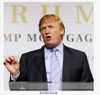
    Donald_trump_photo_2 Consider that the mania for real estate gave allowed Don Trump another Phoenix like rise to prominence. His Apprentice show has given way to Celebrity Apprentice then get rich quick seminars on real estate and now how to get rich on real estate foreclosure seminars!  The only one getting rich of course is Donald (check the graph of TRMP). Cable tv shows like Flip this House assume that there is always a market for the old fixer upper, as Buffalo lender have discovered, not necessarily. At this point it is rather like the parlor game of musical chairs, someone is short a chair to sit in every time the music stops, whoops, and they hold the toxic title.

    The same thing happened in the oil bust of 1986.  Marginal producing oil wells were profitable at $36 oil in 1981.  But at $12 the cost producing the oil and maintaing the well as it dried up made the property worthless.  So who was going to plug and abandon the well?  Explanation, one does not just leave a hole in the ground to let whatever seep into the water table, it has to be properly closed.  Like our abadoned home in Buffalo, no one wanted to assume the responsibility for the plugging the well, finger pointing ensued, the bank owns it, no the bank responds, we never foreclosed, it is your hot potato.

    And so the business cycle is complete.  Seemingly marginal properties be they oil wells or houses, became valuable as commodity prices in a sector increase. Asset values rise, consider that oil prices have risen 8x since 1998-9!   Let them fall back 50% or so and the same thing will happen again.

    How many $500 K condos in Las Vegas will be tomorow’s toxic title?

  • Professor Elam

    Today Bank of America bought Countrywide Finance CFC.   Click and read the article.  Did the shareholder of CFC get a good deal, better yet did Bank of America get a good deal? Why did Bank of America pay in stock rather than cash?  If you had been CFC shareholder are you happier now?  We will be studying the euqity side of the balance sheet this semester in Intermed II and will address these questions!

  • Professor Elam

    Goldman Sachs and Merrill see a recession coming.  Okay what is the difference between

    everything AOK

    recession

    depression

    I went to www.quickmba.com and found an explanation for recession along with the business cycle. So I put in depression and guess what, nothing.  I suppose no oe is worreid about more than a two quarter slowdown which is the rought definition of recession.   So I tried www.about.com, and i got a great Dr. Phil rundown on mental depression but nothing on economic depression. Gee if we don’t have the latter why the former?  Finally I tried www.-m-w.com which is to say the dictionary, and there listed fifth was, a period of low economic activity.  Gee what doe it say about the overall outlook if I cannot find a definition of Depression?