Tuesday April 4 2023
- April 7 is the deadline for students to apply for a scholarship from the SA Chapter of TXCPA – https://www.tx.cpa/sanantonio/news/details/2023/02/15/student-scholarship-is-here!-apply-now!
Accounting & Investing Info for San Antonio A & M
Tuesday April 4 2023
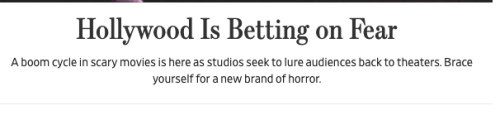
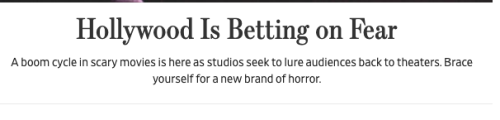
The 1930s brought us the mddern horror films with Dracula, ƒrankenstein, Wolf Man. †he 1970s brought us the Exorcist. Both were periods of negative mood and stagnation, well right on time horror movies are back.
|
|
|||||
|
Friday March 24 2023
Social Mood Turning Negative
Å recession in the US is upon us. I expect some countries to default on their debt this year.
Kevin Hassett to Maria Bartiromo this morning, he is a former Chair of the Councill of Economic Advisers under Trump
If a recession is upon us, how is it that the stock market has managed to stay over 30,00 all year?
The answer is that the indexes are weighted in favor of the more popular and widely held stocks. On the way up the FANG stocks held sway. Now Apple and Microsoft account for some 25% of the value of the SPX. No wonder the averages seem higher than the should be
To illustrate just how broad the weakness is, consider these statistics. The NASD is up about 12% this year, thanks to those two stocks. But only 18% of the entire NASD trades over its respective 50 day moving average. the DOW and SPX re now negative for the year.
Positive social mood is expansive and inclusive People are happy and optimistic. They invest in stocks and real estate with no memory of even recent down turns. Negative mood is exclusive and skeptical causing people not to invest. Hence Amazon has lost half its value since peaking in late 2021. Facebook or Meta has fallen from 375 to 200 in the same time period.
On the popular culture front, signs of a downturn are here and world-wide. The Manhattan District Attorney looks set to indict and possible arrest former President Trump. The charge involves an illegal payment as hush money, hardly national crime. This will be a first time ever event. President Ford pardoned Nixon to avoid just such a circumstance. Ford realized the country had been through enough. This is the equivalent of banana republics to the south famous for jailing their political opposition. Thounsands protest in both France, and now, hello, Peru!
This matters for at least two reasons. First it sets a terrible precedent. Does Democrat Alvin Bragg believe Republican prosecutors will not fixate on some future Democrat, apparently not.
The modern timeline dates back to the Watergate investigation and threats of impeachment. Fast forward to actually impeaching Bill Clinton but no conviction. Sure enough, tit for tat, Pelosi et all impeaches Trump not once but twice. Recall the video of her tearing up Trump’s State of the Union speech. Now both the Manhattan DA and New York Attorney General are promising to convict a former President.
Imagine you are in the intelligence office of Russian or China. You have spent actual time in the US studying American culture. How would you report this to Putin or Xi? No wonder China thinks the US is in decline.
Oil prices challenged the $70 level but fell back over $2 today. Not much else to report on the energy front.
Many pundits have expressed worry about the ramifications of global debt — and rightly so. As the Wall Street Journal noted toward the end of 2022:
The world has amassed $290 trillion of debt and it's getting more expensive to pay for it.
In the U.S. alone, the cost of servicing the national debt is expected to skyrocket over the next decade (Fox News, Feb. 27):
Interest payments on the national debt to reach $1.4 trillion annually in 2033: CBO
There's also the issue of household debt in the U.S. That debt bomb is already in the process of imploding. Here's a chart and commentary from our March Global Market Perspective, a monthly Elliott Wave International publication which covers 50-plus financial markets:
A rare shift in the mindset of consumers started in March 2020, when Real Total Consumer Credit began to decline. Since August 1982 … the growth in U.S. consumer debt has been almost straight up. But there were two prior episodes in which American consumers' otherwise insatiable appetite for debt dissipated: from December 1989 to October 1992 and from December 2008 to November 2011. Both periods encompassed economic recessions. It happened again starting in March 2020, but this time, real consumer debt failed to recover to new highs with the economy.
Another important point to make is that the balance sheets of the European Central Bank, the Bank of England and the Federal Reserve have been deflating — and so has another key measure.
This chart and commentary are also from our March Global Market Perspective:
More deflation evidence comes in the form of overall money supply in the U.S. … The chart shows the annualized percentage change in M2 since 1981. Apart from a very brief (one week!) foray into negative territory in 1995, money supply in the U.S. has been inflating for at least 40 years. Now, though, money supply is deflating at a current annualized clip of over 2%. This historic and now twelve-week-long contraction in money on this basis looks like it is becoming embedded.
It’s also a good idea to keep an eye on major worldwide stock indexes. History shows that global economies tend to follow global stock indexes. In other words, when stock markets tank, economies generally follow and vice versa.
You can get a handle on the main trends of global stock indexes by using the Elliott wave method.
If you’re unfamiliar with Elliott wave analysis, read Frost & Prechter’s Wall Street classic, Elliott Wave Principle: Key to Market Behavior. Here’s a quote from the book:
In markets, progress ultimately takes the form of five waves of a specific structure. Three of these waves, which are labeled 1, 3 and 5, actually effect the directional movement. They are separated by two countertrend interruptions, which are labeled 2 and 4. The two interruptions are apparently a requisite for overall directional movement to occur.
[R.N.] Elliott noted three consistent aspects of the five-wave form. They are: Wave 2 never moves beyond the start of wave 1; wave 3 is never the shortest wave; wave 4 never enters the price territory of wave 1.
[Elliott] did not specifically say that there is only one overriding form, the “five-wave” pattern, but that is undeniably the case. At any time, the market may be identified as being somewhere in the basic five-wave pattern at the largest degree of trend. Because the five-wave pattern is the overriding form of market progress, all other patterns are subsumed by it.
If you’d like to read the entire online version of the book for free, you may do so by joining Club EWI, the world’s largest Elliott wave educational community.
A Club EWI membership is also free and members enjoy free access to a wealth of Elliott wave resources on investing and trading.
Join Club EWI now by following this link: Elliott Wave Principle: Key to Market Behavior — get free and instant access.
This article was syndicated by Elliott Wave International and was originally published under the headline U.S. Money Supply Deflates 2% Annually (What That Means). EWI is the world's largest market forecasting firm. Its staff of full-time analysts led by Chartered Market Technician Robert Prechter provides 24-hour-a-day market analysis to institutional and private investors around the world.
Tuesday March 21 2023
The phrase "Everything Bust" means a bust in just about every financial risk-asset of which you can think, as well as the economy and, I dare say, the financial system itself.
Indeed, in a section titled "The Everything Bust Is on The Way," the December Global Market Perspective, a monthly Elliott Wave International publication which covers 50-plus financial markets, noted:
The pressure on banks will rise as the economy heads south.
And, now, we have these headlines:
Silicon Valley's collapse was the biggest bank failure since Washington Mutual in 2008 and the second largest bank failure in U.S. history.
Many of those on Wall Street blamed the bank failures for triple-digit declines in the Dow Industrials on the day the news came out. However, the real "bust" in the Dow Industrials and S&P 500 began a year earlier, in January 2022. It reflected a downturn in a social mood; today's bank failures have the same roots that stretch back months and months. And since social mood is showing no signs of improvement, it's likely not over.
The "Everything Bust" is on — in stocks, real estate, bonds, the world of crypto, SPACs (a.k.a. special purpose acquisition companies) and elsewhere in the world of finance, including the subprime auto market.
This chart and commentary are from the March Global Market Perspective:

The percentage of subprime auto borrowers who are at least 60 days late on payments surged to 6.05% in December, more than double the seven-year low of 2.58% recorded in April 2021, and eclipsing the peak reading of 5.7% during the Great Recession of December 2007 to June 2009.
As a March 10 New York Post headline said:
Silicon Valley Bank meltdown sparks contagion fears: 'We found our Enron'
Whether you want to call it "contagion fears" or the manifestation of an increasingly fearful mood, don't be surprised if more bank failures appear on the horizon sooner rather than later.
Also, don't be surprised if more triple-digit declines occur with the Dow Industrials.
The Elliott wave pattern of this senior U.S. index is revealing what very well may be next for U.S. stocks.
If you're unfamiliar with Elliott wave analysis, or simply need a refresher, read Frost and Prechter's Elliott Wave Principle: Key to Market Behavior. Here's a quote from the book:
Although it is the best forecasting tool in existence, the Wave Principle is not primarily a forecasting tool; it is a detailed description of how markets behave. Nevertheless, that description does impart an immense amount of knowledge about the market's position within the behavioral continuum and therefore about its probable ensuing path. The primary value of the Wave Principle is that it provides a context for market analysis. This context provides both a basis for disciplined thinking and a perspective on the market's general position and outlook. At times, its accuracy in identifying, and even anticipating, changes in direction is almost unbelievable. Many areas of mass human activity display the Wave Principle, but it is most popularly used in the stock market.
If you'd like to read the entire online version of this Wall Street classic, you may do so for free once you become a member of Club EWI, the world's largest Elliott wave educational community (around 500,000 worldwide members).
A Club EWI membership is also free and members enjoy complimentary access to a range of Elliott wave resources on investing and trading.
Join Club EWI now by following this link: Elliott Wave Principle: Key to Market Behavior — get free and instant access.
This article was syndicated by Elliott Wave International and was originally published under the headline Silicon Valley Bank, Silvergate and "The Everything Bust". EWI is the world's largest market forecasting firm. Its staff of full-time analysts led by Chartered Market Technician Robert Prechter provides 24-hour-a-day market analysis to institutional and private investors around the world.
Tuesday March 21 2023
Monday March 20 2023
Imagine a bank in Houston that caters to the oil-and-gas industry. It makes low-cost loans with credit-friendly terms to unprofitable shale frackers on the condition that they hold their deposits exclusively at the bank, where they earn an above-market return. It also manages the wealth of oil and gas executives.
The bank uses its enormous deposits to fund more risky loans to frackers and acquire Treasury bonds and government mortgage-backed securities. The latter obscure the credit risk on its balance sheet. As frackers burn cash, the bank struggles to redeem deposits and has to sell assets at a loss.
As news of the losses spreads, there is a run on deposits. The Federal Deposit Insurance Corp., with the approval of a Republican president, takes over the bank and guarantees all its uninsured deposits, including those of oil-and-gas executives. Wouldn’t Democrats scream “bailout”?
This essentially describes what has happened at Silicon Valley Bank over the past week. Democrats insist the FDIC’s guarantee of uninsured deposits decidedly isn’t a bailout. The truth is that the Biden administration not only bailed out Silicon Valley investors and companies. It also rescued California, whose budget depends on them, and the state’s liberal political class. It did the same for New York by back-stopping uninsured deposits at Signature Bank.
Newsletter Sign-up
Morning Editorial Report
All the day's Opinion headlines.
Subscribe
California’s tax revenue has swelled—and is now falling—in tandem with Silicon Valley’s fortunes. As the Federal Reserve pumped trillions of dollars into the economy and cut interest rates to near-zero, the stock market surged. Investors sold stock in tech companies at inflated prices. Startups took advantage of the hot stock market to float public shares.
Investors plowed their capital gains into high-yielding accounts at SVB and startups with accounts at the bank. Between December 2019 and December 2022, its deposits tripled to $173 billion. SVB became Silicon Valley’s premier bank by offering generous loan terms and above-market returns on deposits to unprofitable companies, many with no revenue.
But as the Fed raised interest rates and tech startups burned through cash, SVB had to sell mortgage-backed securities at a loss to cover deposit redemptions. You know the rest of the story.
Normally, uninsured depositors—those with more than $250,000 in an account—would take a haircut of some 10% to 15% if a bank fails. But tech investors, California Gov. Gavin Newsom and Silicon Valley politicians lobbied the White House for help. Not guaranteeing uninsured deposits would “hurt the innovation pipeline” and “ordinary people,” claimed Silicon Valley Rep. Ro Khanna.
It’s true: Absent the FDIC bailout, startups would have had to raise more capital from venture investors to offset their losses. That may have proved difficult for less-promising enterprises, as investors refused to give more money while they tried to pare their own losses. But it likely wouldn’t have been a problem for the truly innovative firms.
And those with more than $250,000 in a bank account aren’t “ordinary” people. What has hurt ordinary people is the Fed’s inflationary policies. Why shouldn’t Silicon Valley have to bear some pain as the central bank corrects the ultra-loose monetary policies that enriched its technocratic class? Is Silicon Valley too important to lose money? As far as Mr. Newsom is concerned, the answer appears to be yes.
High earners in California’s Bay Area pay about half of state income tax. Capital-gains realizations surged to $245 billion in 2021 from $145 billion in 2019, helping create a more than $100 billion budget surplus last year. But stocks have plunged and tech layoffs are increasing, so California is staring down the barrel of a gaping deficit.
Tax revenue through the first eight months of this year is running $25 billion lower than last year. The budget carnage would be greater if investors had to write down their startup investments. No wonder Mr. Newsom, who reportedly had an account at SVB, praised the administration’s bailout’s “profoundly positive impacts on California.”
Meantime, SVB’s New York bailout companion, Signature, has received a bum rap as a crypto bank. But if most of its uninsured depositors were crypto companies, there’s no chance the FDIC would have bailed them out. Signature primarily caters to New York’s liberal special interests, which donate to Democratic campaigns.
It is New York City’s top lender to low-income housing developers and “a significant player when it came to financing for personal injury firms,” according to Law.com. One of its specialities was financing the purchase of taxi medallions. According to the New York Times, it was also known “for catering to wealthy families.” Former Gov. Andrew Cuomo has a campaign account at the bank.
Mr. Khanna insists that a bank catering to the oil-and-gas industry would be treated the same as SVB and Signature. But maybe the reason those two banks failed to manage their risks is their leaders knew they had political protection in case they got into trouble.
The Very Big Picture
The banking system in the US is sound.
Janet Yellen, US Treasury Secretary
For updates on SVB et al see
www.professorealmtypepad.com/markets
If the banking system is in such good shape why did a group of big banks need to deposit $30 B at First Republic? The better question is, where were the layers of Federal oversight as this unfolded? Just to name a few, the Comptroller of the Currency, the Treasury Dept. the FDIC, and the FED all failed to open the ‘window’ and flood Silicon Valley Bank with enough over night lending to meet the withdrawals? Worse, KPMG CPAs had issued ‘clean opinions’ on Silicon Valley, Signature Bank (note Barney Frank pocketed $2.4 M while on that board before the collapse) and First Republic? Ironically First Republic needed funds exactly 15 years to the day that Bear Stearns failed. What am I getting for my $31000 tax bill from the Federal Government?
The big picture is this. Interest rates rose from 1942 to 1981. By 1981 one could make double-digit returns on a safe CD, so why invest in stocks. The top in rates, low in bond prices reversed as Paul Volcker raised rates higher still, marking the peak for inflation. A final low in stocks occurred the next year 1982 an. The new bull market was born which lasted until November 2021- January 2022. Rates have risen sharply since the March 2020 low. And investors are slowly realizing stocks can go down and stay down as demonstrated by the ups and downs of this week. The reverse of 1982-1984 is now underway. Investors will be abandoning stocks for safer Treasury notes and CDs. A new bear market in stocks is underway.
Central banks have a universal solution for those companies with debt problems, take on more debt! The second largest bank in Switzerland, Credit Suisse, now trades at 25% of its book value. No one wants to buy the stock at that discount, so what to do? The Swiss Central Bank proposes to loan up to $54 M dollars. Who ever heard of anyone re-paying a $54 B loan? Credit Suisse lost the equivalent of its entire year net income, $5 B, on one client and has yet to recover. In my presentations on that Archegos financial disaster, I wondered to the audience, how many more Archegos deals are out there we don’t know about? We are finding out now.
Investors are exiting oil investments, Crude oil broke the $70 support, now trading at $66.42. This is also a sign of economic weakness, less demand for crude oil. The move to electric everything is over done. There is not enough grid and all these trucks,, planes, and ships are not going electric. Let’s watch for a coming low in the energy markets.
I mentioned Nustar NS which continues to fall in price, now yielding 10% dividend. Patience is needed waiting for a final low..
The Very Big Picture
The banking system in the US is sound.
Janet Yellen, US Treasury Secretary
For updates on SVB et al see
www.professorealmtypepad.com/markets
If the banking system is in such good shape why did a group of big banks need to deposit $30 B at First Republic? The better question is, where were the layers of Federal oversight as this unfolded? Just to name a few, the Comptroller of the Currency, the Treasury Dept. the FDIC, and the FED all failed to open the ‘window’ and flood Silicon Valley Bank with enough over night lending to meet the withdrawals? Worse, KPMG CPAs had issued ‘clean opinions’ on Silicon Valley, Signature Bank (note Barney Frank pocketed $2.4 M while on that board before the collapse) and First Republic? Ironically First Republic needed funds exactly 15 years to the day that Bear Stearns failed. What am I getting for my $31000 tax bill from the Federal Government?
The big picture is this. Interest rates rose from 1942 to 1981. By 1981 one could make double-digit returns on a safe CD, so why invest in stocks. The top in rates, low in bond prices reversed as Paul Volcker raised rates higher still, marking the peak for inflation. A final low in stocks occurred the next year 1982 an. The new bull market was born which lasted until November 2021- January 2022. Rates have risen sharply since the March 2020 low. And investors are slowly realizing stocks can go down and stay down as demonstrated by the ups and downs of this week. The reverse of 1982-1984 is now underway. Investors will be abandoning stocks for safer Treasury notes and CDs. A new bear market in stocks is underway.
Central banks have a universal solution for those companies with debt problems, take on more debt! The second largest bank in Switzerland, Credit Suisse, now trades at 25% of its book value. No one wants to buy the stock at that discount, so what to do? The Swiss Central Bank proposes to loan up to $54 M dollars. Who ever heard of anyone re-paying a $54 B loan? Credit Suisse lost the equivalent of its entire year net income, $5 B, on one client and has yet to recover. In my presentations on that Archegos financial disaster, I wondered to the audience, how many more Archegos deals are out there we don’t know about? We are finding out now.
Investors are exiting oil investments, Crude oil broke the $70 support, now trading at $66.42. This is also a sign of economic weakness, less demand for crude oil. The move to electric everything is over done. There is not enough grid and all these trucks,, planes, and ships are not going electric. Let’s watch for a coming low in the energy markets.
I mentioned Nustar NS which continues to fall in price, now yielding 10% dividend. Patience is needed waiting for a final low..


 Professor Elam