• Professor Elam

    Monday Nov 28 2022

    WSJ article

    The tight labor market is prompting more employers to eliminate one of the biggest requirements for many higher-paying jobs: the need for a college degree.


    Companies such as Alphabet Inc.’s Google, Delta Air Lines Inc. and International Business Machines Corp. have reduced educational requirements for certain positions and shifted hiring to focus more on skills and experience. Maryland this year cut college-degree requirements for many state jobs—leading to a surge in hiring—and incoming Pennsylvania Gov. Josh Shapiro campaigned on a similar initiative.

    U.S. job postings requiring at least a bachelor’s degree were 41% in November, down from 46% at the start of 2019 ahead of the Covid-19 pandemic, according to an analysis by the Burning Glass Institute, a think tank that studies the future of work. Degree requirements dropped even more early in the pandemic. They have grown since then but remain below prepandemic levels.

    The shift comes as demand for workers remains high and unemployment is low. Job postings far outpace the number of unemployed people looking for work—10.7 million openings in September compared with 5.8 million unemployed—creating unusually stiff competition for workers.

    Newsletter Sign-up

    Real Time Economics

    The latest economic news, analysis and data curated weekdays by WSJ's Jeffrey Sparshott.


    Subscribe

    The persistently tight labor market has accelerated the trend that builds on a debate about the benefits and drawbacks of encouraging more people to attend four-year colleges and as organizations try to address racial disparities in the workplace.

    Some occupations have universal degree requirements, such as doctors and engineers, while others typically have no higher education requirements, such as retail workers. There is a middle ground, such as tech positions, that have varying degree requirements depending on the industry, company and strength of the labor market and economy.

    Lucy Mathis won a scholarship to attend a women in computer science conference. There, she learned about an IT internship at Google and eventually dropped out of her computer science undergraduate program to work at the company full time. The 28-year-old now makes a six-figure sum as a systems specialist.

    “I found out I had a knack for IT,” she said. “I’m not good at academics. It’s not for me.”

    More than 100,000 people in the U.S. have completed Google’s online college-alternative program that offers training in fast-growing fields such as digital marketing and project management, the company said. It and 150 other companies are now using the program to hire entry-level workers.

    The majority of its U.S. roles at IBM no longer require a four-year degree after the company conducted a review of hiring practices, IBM spokeswoman Ashley Bright said.

    Delta eased its educational requirements for pilots at the start of this year, saying a four-year college degree was preferred but no longer required of job applicants.

    Walmart Inc., the country’s largest private employer, said it values skills and knowledge gained through work experience and that 75% of its U.S. salaried store management started their careers in hourly jobs. 

    “We don’t require degrees for most of our jobs in the field and increasingly in the home office as well,” Kathleen McLaughlin, Walmart executive vice president, said at an online event this fall. The company’s goal is to shift the “focus from the way someone got their skills, which is the degree, to what skills do they have.”

    A four-year college degree holder has more lifetime earnings than one without. The lifetime earnings of a worker with a high-school diploma is $1.6 million while that of a bachelor’s degree holder is $2.8 million, according to a 2021 report by the Center on Education and the Workforce at Georgetown University.

    But many people don’t finish college and are left with mountains of debt—more than 43 million people in the U.S. hold a total of $1.6 trillion in student-loan debt. While a college degree can provide specific workplace skills, workers can gain the skills needed for many jobs without a four-year degree.

    Black and Hispanic people are less likely to have a college degree compared with white and Asian people, according to the Commerce Department. Men are less likely than women.
    “Even though education is supposed to open up doors and windows of opportunity, they have, in some ways, become a means of closing off opportunity,” said Nicole Smith, the chief economist at the Georgetown center.

    The Ad Council, a marketing nonprofit that targets issues such as drunken driving, this summer launched a multiyear national advertising campaign aimed at reducing barriers to the workforce for non-college-degree holders. “Rethink bachelor’s degree requirements and discover a world of talent,” says one bus-stop poster.

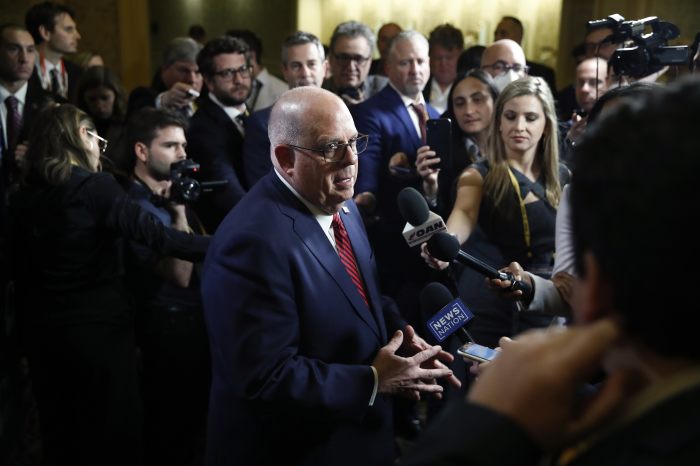
    Maryland Gov. Larry Hogan in March said the government would review college-degree requirements for every state job. State and local governments have struggled to hire workers in the tight labor market.

    Half a year later, Maryland said the program is showing early signs of working as intended. The number of state employees hired without a four-year degree from May to August is up 41% from a year before while the number of all employees hired is up 14%.


    Opportunity@Work, a nonprofit that wants to cut degree requirements, worked with Maryland on its program. Bridgette Gray, the chief customer officer, said there are around 70 million Americans over the age of 25 who are in the workforce today and don’t have a college degree. Around four million are already in high-wage careers.

    “College is a clear pathway to upward mobility, but it shouldn’t be the only pathway,” she said.

    Mark Townend, who leads recruiting efforts for Maryland’s state jobs, said reducing degree requirements was a way to tackle a societal problem and to make finding employees easier for the government. Mr. Townend and his team have been examining and rewriting nearly 2,500 job classifications for nearly 60,000 state workers.

    “We basically had a need for more applicants,” he said. “There is a large population of nondegree candidates who are good for our jobs.”

    A recent Maryland job posting for an administrative officer paying up to nearly $80,000 a year said that the job required a high-school diploma and three years of experience. That same level job previously required four years of college.

    Philip Deitchman, the head of human resources at Maryland’s Department of Juvenile Services, said he previously declined job candidates without the right credentials. The state had specification sheets that had strictly defined job requirements, he said.

    “We would say, ‘Wow we want this person,’ but they didn’t have a college degree,” he said. “I’m passing up someone really good.”

    Governments are less flexible and have more stringent requirements than the private sector, economists said, partly because they often have rules intended to reduce corruption and political favoritism.

    SHARE YOUR THOUGHTS

    Do you think a college degree is essential for many jobs? Why or why not? Join the conversation below.

    Mr. Deitchman said since the policy change he is seeing more applicants and higher quality job applicants.

    “I would rather have someone with experience,” he said. “It’s just something that should have been done years ago.”

    Patricia Bruzdzinski works as an employee specialist for Maryland, helping state workers navigate health insurance and other human-resources issues. Ms. Bruzdzinski said she was hired at a lower level in 2016, partially because she doesn’t have a college degree. She said the new policy should help her advance in her career and open doors for others to get state jobs.

    Ms. Bruzdzinski said online training resources and learning on the job have allowed her to gain new skills for her $50,000-a-year position.

    “It’s also about self-education,” she said. “I listen to podcasts on Medicaid.”

    Write to Austen Hufford at austen.hufford@wsj.com


  • Professor Elam

    Weekend Nov 27, 2022


    Latino Justice alleges MTC charged for services they nefer performed.

    The multiple contracts between the Texas Department of Criminal Justice (TDCJ) and MTC were to provide minimum hours of group therapy, individual one-on-one therapy, and other treatment programs. Prisoners were allegedly told that COVID protocols prevented them from participating in counseling, but they were still housed in bunkrooms with 50 or more people.

    The document also details how MTC created a "fraudulent paper trail" to "hide the fact that it breached contracts" to collect millions from work it did not perform. It also accuses MTC of charging TDCJ for requiring prisoners to fill out workbook pages instead of providing in-person counseling sessions. MTC allegedly asked that inmates participating in the program falsify time sheets and if they did not, their parole would be revoked.

    Latino Justice's complaint names three Texas prisons that earned the company more than $5 million from March 2020 to January 2022. The advocacy group also noted that MTC has 17 active contracts with TDCJ valued at more than $100 million.

    MTC spokesperson David Martinson declined to answer questions to the Texas Tribune Monday. However, TDCJ spokesperson Robert Hurst sent a statement saying the company will fully cooperate with the state auditor's investigation into the complaint and launch an independent internal investigation.

  • Professor Elam

    1844

    It is said that the world is in a state of bankruptcy, that the world owes the world more than the world can pay, and ought to go into chancery, and be sold. I do not think this general insolvency, which involves in some sort all the population, to be the reason of the difficulty experienced at Christmas and New Year, and other times, in bestowing gifts; since it is always so pleasant to be generous, though very vexatious to pay debts. But the impediment lies in the choosing. If, at any time, it comes into my head, that a present is due from me to somebody, I am puzzled what to give, until the opportunity is gone. Flowers and fruits are always fit presents; flowers, because they are a proud assertion that a ray of beauty outvalues all the utilities of the world. These gay natures contrast with the somewhat stern countenance of ordinary nature: they are like music heard out of a work-house. Nature does not cocker us: we are children, not pets: she is not fond: everything is dealt to us without fear or favor, after severe universal laws. Yet these delicate flowers look like the frolic and interference of love and beauty. Men use to tell us that we love flattery, even though we are not deceived by it, because it shows that we are of importance enough to be courted. Something like that pleasure, the flowers give us: what am I to whom these sweet hints are addressed? Fruits are acceptable gifts, because they are the flower of commodities, and admit of fantastic values being attached to them. If a man should send to me to come a hundred miles to visit him, and should set before me a basket of fine summerfruit, I should think there was some proportion between the labor and the reward.

    For common gifts, necessity makes pertinences and beauty every day, and one is glad when an imperative leaves him no option, since if the man at the door have no shoes, you have not to consider whether you could procure him a paint-box. And as it is always pleasing to see a man eat bread, or drink water, in the house or out of doors, so it is always a great satisfaction to supply these first wants. Necessity does everything well. In our condition of universal dependence, it seems heroic to let the petitioner be the judge of his necessity, and to give all that is asked, though at great inconvenience. If it be a fantastic desire, it is better to leave to others the office of punishing him. I can think of many parts I should prefer playing to that of the Furies. Next to things of necessity, the rule for a gift, which one of my friends prescribed, is, that we might convey to some person that which properly belonged to his character, and was easily associated with him in thought. But our tokens of compliment and love are for the most part barbarous. Rings and other jewels are not gifts, but apologies for gifts. The only gift is a portion of thyself. Thou must bleed for me. Therefore the poet brings his poem; the shepherd, his lamb; the farmer, corn; the miner, a gem; the sailor, coral and shells; the painter, his picture; the girl, a handkerchief of her own sewing. This is right and pleasing, for it restores society in so far to its primary basis, when a man's biography is conveyed in his gift, and every man's wealth is an index of his merit. But it is a cold, lifeless business when you go to the shops to buy me something, which does not represent your life and talent, but a goldsmith's. This is fit for kings, and rich men who represent kings, and a false state of property, to make presents of gold and silver stuffs, as a kind of symbolical sin-offering, or payment of black-mail.

    The law of benefits is a difficult channel, which requires careful sailing, or rude boats. It is not the office of a man to receive gifts. How dare you give them? We wish to be self-sustained. We do not quite forgive a giver. The hand that feeds us is in some danger of being bitten. We can receive anything from love, for that is a way of receiving it from ourselves; but not from any one who assumes to bestow. We sometimes hate the meat which we eat, because there seems something of degrading dependence in living by it.

    "Brother, if Jove to thee a present make,
    Take heed that from his hands thou nothing take."

    We ask the whole. Nothing less will content us. We arraign society, if it do not give us besides earth, and fire, and water, opportunity, love, reverence, and objects of veneration.

    He is a good man, who can receive a gift well. We are either glad or sorry at a gift, and both emotions are unbecoming. Some violence, I think, is done, some degradation borne, when I rejoice or grieve at a gift. I am sorry when my independence is invaded, or when a gift comes from such as do not know my spirit, and so the act is not supported; and if the gift pleases me overmuch, then I should be ashamed that the donor should read my heart, and see that I love his commodity, and not him. The gift, to be true, must be the flowing of the giver unto me, correspondent to my flowing unto him. When the waters are at level, then my goods pass to him, and his to me. All his are mine, all mine his. I say to him, How can you give me this pot of oil, or this flagon of wine, when all your oil and wine is mine, which belief of mine this gift seems to deny? Hence the fitness of beautiful, not useful things for gifts. This giving is flat usurpation, and therefore when the beneficiary is ungrateful, as all beneficiaries hate all Timons, not at all considering the value of the gift, but looking back to the greater store it was taken from, I rather sympathize with the beneficiary, than with the anger of my lord Timon. For, the expectation of gratitude is mean, and is continually punished by the total insensibility of the obliged person. It is a great happiness to get off without injury and heart-burning, from one who has had the ill luck to be served by you. It is a very onerous business, this of being served, and the debtor naturally wishes to give you a slap. A golden text for these gentlemen is that which I so admire in the Buddhist, who never thanks, and who says, "Do not flatter your benefactors."

    The reason of these discords I conceive to be, that there is no commensurability between a man and any gift. You cannot give anything to a magnanimous person. After you have served him, he at once puts you in debt by his magnanimity. The service a man renders his friend is trivial and selfish, compared with the service he knows his friend stood in readiness to yield him, alike before he had begun to serve his friend, and now also. Compared with that good-will I bear my friend, the benefit it is in my power to render him seems small. Besides, our action on each other, good as well as evil, is so incidental and at random, that we can seldom hear the acknowledgments of any person who would thank us for a benefit, without some shame and humiliation. We can rarely strike a direct stroke, but must be content with an oblique one; we seldom have the satisfaction of yielding a direct benefit, which is directly received. But rectitude scatters favors on every side without knowing it, and receives with wonder the thanks of all people.

    I fear to breathe any treason against the majesty of love, which is the genius and god of gifts, and to whom we must not affect to prescribe. Let him give kingdoms or flower-leaves indifferently. There are persons, from whom we always expect fairy tokens; let us not cease to expect them. This is prerogative, and not to be limited by our municipal rules. For the rest, I like to see that we cannot be bought and sold. The best of hospitality and of generosity is also not in the will, but in fate. I find that I am not much to you; you do not need me; you do not feel me; then am I thrust out of doors, though you proffer me house and lands. No services are of any value, but only likeness. When I have attempted to join myself to others by services, it proved an intellectual trick,– no more. They eat your service like apples, and leave you out. But love them, and they feel you, and delight in you all the time.

  • Professor Elam

    Friday Nov 25 2022


    Meet White Collar Advice

    From their Website

    We Prepare you to get a shorter sentence. Learn exactly what to write to your sentencing Judge to earn the shortest sentence  possible.

    Schedue a time and let us take awayu any confusion out of preparing for your sentencing.

    ________________

    There are so many individuals looking at white collar crime sentences, advising them is not a full time business.

    Listen to the podcast

    We prWe Prepare You to Get a Shorter Sentence


  • Professor Elam

    Friday Nov 25 2022

    A federal judge recommended that Theranos Inc. founder Elizabeth Holmes serve her more than 11-year sentence in a minimum-security prison camp in Texas, new court filings show.

    U.S. District Judge Edward Davila, who oversaw the trial and sentenced her on Friday, ordered Ms. Holmes to surrender to the facility in April. He also recommended that she be allowed family visitation, saying that it enhanced the possibility for rehabilitation. Upon release, Ms. Holmes would serve three years under court supervision, the judge said.

    Federal prosecutors have said Ms. Holmes could get about a 15% reduction on prison time with good behavior, which would put her sentence at 9 1/2 years with no possibility for parole.

    Ms. Holmes has 14 days from her sentencing to appeal her conviction. Her lawyers said in court Friday that they would seek to let her stay out of prison on bail pending the outcome of her appeal. 

    The prison camp where Ms. Holmes has been recommended to serve time is in Bryan, Texas, about 100 miles north of Houston, and is designated for female inmates. According to the Bureau of Prisons website, the camp has a population of 539 inmates; they are allowed to accept visitors, five adults and five children at a time, on weekends. They are expected to rise at 6 a.m. each morning and are limited to clothes that are pastel green, gray or white. Before the trial, Ms. Holmes was known for wearing black turtleneck tops similar to the kind worn by late Apple Inc. founder Steve Jobs, whom she idolized. 

    The Texas prison offers similar amenities to the West Virginia facility where Martha Stewart served time nearly two decades ago, such as access to tennis courts and a running track. But it is far from where Ms. Holmes’s family lives in California, potentially making visitation harder and more costly, said Justin Paperny, founder of White Collar Advice, a consulting business that helps defendants prepare for sentencing and time behind bars. 

    Ms. Holmes would be closer to family if she were assigned to the minimum-security prison in Dublin, Calif., where actresses Felicity Huffman and Lori Loughlin served brief sentences a few years ago for their roles in a college-admissions scandal. 

    The fall of Ms. Holmes, who is pregnant with her second child, was triggered by Wall Street Journal investigative reporting in 2015 and 2016 that exposed how Theranos’s technology didn’t work, how the blood-testing company tried to cover up its failures and how patients’ lives were affected and their health jeopardized.

    Theranos denied the Journal’s reports. The company later voided its patient tests and settled with investors and federal regulators. 

    Before Friday’s sentencing, Judge Davila said the fact that Ms. Holmes didn’t accept responsibility for her crime would count against her. Government prosecutor Jeff Schenk told the judge that he shouldn’t be lenient with Ms. Holmes just because there was a lot of media coverage of her sentencing, noting that the former Silicon Valley wunderkind had used the media to perpetuate her fraud while running Theranos.

    Kevin Downey, an attorney for Ms. Holmes, argued that all of the money Ms. Holmes raised went into building Theranos and that she didn’t buy yachts or a mansion with it.


  • Professor Elam

    Friday Nov, 25, 2022


    Self-described sneakerheads bidding up prices for limited-edition kicks sold online have created profits for tens of thousands of entrepreneurial kids and adults.

    In nine years, Michael Malekzadeh outpaced the crowd to become an American sneaker celebrity. He made more than $300 million in the sneaker resale market, where scarcity and cool have driven runaway prices.

    Mr. Malekzadeh was known as one of the largest buyers and sellers of exceptional sneakers, including many he offered before they hit retail stores and some at cheaper-than-retail prices. He could get the rarest Nike Inc.’s Air Jordans, as well as Yeezys, which are expected to see a spike in resale prices after Adidas AG ended its partnership last month with rapper and entrepreneur Kanye West, who now goes by Ye.

    Mr. Malekzadeh’s apparent success afforded him the kind of insouciant, gold-plated lifestyle that luxury sneakers are thought to reflect. On Instagram, the 39-year-old showed off his Ferraris and a six-figure Girard-Perregaux watch next to a hamburger. He also posted shots of himself riding a $29,000 Louis Vuitton bicycle inside his million-dollar home in Eugene, Ore.

    Newsletter Sign-up

    The 10-Point.

    A personal, guided tour to the best scoops and stories every day in The Wall Street Journal.


    Subscribe

    The business, in real life, was collapsing under the weight of unfulfilled orders, late payments and customer complaints. In May, Mr. Malekzadeh’s fiancée—also the company’s finance chief—pushed for both of them to come clean, according to people familiar with the situation.

    Federal prosecutors a few months later charged the couple with bank fraud and Mr. Malekzadeh with wire fraud and money laundering. Customers claim they paid millions of dollars for shoes that never arrived. A court-appointed receiver is sorting out the remaining inventory of the entrepreneur’s company, Zadeh Kicks.

    Early last year, Mr. Malekzadeh collected orders for about 600,000 pairs of Air Jordan 11 Cool Grey sneakers months before they hit stores, netting over $70 million, according to prosecutors. He priced the sneakers between $115 and $200 a pair, cheaper than their expected retail price of around $225, prosecutors said.

    Mr. Malekzadeh was able to get only 6,000 pairs.

    Prosecutors allege he collected preorder funds from customers while knowing he couldn’t fill all the orders. Since at least 2020, he spent more than $10 million of the company’s preorder proceeds on luxury goods, including watches, furs and handbags, they said. In a seizure warrant affidavit, federal authorities allege the couple also used customer money to help make a down payment on a house and complete about $600,000 of work to remodel it.

    This is a Bernie Madoff-size scam for the sneaker market,” said Michael Schneider, chief executive of Secret Sauce, a sneaker reseller who runs an online community focused on sneakers and collectibles.

    Mr. Malekzadeh and his fiancée, Bethany Mockerman, 39, have pleaded not guilty. They are cooperating with authorities and working to minimize the financial harm to customers, their attorneys said in separate written statements.

    Thousands of individuals and businesses have filed claims against Zadeh Kicks, including one creditor that reported being owed roughly $15 million plus interest, according to documents filed by the court-appointed receiver. The company had 23,000 customers, the affidavit said, and unfilled orders went back as far back as 2018, according to former customers. Some of them were given now-worthless store credits.

    “The Zadeh Kicks thing was the big hit that kind of wiped a lot of people,” said Minnat Azad, a sneaker reseller from Boca Raton, Fla.

    Based on the company’s reputation among sneakerheads, Mr. Azad said, he ordered 100 pairs of Air Jordan 11 “Jubilee” sneakers in October 2020. Even though he received just 50 pairs, he said, he made a $5,000 profit reselling them.

    It was the easiest money he had ever made, Mr. Azad said. “This guy is better than the S&P 500,” he recalled thinking about Mr. Malekzadeh.

    It was such a good investment opportunity that he paid $100,000 for another 400 or so pairs of other sneakers. None came, he said.

    First steps

    Mr. Malekzadeh was born in Eugene, where Nike also took its first steps, and graduated from the University of Oregon in 2005. He enrolled at the Art Institute of Portland to study footwear design but dropped out. In 2010, he worked for a Nike store in the Portland area and was fired for reselling items that he was buying with an employee discount, according to people familiar with the matter.

    In 2013, the same year Mr. Malekzadeh began dating Ms. Mockerman, he embarked on his sneaker-reselling career, according to the seizure warrant affidavit. He borrowed about $20,000 from his father to start his business, records show.

    He didn’t think it was enough. Prosecutors allege that since 2013, the couple sent at least 15 fraudulent loan applications to banks, using doctored financial and bank statements to net around $20 million in loans.

    Next, Mr. Malekzadeh built a supply chain for in-demand sneakers.

    Resale markets have operated on the internet since the 1990s, mostly through sites like eBay, forums and consignment stores. Early on, sneaker resellers sought a competitive advantage through insider knowledge about inventories and securing pairs through personal connections at retail stores.

    Buying online eventually rivaled the practice of waiting in line at retail stores on the day a highly sought sneaker went on sale.

    Images of high-end fashion designers and celebrities in limited-edition shoes flooded social media, elevating sneakers to markers of wealth and prestige. Retail demand soared and expanded the secondary market, where people buy and resell items through eBay and newer platforms such as StockX and Goat.

    Nike made $29 billion in revenue from Nike- and Jordan-branded footwear in the year ended in May. Analysts at Cowen, an investment bank, predict the $6 billion-a-year resale market will reach $30 billion by the end of the decade.

    Buying limited-run sneakers by computer at first gave buyers a fair shot at getting a pair when sales opened, a moment known as a drop. Some models sell out in less than a minute.

    Resellers pay thousands of dollars for software to push them ahead of other online buyers and, at times, to place larger-than-allowed orders.

    Mr. Malekzadeh initially relied on deals with store managers at authorized retailers around the country to buy in bulk before sneakers hit store shelves, according to people familiar with that issue.

    He definitely had this image of being the end-all, be-all, backdoor plug,” Mr. Schneider said of Mr. Malekzadeh’s renown for acquiring inventory.

    As supply pipelines began to close in the Covid-19 pandemic, Mr. Malekzadeh turned to buying items in large quantities primarily through StockX, paying for many in-demand sneakers at a significant markup, these people said.

    A spokeswoman for StockX said that “no single buyer has ever represented more than 1% of our overall trade volume in a given year.”

    High jump

    2019 was a landmark year for the sneaker market. StockX secured a private market valuation of more than $1 billion. Sotheby’s sold a worn-and-torn pair of one of Nike’s first designs for $150,000 during its first-ever sneaker auction. Nike’s Jordan brand also recorded its first billion-dollar quarter in sales.

    Zadeh Kicks sales also were on the rise, especially among other resellers. Some of them posted photos showing bulk orders from the company. Others gave shout-outs for the seemingly unbelievable deals they got. Mr. Malekzadeh left his signs of success across social media, giving the impression that anybody could make a buck reselling sneakers.

    For years, the company had accepted money from customers preordering Air Jordans, according to its now-deleted website. As demand increased, so did customer wait times and cancellation fees. Customers were charged a 20% fee if they canceled a preorder, according to policies shown on the website. Later, it was 50%.

    Refund rules also changed. In 2018, the company told customers they had to wait as long as 10 months past their order date to cancel without penalty. Instead of cash refunds to every customer, Mr. Malekzadeh offered store credits and gift cards.

    He didn’t tolerate his customers bad-mouthing the company in posts over unfilled orders and delays, and threatened to ban them from buying his shoes.

    When Damian Ortiz commented on Instagram about a problem, Mr. Malekzadeh emailed him. “We want to give you a one time courtesy (which we normally do not) that typically we BLOCK those who do not follow our listed policies,” the July 2019 email said.

    Mr. Ortiz, of Oakland, Calif., estimated he lost about $14,000 in unfulfilled orders. He broke even overall doing business with Zadeh Kicks, he said, taking into account his earlier profits.

    Missed shot

    As luxury sneakers became more popular, the limited releases had the potential for hefty resale profits, especially if the shoes were a collaboration between a brand like Nike and a well-known fashion designer such as the late Virgil Abloh or rapper Travis Scott.

    Some sneakers fail to match the hype, and investors lose money. Other times, sneakers drop in value because a shoe company decides to restock the model, killing the lure of exclusivity.

    Indiana University finance major Arnav Kamra learned about the market’s ups and downs firsthand. He started reselling sneakers in 2020, as a 15-year-old high-school sophomore in Cary, N.C.

    When his school moved to remote instruction during the pandemic, reselling sneakers became his focus, he said. With money from his parents, Mr. Kamra set up an online sneaker store.

    By last year, he said he amassed a portfolio of assets, both sneakers and other collectibles valued at $40,000.

    One deal in particular caught the teen’s attention. Zadeh Kicks was selling pairs of Air Jordan 1s that Nike released in collaboration with Mr. Scott for $590. The white leather and brown suede high-tops fetched about $2,000 in the resale market.

    “The ROI was simply insane,” Mr. Kamra said, “I just convinced myself that I had to buy more.” He paid Zadeh Kicks close to $18,000 in various orders.

    Mr. Kamra said that two days before his 18th birthday in May, he got an email from Zadeh Kicks. He was expecting a new, unbelievable deal from Mr. Malekzadeh. Instead, he said, it announced that Zadeh Kicks had been dissolved and no more orders would be filled, including his.

    Mr. Kamra said he was still reselling but has turned his focus to schoolwork.

    Early this year, Ms. Mockerman learned more details than she had previously known about significant discrepancies between the amount of money coming in and orders being filled, according to people familiar with that.

    After some Zadeh Kicks buyers made threats about unfilled orders, Mr. Malekzadeh and Ms. Mockerman started fearing for their safety, according to people familiar with the situation. The couple sought help from lawyers who directed them to federal authorities, the people said.

    In late May, Mr. Malekzadeh petitioned to dissolve his company.

    Nike representatives have since been working with the court-appointed receiver and law enforcement, evaluating the remaining inventory in the Zadeh Kicks warehouse, according to reports filed by the receiver. A spokeswoman for Nike declined to comment.

    Mr. Malekzadeh’s assets are being liquidated to cover debts. The Federal Bureau of Investigation seized cashier’s checks for $6.1 million and $290,000 from Mr. Malekzadeh, as well as handbags and watches.

    Close to 60,000 pairs of shoes were found at the company warehouse. The receiver said it had fielded inquiries from customers seeking a share of the remaining inventory: some 48,000 pairs of Nike shoes, close to 8,500 Adidas and about 1,100 pairs in Mr. Malekzadeh’s personal collection.

    Write to Inti Pacheco at inti.pacheco@wsj.com

     
  • Professor Elam

    Before Black Friday

    But it is a cold, lifeless business when you go to the shops to buy me something, which does not represent your life and talent, but a goldsmith’s. This is fit for kings, and rich men who represent kings, and a false state of property, to make presents of gold and silver stuffs, as a kind of symbolical sin-offering, or payment of black-mail.


    I have posted this essay since 2009

     before the nonsense of Black Friday, the shopping day after Thanksgiving Day''

    Ralph got it right in  1841 as well as he does today


    It is said that the world is in a state of bankruptcy, that the world owes the world more than the world can pay, and ought to go into chancery, and be sold. I do not think this general insolvency, which involves in some sort all the population, to be the reason of the difficulty experienced at Christmas and New Year, and other times, in bestowing gifts; since it is always so pleasant to be generous, though very vexatious to pay debts. But the impediment lies in the choosing. If, at any time, it comes into my head, that a present is due from me to somebody, I am puzzled what to give, until the opportunity is gone. Flowers and fruits are always fit presents; flowers, because they are a proud assertion that a ray of beauty outvalues all the utilities of the world. These gay natures contrast with the somewhat stern countenance of ordinary nature: they are like music heard out of a work-house. Nature does not cocker us: we are children, not pets: she is not fond: everything is dealt to us without fear or favor, after severe universal laws. Yet these delicate flowers look like the frolic and interference of love and beauty. Men use to tell us that we love flattery, even though we are not deceived by it, because it shows that we are of importance enough to be courted. Something like that pleasure, the flowers give us: what am I to whom these sweet hints are addressed? Fruits are acceptable gifts, because they are the flower of commodities, and admit of fantastic values being attached to them. If a man should send to me to come a hundred miles to visit him, and should set before me a basket of fine summerfruit, I should think there was some proportion between the labor and the reward. For common gifts, necessity makes pertinences and beauty every day, and one is glad when an imperative leaves him no option, since if the man at the door have no shoes, you have not to consider whether you could procure him a paint-box. And as it is always pleasing to see a man eat bread, or drink water, in the house or out of doors, so it is always a great satisfaction to supply these first wants. Necessity does everything well. In our condition of universal dependence, it seems heroic to let the petitioner be the judge of his necessity, and to give all that is asked, though at great inconvenience. If it be a fantastic desire, it is better to leave to others the office of punishing him. I can think of many parts I should prefer playing to that of the Furies. Next to things of necessity, the rule for a gift, which one of my friends prescribed, is, that we might convey to some person that which properly belonged to his character, and was easily associated with him in thought. But our tokens of compliment and love are for the most part barbarous. Rings and other jewels are not gifts, but apologies for gifts. The only gift is a portion of thyself. Thou must bleed for me. Therefore the poet brings his poem; the shepherd, his lamb; the farmer, corn; the miner, a gem; the sailor, coral and shells; the painter, his picture; the girl, a handkerchief of her own sewing. This is right and pleasing, for it restores society in so far to its primary basis, when a man’s biography is conveyed in his gift, and every man’s wealth is an index of his merit. But it is a cold, lifeless business when you go to the shops to buy me something, which does not represent your life and talent, but a goldsmith’s. This is fit for kings, and rich men who represent kings, and a false state of property, to make presents of gold and silver stuffs, as a kind of symbolical sin-offering, or payment of black-mail.

    The law of benefits is a difficult channel, which requires careful sailing, or rude boats. It is not the office of a man to receive gifts. How dare you give them? We wish to be self-sustained. We do not quite forgive a giver. The hand that feeds us is in some danger of being bitten. We can receive anything from love, for that is a way of receiving it from ourselves; but not from any one who assumes to bestow. We sometimes hate the meat which we eat, because there seems something of degrading dependence in living by it.

    “Brother, if Jove to thee a present make,
    Take heed that from his hands thou nothing take.”

    We ask the whole. Nothing less will content us. We arraign society, if it do not give us besides earth, and fire, and water, opportunity, love, reverence, and objects of veneration.

    He is a good man, who can receive a gift well. We are either glad or sorry at a gift, and both emotions are unbecoming. Some violence, I think, is done, some degradation borne, when I rejoice or grieve at a gift. I am sorry when my independence is invaded, or when a gift comes from such as do not know my spirit, and so the act is not supported; and if the gift pleases me overmuch, then I should be ashamed that the donor should read my heart, and see that I love his commodity, and not him. The gift, to be true, must be the flowing of the giver unto me, correspondent to my flowing unto him. When the waters are at level, then my goods pass to him, and his to me. All his are mine, all mine his. I say to him, How can you give me this pot of oil, or this flagon of wine, when all your oil and wine is mine, which belief of mine this gift seems to deny? Hence the fitness of beautiful, not useful things for gifts. This giving is flat usurpation, and therefore when the beneficiary is ungrateful, as all beneficiaries hate all Timons, not at all considering the value of the gift, but looking back to the greater store it was taken from, I rather sympathize with the beneficiary, than with the anger of my lord Timon. For, the expectation of gratitude is mean, and is continually punished by the total insensibility of the obliged person. It is a great happiness to get off without injury and heart-burning, from one who has had the ill luck to be served by you. It is a very onerous business, this of being served, and the debtor naturally wishes to give you a slap. A golden text for these gentlemen is that which I so admire in the Buddhist, who never thanks, and who says, “Do not flatter your benefactors.”

    The reason of these discords I conceive to be, that there is no commensurability between a man and any gift. You cannot give anything to a magnanimous person. After you have served him, he at once puts you in debt by his magnanimity. The service a man renders his friend is trivial and selfish, compared with the service he knows his friend stood in readiness to yield him, alike before he had begun to serve his friend, and now also. Compared with that good-will I bear my friend, the benefit it is in my power to render him seems small. Besides, our action on each other, good as well as evil, is so incidental and at random, that we can seldom hear the acknowledgments of any person who would thank us for a benefit, without some shame and humiliation. We can rarely strike a direct stroke, but must be content with an oblique one; we seldom have the satisfaction of yielding a direct benefit, which is directly received. But rectitude scatters favors on every side without knowing it, and receives with wonder the thanks of all people.

    I fear to breathe any treason against the majesty of love, which is the genius and god of gifts, and to whom we must not affect to prescribe. Let him give kingdoms or flower-leaves indifferently. There are persons, from whom we always expect fairy tokens; let us not cease to expect them. This is prerogative, and not to be limited by our municipal rules. For the rest, I like to see that we cannot be bought and sold. The best of hospitality and of generosity is also not in the will, but in fate. I find that I am not much to you; you do not need me; you do not feel me; then am I thrust out of doors, though you proffer me house and lands. No services are of any value, but only likeness. When I have attempted to join myself to others by services, it proved an intellectual trick, — no more. They eat your service like apples, and leave you out. But love them, and they feel you, and delight in you all the time.

  • Professor Elam

  • Professor Elam

    Thursday Nov 17 2022

    Here Are the Wildest Parts of the New FTX Bankruptcy Filing

    Never in my career have I seen such a complete failure of corporate controls…”

    By Tracy Alloway

    November 17, 2022 at 8:42 AM EST

    Bloomberg

    Lawyers for the bankrupt crypto exchange FTX filed today in Delaware, asking a federal judge to transfer a competing bankruptcy case filed in New York by Bahamian liquidators to the state.

    The filing, led by new CEO and chief restructuring officer for FTX, John Ray, is quite something.

    Here, for instance, is Ray blasting former FTX CEO Sam Bankman-Fried (our emphasis throughout):

    I have over 40 years of legal and restructuring experience.  I have been the Chief Restructuring Officer or Chief Executive Officer in several of the largest corporate failures in history.  I have supervised situations involving allegations of criminal activity and malfeasance (Enron).  I have supervised situations involving novel financial structures (Enron and Residential Capital) and cross-border asset recovery and maximization (Nortel and Overseas Shipholding). Nearly every situation in which I have been involved has been characterized by defects of some sort in internal controls, regulatory compliance, human resources and systems integrity. Never in my career have I seen such a complete failure of corporate controls and such a complete absence of trustworthy financial information as occurred here.  From compromised systems integrity and faulty regulatory oversight abroad, to the concentration of control in the hands of a very small group of inexperienced, unsophisticated and potentially compromised individuals, this situation is unprecedented.

    FTX, once the world’s second biggest crypto-exchange, filed for Chapter 11 bankruptcy protection last week following a stunningly swift collapse that has sparked the unwinding of Bankman-Fried’s erstwhile crypto empire and an ongoing series of revelations about how it was run.

    The first day bankruptcy filing paints a picture of a chaotically-run web of intertwined companies, including potentially serious lack of controls around spending both corporate and client money. 

    Here is a footnote which reveals a tangled web of lending between Alameda Research and other entities, including potentially billions of dollars worth of loans made to Bankman-Fried himself:

    relates to Here Are the Wildest Parts of the New FTX Bankruptcy Filing

    There is some talk of FTX assets having been sent to the Bahamian government:

    In addition, in connection with investigating a hack on Sunday, November 13, Mr. Bankman-Fried and Mr. Wang stated in recorded and verified texts that “Bahamas regulators” instructed that certain post-petition transfers of Debtor assets be made by Mr. Wang and Mr. Bankman-Fried (who the Debtors understand were both effectively in the custody of Bahamas authorities) and that such assets were “custodied on FireBlocks under control of Bahamian gov’t”  … The Debtors thus have credible evidence that the Bahamian government is responsible for directing unauthorized access to the Debtors’ systems for the purpose of obtaining digital assets of the Debtors—that took place after the commencement of these cases …

    And here’s some color regarding spending controls within the crypto exchange FTX:

    The Debtors did not have the type of disbursement controls that I believe are appropriate for a business enterprise.  For example, employees of the FTX Group submitted payment requests through an online ‘chat’ platform where a disparate group of supervisors approved disbursements by responding with personalized emojis. In the Bahamas, I understand that corporate funds of the FTX Group were used to purchase homes and other personal items for employees and advisors.  I understand that there does not appear to be documentation for certain of these transactions as loans, and that certain real estate was recorded in the personal name of these employees and advisors on the records of the Bahamas.

    The crypto tokens held by FTX.com are now being valued at just $659,000, compared to the billions Bankman-Fried was valuing them at in a term sheet leaked last week. (The filing splits FTX’s businesses into two major units, the Dotcom Silo [which includes FTX.com] and the Ventures Silo which includes various companies managing investments.

    relates to Here Are the Wildest Parts of the New FTX Bankruptcy Filing


    It seems FTX.com wasn’t including customer liabilities in its financial statements:

    To my knowledge, the Dotcom Silo Debtors do not have any long-term or funded debt.  The Dotcom Silo Debtors may have significant liabilities to customers through the FTX.com platform.  However, such liabilities are not reflected in the financial statements prepared by these companies while they were under the control of Mr. Bankman-Fried.  The chart below summarizes certain information regarding the Dotcom Silo’s consolidated liabilities as reflected in the September 30, 2022 balance sheet: 

    Cash management also seems to have left something to be desired:

    The FTX Group did not maintain centralized control of its cash.  Cash management procedural failures included the absence of an accurate list of bank accounts and account signatories, as well as insufficient attention to the creditworthiness of banking partners around the world.  Under my direction, the Debtors are establishing a centralized cash management system with proper controls and reporting mechanisms … Because of historical cash management failures, the Debtors do not yet know the exact amount of cash that the FTX Group held as of the Petition Date.  The Debtors are working with Alvarez & Marsal to verify all cash positions.  To date, it has been possible to approximate the following balances as of the Petition Date based on available books and records: 

    relates to Here Are the Wildest Parts of the New FTX Bankruptcy Filing


    relates to Here Are the Wildest Parts of the New FTX Bankruptcy Filing


    Regarding FTX’s auditors, Armanino LLP and Prager Metis, and general accounting style:

    The Debtors do not have an accounting department and outsource this function … The FTX Group received audit opinions on consolidated financial statements for two of the Silos – the WRS Silo and the Dotcom Silo – for the period ended December 31, 2021.  The audit firm for the WRS Silo, Armanino LLP, was a firm with which I am professionally familiar.  The audit firm for the Dotcom Silo was Prager Metis, a firm with which I am not familiar and whose website indicates that they are the “first-ever CPA firm to officially open its Metaverse headquarters in the metaverse platform Decentraland. I have substantial concerns as to the information presented in these audited financial statements, especially with respect to the Dotcom Silo.  As a practical matter, I do not believe it appropriate for stakeholders or the Court to rely on the audited financial statements as a reliable indication of the financial circumstances of these Silos.

    Even putting together a list of FTX’s employees seems difficult:

    The FTX Group’s approach to human resources combined employees of various entities and outside contractors, with unclear records and lines of responsibility.  At this time, the Debtors have been unable to prepare a complete list of who worked for the FTX Group as of the Petition Date, or the terms of their employment.  Repeated attempts to locate certain p resumed employees to confirm their status have been unsuccessful to date.

    The filing also seems to confirm some sort of backdoor relationship between Alameda and FTX:

    The FTX Group did not keep appropriate books and records, or security controls, with respect to its digital assets.  Mr. BankmanFried and Mr. Wang controlled access to digital assets of the main businesses in the FTX Group (with the exception of LedgerX, regulated by the CFTC, and certain other regulated and/or licensed subsidiaries).  Unacceptable management practices included the use of an unsecured group email account as the root user to access confidential private keys and critically sensitive data for the FTX Group companies around the world, the absence of daily reconciliation of positions on the blockchain, the use of software to conceal the misuse of customer funds, the secret exemption of Alameda from certain aspects of FTX.com’s auto-liquidation protocol, and the absence of independent governance as between Alameda (owned 90% by Mr. Bankman Silo (in which third parties had invested)

    And here’s a bit about unauthorized minting of  FTX’s native token, FTT, after the Chapter 11 bankruptcy petition:

    The Debtors have located and secured only a fraction of the digital assets of the FTX Group that they hope to recover in these Chapter 11 Cases.  The Debtors have secured in new cold wallets approximately $740 million of cryptocurrency that the Debtors believe is attributable to either the WRS, Alameda and/or Dotcom Silos.  The Debtors have not yet been able to determine how much of this cryptocurrency is allocable to each Silo, or even if such an allocation can be determined.  These balances exclude cryptocurrency not currently under the Debtors’ control as a result of (a) at least $372 million of unauthorized transfers initiated on the Petition Date, during which time the Debtors immediately began moving cryptocurrency in to cold storage to mitigate the risk to the remaining cryptocurrency that was accessible at the time, (b) the dilutive ‘minting’ of approximately $300 million in FTT tokens by an unauthorized source after the Petition Date and (c) the failure of the cofounders and potentially others to identify additional wallets believed to contain Debtor assets.

    Here’s Bankman-Fried allegedly using auto-deleting messages to communicate major decisions:

    One of the most pervasive failures of the FTX.com business in particular is the absence of lasting records of decision 4892–making.  Mr. Bankman–Fried often communicated  by using applications that were set to employees to do the same. 

    And here are the new FTX CEO’s thoughts on the old FTX CEO’s recent tweeting:


    Finally, and critically, the Debtors have made clear to employees and the public that Mr. Bankman-Fried is not employed by the Debtors and does not speak for them.  Mr. Bankman-Fried, currently in the Bahamas, continues to make erratic and misleading public statements.  Mr. Bankman-Fried, whose connections and financial holdings in the Bahamas remain unclear to me, recently stated to a reporter on Twitter:  “F*** regulators they make everything worse” and suggested the next step for him was to “win a jurisdictional battle vs. Delaware”. 

    Still to come, according to the liquidators’, are balance sheets and other financial statements for the Alameda Silo.

    But in the meantime, you can read the whole filing over here


    •  

     
    • ,
    • or
  • Professor Elam

    Thursday Nov 17 2022

    Charles Payne recoils over FTX

    Class please notice we have now had

    Archegos – billions in loses

    Trevor Milton – guilty of fraud at Nikola


    and now FTX, who knows how many creditors

    let's see a guy