• Professor Elam

    6/13/2025

     
    • Many U.S. states are amending CPA licensing laws, allowing candidates to use work experience instead of a fifth year of school.

    • The legislative changes aim to make accounting more appealing amid accountant shortages and departures for less stressful jobs.

    • Professional groups anticipate all 50 states will offer alternatives to the 150-hour rule by 2027 to combat accountant shortages.

    Recent changes to CPA licensing laws in many U.S. states mean one thing for some prospective accountants: School’s out early.

    After a year of networking with graduate school representatives, Bryan Flannery, a rising senior at Otterbein University in Westerville, Ohio, was dead set on continuing his education. Now, he is considering skipping his plan to start applying to master’s programs after the state this year passed legislation allowing prospective CPAs to bypass a fifth year of school.

    “[The Ohio law] presents a great opportunity where I can start doing the job that I want to do,” he said.

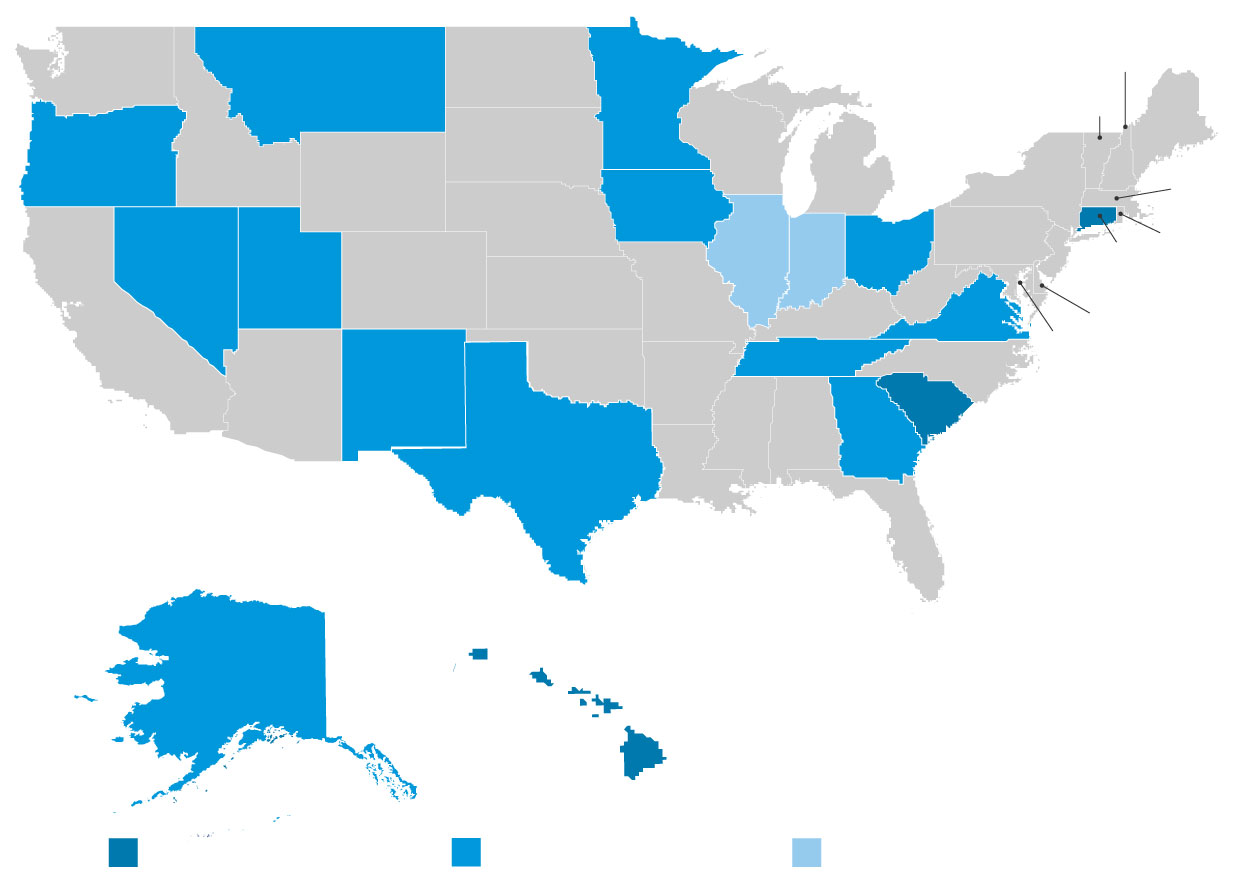
    Nearly 20 U.S. states have amended CPA licensing laws since January, in what may become a precursor for the entire country. Several professional groups say they expect close to or all 50 U.S. states to offer alternatives to the 150-hour rule by 2027. 

    Portrait of a smiling Bryan Flannery.

    Bryan Flannery, a rising senior at Otterbein University in Westerville, Ohio. Photo: Melissa McCrady

    The changes permit CPA candidates like Flannery to use an additional year of work experience instead of schoolwork to qualify as a certified public accountant. Prospects would still have to hold a bachelor’s degree, pass a qualifying exam and work another year to achieve two years of on-the-job experience. CPAs generally still have to fulfill continuing education requirements to renew their license, usually every one to three years depending on the state.

    The legislative groundswell is part of a move by states to make the accounting profession more appealing to students as more accountants retire or quit for higher paying, less stressful jobs without an adequate pipeline of new entrants obtaining accounting degrees and filling the gap.

    Professional groups say they expect CPA law changes to help combat the shortage of accountants, but more outreach to high-schoolers, higher salaries and other measures are needed.

    Advertisement

    “The whole profession is on the same page, whereas last year, everybody was in different places,” said Jen Cryder, chief executive of the Pennsylvania Institute of CPAs. “We’re all driving to the same destination.”

    Before the recent changes, CPAs were required to take 150 credit hours of schooling. Now, they can just earn a bachelor’s degree, typically 120 credit hours, on top of other requirements.

    Before the 150-hour rule was instituted in 1983 in Florida, CPA licensure generally required a bachelor’s degree and the passing of the exam. Following Florida’s lead, all other states adopted the 150-hour rule over the next few decades in initiatives aimed at keeping up with evolving regulations.

    CPA Licensing State of Play

    Nearly 20 U.S. states have amended CPA licensing laws since January, in what may become a precursor for the entire country. Several professional groups say they expect close to or all 50 U.S. states to offer alternatives to the 150-hour rule by 2027.


    NH

    WA

    ND

    MT

    VT

    MN

    ME

    WI

    SD

    OR

    ID

    MI

    NY

    WY

    MA

    IA

    NE

    RI

    PA

    IL

    OH

    CT

    IN

    NJ

    NV

    CO

    UT

    KS

    WV

    MO

    DE

    KY

    VA

    CA

    MD

    TN

    OK

    NC

    AR

    NM

    AZ

    SC

    MS

    AL

    GA

    TX

    LA

    FL

    AK

    HI

    2025 Implementation

    2027 Implementation

    2026 Implementation

    Note: Pathways bills were passed in Alaska, Connecticut and Illinois, but they need signatures from their respective governors to become law. All are expected to be signed.
    Source: Corey Butler/MNCPA

    Defenders of the 150-hour rule say it is a purposeful hurdle for meeting a standard needed to service clients around the U.S. 

    During the transition toward a new rule, students say some accounting firms have been advising them to still pursue the 150 credit hours to be able to practice in other states that haven’t yet passed legislation. 

    Hurdles remain in some states. In Florida, a bill allowing alternative CPA paths passed the Senate. Although a separate measure passed the House, neither bill passed through both chambers. The Senate proposal last month was indefinitely postponed and withdrawn from consideration after being added to the broader deregulation bill in the House. Both chambers last week agreed to withdraw all legislation not related to the state budget for the remainder of this year’s session. 

    Newsletter Sign-up

    WSJ | CFO Journal

    The Morning Ledger provides daily news and insights on corporate finance from the CFO Journal team.


    Subscribe

    The American Institute of CPAs, an advocacy group, and the National Association of State Boards of Accountancy, which represents 55 U.S. boards, in May approved model legislation for alternative CPA pathways. Some state groups waited for the completed framework before drafting their own language to ensure uniformity. 

    “Always, our concern has been mobility and consistency so that CPAs can go from state to state and practice,” AICPA CEO Mark Koziel said. “We’re trying to create consistency.” 

    The AICPA and NASBA previously stripped from their proposal a more intensive process for evaluating CPA candidates than currently exists, including the requirement to demonstrate so-called “core competencies” in areas such as ethical behavior and critical thinking amid industry concerns over feasibility. If state legislatures pass a new CPA law, the accountancy board would implement it by granting licenses, regulating those who have them and setting broad criteria for the approval of work experience.

    An easier path

    Virginia, like Ohio and several other states, will implement its new law at the start of 2026. Kameron Samuel, a rising senior at Virginia Commonwealth University in Richmond, Va., is setting aside plans to try to reach the 150-credit threshold in favor of applying for jobs once he graduates next May. 

    “Not only will I be able to save more money by not paying for additional schooling and possibly having to take out more loans, I could get more experience as well,” Samuel said. “It was very appealing.”

    Portrait of Kameron Samuel in a dark patterned suit and bow tie.

    Kameron Samuel, a rising senior at Virginia Commonwealth University in Richmond, Va. Photo: Shameka Samuel

    Samuel turned to federal financial aid to help fund his VCU tuition. He would have needed to seek out grants or scholarships to afford obtaining the additional credits at a community college or master’s program elsewhere, he said.

    Foreign aspiring CPAs see the cost benefit, too. Rachel Sian Hung, who recently completed her first year studying accounting at Austin Community College in Texas, plans to transfer to a four-year program at a different university in the fall of 2026, graduate with a bachelor’s degree and start a full-time job. For Hung, who is on a visa from the Czech Republic, this is appealing because international tuition fees are sometimes as much as triple that of in-state tuition, making a fifth year of school an extra burden.

    Texas’ new CPA legislation allows her to skip the extra schooling. “As an international student, it’s a huge financial relief for me, more than anyone can imagine,” Hung said. 

    Some finance executives applaud the law changes. Pascal Desroches, chief financial officer at Dallas-based AT&T, said the additional work experience now allowed under some state legislation is particularly important to becoming a CPA.

    “You work with people, they give you feedback,” said Desroches, who is a CPA. “Sometimes it’s tough feedback, but over time you get better, and I think that’s really what’s most valuable as opposed to that extra year of school, which costs a lot of money.”

    The future

    Accounting students choosing work over a master’s poses a threat to the popularity of graduate programs, for which demand has been rising. Nearly three-quarters of U.S. accounting master’s programs reported increased levels of applications in 2024, up from 43% the previous year, according to the Graduate Management Admission Council, an association of graduate business schools.

    Even with strong growth in master’s applications, it isn’t enough to replace the larger numbers of departing and retiring accountants. Over the next three or four years, universities could see an average 10% drop in enrollment in graduate accounting programs due to the law change, said Mohan Kuruvilla, director of the Master of Science in accountancy program at University of Houston. 

    SHARE YOUR THOUGHTS

    Do you expect states’ CPA law changes to weaken demand for master’s programs in accounting? Join the conversation below.

    “Let’s accept that the impact on the master’s will vary depending on the type of school and the brand name,” said Kuruvilla, who also serves as chair of the Texas Society of CPAs. “On the flip side, all these schools are going to see an increase at the undergraduate level because you’ve opened up the space to more people by creating an alternative pathway.”

    The accountant shortage has shown signs of lessening. For example, undergraduate accounting enrollment at four-year colleges rose 11% in the spring 2025 semester compared with a year earlier, according to the National Student Clearinghouse Research Center. 

    “It’s not going to be overnight, but I think in the coming years we’ll see an increase in interest in accounting” because of the law changes, said Bob Doyle, CEO of the Michigan Association of CPAs, adding that Michigan lawmakers plan to introduce a CPA bill soon. 

    Accountants who just missed out on the alternative CPA path are sticking it out despite frustration over the timing.

    Angel Traber, who graduated last year with a master’s in accounting from Kennesaw State University in Georgia, was disappointed to have missed out on the new option, which is set to go into effect in the state in 2026. Traber, who is now sitting for the CPA exam, said prospective CPAs who have completed 150 credit hours should have to take only three of the exam’s four required sections to compensate for missing the new alternative. 

    “Honestly, I was upset at first,” Traber said. “It’s an expense I wish I didn’t have to go through.”

  • Professor Elam

  • Professor Elam

    6/12/2025

    NRG Energy NRG 1.29%increase; green up pointing triangle

    , one of the S&P 500’s biggest year-to-date gainers, has volatile earnings due to its large derivatives-trading operation. Late last year, an accounting switcheroo let it start acting like some of those gyrations don’t exist.

    While that smooths the company’s results, it poses a dilemma for investors. NRG’s stock, up 65% this year, trades at 23 times trailing earnings.

    But the multiple could be higher or lower if real-life fluctuations in the value of all its derivative contracts were included. That complicates investors’ ability to gauge if the stock is trading at an appropriate valuation, or if the company is trying to obscure looming losses.

    So far, that hasn’t hurt shares in the retail energy supplier. They have surged on investor enthusiasm for power producers tapping into artificial-intelligence demand.


    NRG EnergyPHLX Utilities IndexS&P 500 Index2025June-250255075100%


    NRG in May said it would double its generation capacity by acquiring a group of power plants from closely held LS Power in a deal originally valued at about $9 billion. The move could mark a shift from its asset-light business model, though financial details on LS Power’s holdings were scant.

    The treatment of some derivative contracts makes NRG’s numbers even murkier.

    During last year’s fourth quarter, NRG elected to freeze balance-sheet values for a large portion of its derivative contracts. The company said it qualified for an exception to normal accounting rules. Usually, such contracts must be carried at fair market value with changes included in quarterly earnings.

    NRG didn’t say what impact the maneuver had on earnings, positive or negative. 

    NRG showed $992 million of net derivative assets, or derivative assets minus derivative liabilities, at year-end. That was equivalent to more than half its book value, or net worth. Of that, $770 million was on contracts with frozen values that NRG relabeled as “normal purchase normal sale,” or NPNS. By March 31, the frozen amount was down to $687 million, after some contracts settled and NRG reversed previous gains.

    The NPNS label means NRG decided it probably would settle the contracts through physical delivery of the underlying items, such as electricity or natural gas. It then stopped normal derivatives accounting and froze their values. The contracts extend through 2036.

    During the third quarter of 2024, before the switch, NRG had a $1.25 billion unrealized, mark-to-market loss on derivatives. This exceeded its $1 billion pretax loss.

    NRG’s earnings remained volatile even after the switch. Unrealized, mark-to-market gains on derivatives were $506 million for the fourth quarter and $512 million last quarter. In both quarters, they accounted for most of pretax profit.

    Energy companies commonly use the NPNS exception for commodity contracts. What is unusual at NRG is that it switched to NPNS after the contracts began, which isn’t the way this typically works.


    NRG did so based on its interpretation of a loophole in the accounting rules. In effect, it is saying it can initially use fair value for a contract but later switch to NPNS, so long as it makes a determination at the outset that the contract could qualify for NPNS treatment. This reading is consistent with what NRG’s outside auditor, KPMG, has said in a derivatives handbook on its website. The other Big Four accounting firms have published similar interpretations.

    SHARE YOUR THOUGHTS

    What are the broader implications of companies smoothing their financial results? Join the conversation below.

    The issue with this approach? For one thing, it potentially lets companies freeze unrealized gains that they believe are likely to turn into losses later.

    “The ability to apply the NPNS exception mid-contract provides a strategic opportunity to suppress the reporting of unwanted volatility,” said Tom Linsmeier, an accounting professor at the University of Wisconsin.

    This wouldn’t be so bad if NRG disclosed the frozen portion’s fair values. It hasn’t. Investors could be forgiven for thinking there is an unpleasant reason for that.

  • Professor Elam

    6/8/2025


    The cost of information is the lowest it has been since humans began walking on two legs. So why is the cost of higher education, well, higher than ever?

    That is a topic for another day, in the meantime here are some great resources of information at very low cost.

    Free Sites

    Popular Science

    https://www.popsci.com/

    Popular Mechanics

    https://www.popularmechanics.com/

    CNET

    https://www.cnet.com/

    Wiki

    https://www.wikipedia.org/

    Scientific American

    https://www.scientificamerican.com/

    Stream the History Channel, this is really cool

    https://play.history.com/

    Gearhead, OK I like cars

    Motor Trend

    https://www.motortrend.com/

    Car & Driver

    https://www.caranddriver.com/

    Road & Track

    https://www.roadandtrack.com/

    Men's Health

    https://www.menshealth.com/

    OK Fair Enough, How about something for the ladies?

    Vogue

    https://www.vogue.com/

    Vanity Fair

    https://www.vanityfair.com/

    Southern Living

    https://www.southernliving.com/

    Women's Health

    https://www.womenshealthmag.com/

    ___________________________

    Paid Subscriptions but inexpensive

    Study for CLEP Exams

    www/study.com

    Click here for CLEP website

    Master Class

    https://www.masterclass.com/

    200 + classes by experts in their field for an annual membership fee of  $180

    The Great Courses Plus

    https://www.thegreatcoursesplus.com/

    now streaming first year for $150, watch any all you want but cannot down load. a terrific deal compared to  buying at $35-50 bucks each

    dozens of courses by professor in their field

    also available for purchase and download but considering one can watch anytime, the streaming is the best deal.

    think  of it as the netflix of study

    Curiosity Stream

    https://curiositystream.com/

    I joined for three bucks a month

    this is run by the guy who started the Discovery Channel, scads of documentaries on a variety of subjects

    Wikipedia

    https://www.wikipedia.org/

    Free and just about what you really want to know about nearly anything

    https://www.udemy.com/

    Personal streaming for $20 a month

    National Geographic

    https://www.nationalgeographic.com

    $34 a year includes access to all issues since start up in  1888

    Udemy

    https://www.udemy.com/

    Looks like $20 a month

    Britanica

    https://www.britannica.com/

    $99 a year for whole family, 

    also free  on tamusa library but I am finding it difficult to use

    CLEP Exams

    College Level Examination Program

    https://clep.collegeboard.org/

    I placed out of 15 semester hours at UT Austin, an entire semester

    __________________

    Accounting

    Khan Academy

    Khan Academy Overview

    the entire undergrad accounting curriculum is here for free

    Khan Academy Accounting

    Professor Farhat

    https://www.youtube.com/results?search_query=professor+farhat+

    all about accounting, financial, cost, you name it

    Accounting Coach

    https://www.youtube.com/results?search_query=accountingcoach


  • Professor Elam

    6/5/2025

    The robots are coming

    Screenshot 2025-06-05 at 11.15.31 AM


    Issac Asimov wrote the classic I Robot sci fi story predicting the rise of robots, that future is here now.

    I understand a Fed Ex or UPS driver makes like $170,000  a year, for delivering packages. What did the Unions think would happen with that kind of wage?

    Ford assembly line workers now make $96,000 for attaching wheels to cars, same thing, what did the Union expect with that kind of wage demand?

    the combination of relatively low interest rates, yes they are still historically low, coupled with ever higher Union wage demands can only result in more mechanization..

    I recently toured an AMZN warehouse. The job of picking and loading looked mind numbing to me, it calls out for more robots. 

  • Professor Elam

    6/5/2025

    Sounds a lot like Medicaidfraud

    billing for work not done and charging for inferior parts seems to be the pattern

  • Professor Elam

    6/3/2025

    Judge is not impressed at the defense

    This sounds a lot like  Chris Pettit who got 50 years for defrauding clients who had suffered injuries. 

  • Professor Elam

  • Professor Elam

    5/28/2025

    Todd and Julie out after a mere two years prison time!

    Incredible, first Biden pardons Rita Crundwell and now Trump lets these two go. The Chrisleys stole millions via fals loan applications and then took bankruptcy to avoid re-payment. 


    The pardon process as the comments to the article say, are out of control.

  • Professor Elam

    5/27/2025

    First time in 80 years, Harvard Prof loses tenure over data claims

    Harvard University revoked the tenure of Harvard Business School professor Francesca Gino after years of data fraud allegations, a university spokesperson confirmed.

    Gino, widely known for researching honesty and ethical behavior, was placed on administrative leave in 2023 after multiple allegations of falsifying data surfaced.

    A spokesperson for Harvard provided no additional details, noting that it does not discuss personnel matters. Gino also did not immediately respond to a request for comment.