5/23/2025
Professor Elam
Accounting & Investing Info for San Antonio A & M
about
-
Professor Elam
-
Professor Elam
5/24/2025
hThis former convicted fraudster claims innocence
Yeah but the Feds are prosecuting here anyway
She previously served four years in jail for fraud
-
Professor Elam
-
Professor Elam
5/20/2025
Sociononomics
Horror movies are a feature of bear markets, think 1930s Frankenstein and Dracula, 1973 Exorcist and now HBO's newest series is another edition of Stephen King's IT, how the clown Pennywise appears every 27 years in Derry, Maine to kill children there's a fun theme.
Click underline for photos
-
Professor Elam
From WSJ 6/20/2025
When I call on college freshmen to demonstrate one of Euclid’s geometrical propositions on the classroom blackboard, I’m never sure what to expect. They could excel or fail, but this much is certain: No one is cheating. That’s more than can typically be expected in academia these days.
Since OpenAI released ChatGPT in November 2022, the world of higher education has been turned upside down. Most of the pedagogical and assessment tools that have dominated college classrooms since at least the 19th century—and especially those that emerged during the Covid-19 pandemic—are no longer effective.
Cheating is rampant. Students turn to generative artificial-intelligence chatbots to do their readings, complete their take-home exams and write their papers. A January 2023 survey from Study.com found that 89% of college students had used ChatGPT to complete a homework assignment. Nearly half admitted to using it on at-home tests or quizzes, and 53% had turned in an AI-generated essay.
We’re still in the early stages of the AI era, but the future for higher education looks bleak. Early research suggests what educators know intuitively: AI assistance can boost students’ short-term performance, but it enervates long-term comprehension, especially after the digital crutches are taken away.
A student who aces a quiz without studying the material has learned nothing. The same is true for a student who completes an essay without performing research, contemplating the subject matter, refining and ordering arguments, or painstakingly choosing the exact words to express the right idea. These students fail not only to retain knowledge, but also to develop their capacities for creative and critical thinking. Even where AI usage doesn’t cross obvious ethical lines—when it’s used for taking notes or creating study guides, for example—it usually undermines learning.
Students’ AI usage usually does cross ethical lines. Today’s academic incentive structure rewards cheating and rarely punishes fraud or dishonesty. Such an environment destroys students’ character formation, creating long-term consequences.
Despite their widespread use of AI chatbots, students don’t want an education predicated on cheating. The Study.com survey found that 72% of college students would like to see ChatGPT banned from their campuses. They want a rigorous education, if only one were available to them.
So, what can be done? Cheating can be difficult to detect. Aging professors will always be a step behind students when it comes to manipulating technology. And even with the help of software to detect plagiarism or AI, it’s difficult to spot artificially generated content. And these tools can be unfair to students, since false positives abound.
It’s time to take a step back from technology and return to pedagogical tools that have served educators for centuries. Start by eliminating online classes and banning screens in the classroom.
Colleges should also institute a more personal and in-person approach to assessment. Take-home exams, which were ripe for abuse long before AI, should be retired. Schools should instead administer in-class evaluations such as blue-book essays, oral exams and chalkboard demonstrations. Papers are too valuable to abandon entirely, but a clear policy that prohibits AI use and imposes serious consequences can reduce cheating.
More important, colleges and universities must restore conversation to its position of prominence in the classroom. Any bot can take lecture notes. College students frequently don’t even bother to attend classes anymore. Real conversations about perennial questions and ideas can make classes meaningful again.
Oral communication has for centuries been the guiding model for higher education. The Socratic seminar exposes students to rational discourse that actively engages the mind. Medieval universities tested their students through discussion and debate—this is the famous disputatio exemplified in the writings of Thomas Aquinas. The University of Oxford’s tutorial system, which focuses on small group discussions, is another remnant of this long tradition, placing reasoned discourse at the heart of a university education.
Some will object that such reforms would be inconvenient, maybe even impossible. Classes would need to be considerably smaller, and professors would need to give students more individualized attention. All that is true, but at a time when elite schools have endowments worth billions of dollars, some college football coaches make eight-figure salaries, and tuition growth outpaces inflation, the resources are available if the will is there.
I have taught for 23 years at a college that embraces small classes built around Socratic discussions, while charging less for tuition than most other private schools. This model isn’t only possible—it works.
AI has exposed a decline in higher education that has been under way for decades. Colleges increasingly focus on job training and credentials rather than intellectual growth for its own sake. Choose-your-own curricula, runaway grade inflation, and the popular notion of the four-year party are symptoms of the same problem. Students have no qualms about cheating, because as far as many of them can tell, college isn’t about learning anyway.
Education is meant to liberate us from bias and ignorance. By hindering the development of students’ critical faculties, AI is setting up future generations for the opposite. Technology has its place in higher education, but not at the expense of learning. Real students deserve a real education.
Mr. Goyette is vice president and dean emeritus of Thomas Aquinas College.
-
Professor Elam
5/17/2025
After viewing the Amazon warehouse in San Marcos, TX, I observed these repeated tasks would be done much better buy robots who don't get bored as surely humans doing with such routine.
-
Professor Elam
5/11/2025
grilling and cooking wit AB
https://www.youtube.com/watch?v=jk04-R2SI64
with barefoot contessa
https://barefootcontessa.com/recipes/linguine-with-shrimp-scampi
-
Professor Elam
Weekend 5/11/2025
Once a year SA TXCPA has its awards meeting. As this is an all volunteer organization save for our hard working two execs, it is a great idea to recognition volunteer effort.
Our students were there in force
Mary Ann Cumpian and yours truly
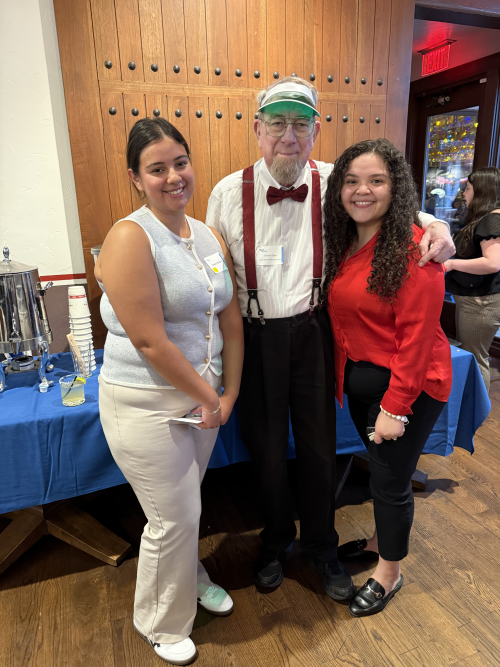
Myself, Erica Acosta and Mary Ann Cumpian
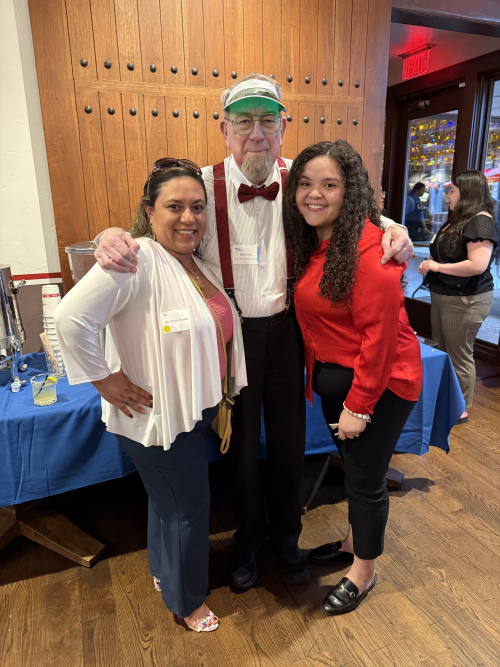
Dennis and our TXCPA Accounting student award winner Kristan Garcia

-
Professor Elam
5/9/2025
TXCPA Legislative Priority Signed by Governor
By Kenneth Besserman
Director of Government Affairs and Special CounselMay 9, 2025 | Issue 15
AUSTIN - On May 8, Texas Governor Greg Abbott signed the first piece of TXCPA’s priority legislation for the 2025 legislative session. Senate Bill 262, authored by Senator Charles Perry, CPA and Representative Angie Chen Button, CPA, and passed unanimously by the Legislature, will create an additional pathway to CPA licensure in Texas.
Passage of SB 262 makes Texas one of the first states to address CPA licensure pathways — and the very first large state to pass such legislation. The new law takes effect on Aug. 1, 2026.
Senate Bill 262 will add an additional pathway to CPA licensure requiring the completion of a bachelor’s degree with anaccounting concentration, two years of relevant work experience, and the passage of the CPA exam.
This new pathway to licensure will be added to the existing pathways of 150 hours and master’s degree, both with the requirement of one year of work experience and passage of the CPA exam. Texas will be a leader in offering educational and experiential flexibility to students with varying educational, financial, and time constraints.
Years of discussions among state CPA societies, the AICPA, and other stakeholders — including numerous committees and advisory groups — have highlighted the urgent need to strengthen the CPA pipeline. One key solution has been reevaluating how CPAs become licensed and finding ways to revise educational and experience requirements to encourage more individuals to pursue licensure. Most states are now addressing the issue with a handful of states already passing the bachelor’s degree plus two years of experience pathway, and dozens of other states amid their legislative sessions and many more likely to address the issue before 2027.
The second piece of TXCPA’s 2025 legislative agenda, Senate Bill 522, is also very close to becoming law. The bill is currently sitting on the governor’s desk awaiting his signature. SB 522 will modernize and individualize CPA practice mobility into Texas. Updating and modernizing CPA practice mobility has become paramount as states begin to add additional pathways to CPA licensure.
Passing Senate Bills 262 and 522 could not have happened without the support and leadership of Senator Perry and Representative Button. Both are CPAs and understand the changing environment of the CPA landscape and the need to provide support for students to enter the field and become licensed. Our heartfelt thanks go out to Senator Perry and Rep. Button for their hard work, dedication, and support for the CPA profession and TXCPA. Many thanks and congratulations are also due to TXCPA’s dedicated key persons, advocates, and members who contributed so substantially to this major legislative success.
-
Professor Elam
5/8/2025
Hello Dr. Elam,I hope this email finds you well.It's been about a year since we last spoke, but I hope you will remember I was one of your students in your Auditing class ACCT 4311 during the Fall of 2023. Originally, I had said that I was not going to pursue the CPA license because I felt I was too old. Well, the situation has changed. You were right to be such a proponent of the CPA license. I recently had to change jobs, and it took over four months and 263 job applications to find a new job. This was largely due to the lack of the CPA license. The company I was working for was experiencing major cash flow issues and was not able to meet payroll. Had I already had the license in hand (or had been in process of obtaining it), I could have obtained another job sooner. If you want to, you can share this with your other students to encourage them to get their licenses.
 Professor Elam