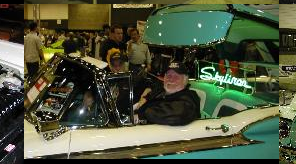
 Art can take many forms. The 1950s was the era of American manufacturing dominance. We won the war, gasoline was cheap, and America went for a ride.
The cars with rocket styled tail fins mirrored the space race, and lots of chrome and heavy cast iron V 8s to drive to the corner grocery,
reflected the self confidence of the day.
Check out these photos
with the gorgeous backdrop of Vancouver Island.
Click on the STEPS at left to follow the re construction of this car. In process problems we show mateiral added at the start of the process and then conversion costs are added to finish. This is an excellent example of how conversion costs are most of the project. Can you see how activity based costing would be of some help in estimating the cost to do this? Can you see that unless you could do it yourself there is no telling what this would cost in labor?
You might think the retractable hardtops that are lately the rage, but did you realize that Ford built these in the 1950s, see photo above.
All this hubris peaked with the muscle cars of the late 1960s and the subsequent energy embargo in the early 1970s. The Japanese were mastering small engine technology building pretty wonderful motorcycle engines. Indeed the 1500cc dohc four in the Honda Fit has its origins in the Honda 750 motorcycle engine. Mired in cast iron V 8s and unwilling to spend the money on new technology, Americans sawed two cylinders off the V 8s for an out of phase V 6 as honda introduced the CVCC engine, it complied with emission laws without an air pump. And so the die was cast. Servicemen returning from Viet Nam brought back high tech Japanese stereos and cameras, setting a belief system that high tech was Oriental. The American response was to ask for a limit on the import of small Japanese trucks. That passed and then the Americans got their worst nightmare, the Japanese simply came here and started building. And today Chrysler and GM are on borrowed time, bet on Ford.


 Professor Elam
Leave a reply to uaRTERL Cancel reply