• Professor Elam

    Tuesday April 13, 2010

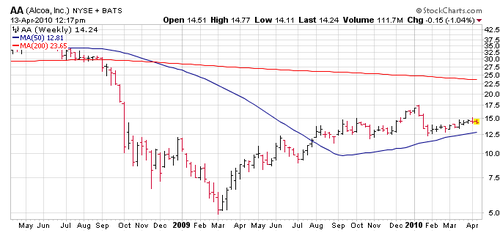
    News reports would have you believe that disappointing earnings from Alcoa Aluminum brought the stock market rally to a screeching halt. The fact of the matter is that news is sort of a white noise to the stock market. Popular opinion and mood has much more to do with stock prices, take a look. 

    Picture 6 

    Alcoa made $2.5 B in 2007, lost $74 million in 2008 and lost, are you ready, $1.1 billion in 2009. Yet the stock rallied all of 2009!  The mood changed form negative to positive in March 2009 and people simply started buying stock again. 

    The news is forever trying to link an event with what happens in the market, the results are not always causal. 

    The reason for the stock market to halt a bit is that it is up over 60% in the last year, needs a rest. With stocks backing off now, expect more stories of investor disappointment the next week or two….
     

  • Professor Elam

    Tuesday April 13, 2010

    The economic pullback, recession, calamity, offers an interesting opportunity for social observation. How are your friends who have lost jobs or who have not found jobs reacting? The WSJ quotes Larry Summers in 1999 pointing out that extending unemployment results in no surprise, people staying unemployed. Indeed another study notes that people do not really start looking until the benefits start to run out. I have contended the better idea would be for unemployment weekly checks to decrease after the first three months, this would re enforce the idea that this is a temporary bridge, not your new job. 

    In the economic collapse of West Texas in 1986, I noticed a new mental paradigm after about three months on unemployment. People would adjust to the new lower income and begin to rationalize that the alternative jobs available were just not good enough. A former oilfield worker at $45 K would reject the $25K job. This resulted in a skyrocketing divorce rate as spouses found their mate watching Oprah, as the expression goes, on their return from work. 

    Bear markets wring out the excess of the previous bull market. Bear markets force failed business models to re think their strategy. But, Michigan keeps getting bailouts so the strategy remains unchanged, perhaps GM will outsell Toyota and Honda, eh?  Europe had double digit unemployment before the 2008 crash, the reason was the the social safety net did not encourage moving to where the jobs are, or taking alternate jobs. The Austin San Antonio economy is much better than many parts of the country and so we are getting an influx of people looking for jobs. And so the unemployment rate here is lower than other places. 

    Again, watch what your friends and neighbors are doing. Everyone looks good in a bull market, a rising tide lifts all boats as the expression goes. But an extended downturn lets the creative and ambitious stand out from the crowd, have you noticed who among your friends is inventing new paradigms for themselves, and who is, well, watching Oprah waiting for change to find them. 

    This article suggests that moving where you want to be is the first step. I would not suggest leaving San Antonio, I moved here!  And I am glad I did. 

    And here is another look at how the Depression really ended after WW II. 

  • Professor Elam

    Monday April 12 2010

    From Dave Rosenberg, 4/12/10

    One reason why interest rates cannot rise is because if they do, there will never be a sustained improvement in the pace of economic activity. Housing is the classic leading indicator, and the most interest-sensitive sector, and until it revives, it seems highly unlikely that bond yields will rise on any sustained basis or that the Fed will embark on a path towards higher policy rates. For a truly sombre assessment on the prospects for a housing recovery, see what Robert Shiller has to say on page 5 of the Sunday NYT biz section. ("Don't Bet The Farm on the Housing Recovery")

    We are not on the same plane as Dave Rosenberg at Gluskin Sheff but…the above quote is from his daily commentary this monday.  Having said that, we believe this is convoluted reasoning, interest rates will go where they want whether it stimulates a recovery or not. INdeed he points out that most of the profit picture in the US is based on 'financial sector profits' which are based on rubber banding FASB 157 on mark to market rules. This means that the bank does not have to get a market price for questionable assets, if such price is not readily available. I suspect the banks have not been able to find those ready prices which means the assets did not get marked down which  means no write offs and we book our trading profits. Those trading profits came courtesy of 

    'free TARP' money and an absence of equity sellers, bingo, these guys ran up the stock market and books bank profits, hardly the stuff of sound lending.  Roseberg notes that Jim Caron is bond bearish, Jan Hatzius is bond bullish,  Bill Gross is bearish, Jim Grant is bearish, Rosenberg noting the Japanese experience is bullish believing that rates will not rocket up.  My conclusion was that we should all simply watch the 4% resistance area on the ten year bond yield, if it goes above 4%, the bears were right, otherwise, govt bonds are a buy here. 

  • Professor Elam

    Monday April 12, 2010

    Mish explains how he started blogging. I was struck at how similar his story was to Bruce Howard, each found themselves out of work, what to do?  Each found a new direction. Each of them did this by mastering communication. We continue to emphasize presentations, oral communications, and written reports, as that is the medium of formal business communication. 

  • Professor Elam

    Monday April 12, 2010

    I waited a few days before putting this one up but apparently the Obama administration has outlawed unpaid internships by for profit entities. It is of course, in their eyes, okay for a non profit, read government, to provide an unpaid internship. In the face of double digit unemployment in multiple states, this is an most unfortunate policy. Read Jeffrey Tucker, a blogger by the way, on this. I have a link at the left to Mish's Economic Blog on the left sidebar, click and read his thoughts today. 

    Accounting has generally required a paid internship but I have had students in unpaid spots where I believed the experience was well worth it. As one can readily see in our class discussions, those that have experience in a particular area, say payroll reporting, have a leg up on those that do not, this only comes from OJT, on the job training. 

    I suggest you remember this when it comes time to vote. I have not encountered accounting firms who were anything but genuine about their intern hires, ditto for other local business. 

  • Professor Elam

    Sunday April 11, 2010

    It is near impossible to stop a bad idea cloaked in good intentions

    Professor Elam

    Mary Anglin reports on the current state of Museo Alameda in her column today. Is is, alas, even worse than she feared. Perhaps Mary should have been tracking our coverage of this non profit. We started reporting last November, apparently the museum was completely broke, having run through the money the Ford Foundation provided. We are big museum fans, and San Antonio has many of them, which was our point originally. 

    Many of our college grads here at Texas A & M San Antonio will be asked to sit on some non profit board at some time in their careers. We urge you to read the financial statements and projections carefully. Here is the short list of questions about new proposals. 

    Is this proposal being done somewhere else already (hint, most are, and yes see Texas Institute of Cultures).

    Is this proposal a totally new approach or does it have  a different expected outcome?

    If the answer to the above is yes someone else is doing this, would it be better to assist them or go it alone. (The multiple chambers of commerce that have blossomed in many cities would do well to ask this question.)

    Are the outcome expectations realistic?  In the case of Museo Alameda, 400,000 viewers, the first year,  were expected to tour a museum devoted solely to Latin culture. There was already a museum of Texas culture, doing well, in San Antonio.

    Are there written outcome measures at specified times to monitor progress?  If the outcomes fall short, will there be sufficient remedy and original thinking to save or alter the project?  Such outcomes should also include rigorous budget requirements and safeguards against spending grant money in unauthorized fashion. 

    Are there indications that the proposed location will be among other successful ventures?  In this case, Market Square, a struggling City Sponsored project was chosen. Rarely do multiple weak projects combine to make one strong one, think Chrysler. 

    At what point is this project a no go?  It is near impossible to get a Board to address this question. Most will gush at new project possibilities, yet the world is awash in failed projects lacking realistic vision even with great funding (Amtrak and the Post Office come to mind)

    In the case of the Museo, the City has asked for a realistic plan. Yet this plan will be drawn up by the project's backers that have yet to have a successful year. The project should be evaluated by an outsider, particularly one that understands sunk costs…..
  • Professor Elam

    Sunday April 11, 2010

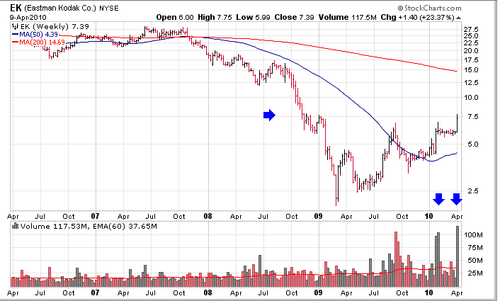
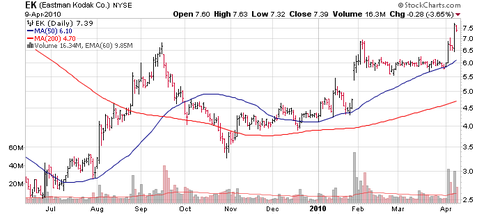
    I suggested using Eastman Kodak for our study of price earnings ratios. 

    Picture 8
    Gee the price of the stock has doubled since last summer, heck it doubled since last november, 

    why? Here is a link to their earnings picture.  But more than that is going on, EK also reflects the desire of consumers to spend money. Social Mood is a part of the picture here. Let's take another step back at the bigger picture. 

    Picture 9
     

    The vertical bars at bottom represent volume in the stock. As you can see, the black bars picked show a huge increase in buys pushing the stock price higher. Note the horizontal blue arrow. It spotlights the $7.50 area. One can see the stock hesitated there on the way down, that will no doubt serve as resistance now on the way up. So we have positive social mood, see below, coupled with improved earnings, but a long way to go to recover. 

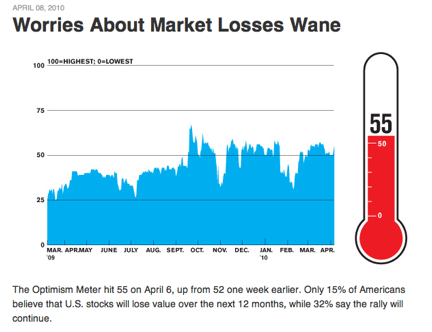
    Optimism indicator
    This indicator was created by Bloomberg Business Week. Optimism index has doubled in the last year, this help consumer oriented firms like Kodak.  


  • Professor Elam

    Thursday April 8, 2010

    P4073518  Bruce Howard with Herbst Fischer CPAs addressed the Ethics class Wed April 7, 2010.  Bruce is head of operations and recruiting for this regional CPA firm. He presented ten ways to engage yourself with the professional community. These included building your rolodex, establishing your brand, and creating your own Board of Directors. He struck a responsive chord with the class who engaged in numerous thoughtful questions. This provided a lively exchange eclipsing all the time available. Speaking of networking, it turns out one  student J and Mr. Howard had met in a CPA network. Another had interviewed with his firm. He mentioned that he had three internships to fill for the following spring. 

    Mr. Howard mentioned the importance of being ready to sit for the CPA exam or better yet, having completed parts or all  of the exam. 

    Our outreach to the professional accounting community in San Antonio continues to pay dividends for our students. Thanks Bruce!

  • Professor Elam

    Tuesday April 6 2010

    The Federal Govt has created yet another dept whose avowed purpose is to reduce costs. 

    This is too funny, and of course it will not work. There has never been and never will be a new dept that cuts costs. Cost Cutting will only be initiated in the dept that creates the cost, only it can cut the cost. 

    And, too funny, the idea that $17 M will cut the cost of a multi trillion dollar operation is like suggesting a dollop of citronella will solve the mosquito problem in Louisiana. 

    As Dr. Deming said, let depts and people create their own slogans. 

  • Professor Elam

    Tuesday April 6, 2010

    From Mish's Global Economic Trend Analysis, Los Angeles is broke. I mentioned in class that this is an excellent time to be studying equity as there is so little of it! This is serious folks. 

    Los Angeles is in deep trouble. The situation has gotten so grim that the city controller says L.A. to Run Out of Cash in a Month.

    Los Angeles will run out of cash on May 5, city Controller Wendy Greuel said today in a release in which she requested a $90 million transfer of reserve funds to pay bills.

    “The question I have been asked most often during the budget crisis is, ‘When will the city run out of money?” Greuel said in the e-mailed release. “Unfortunately, we finally have the answer.”

    Greuel, 48, said in the release that the city might not be able to make payroll. She asked Mayor Antonio Villaraigosa and the City Council to release $90 million from reserve funds to meet what she described as “an urgent cash need.” The controller’s financial reporting division estimated that the city would need $90 million to ensure solvency through the fiscal year that ends June 30, according to Golombek.